Best wood for baseball bats
Start with bat-grade stock and evaluate grain, finished weight, and the intended league.
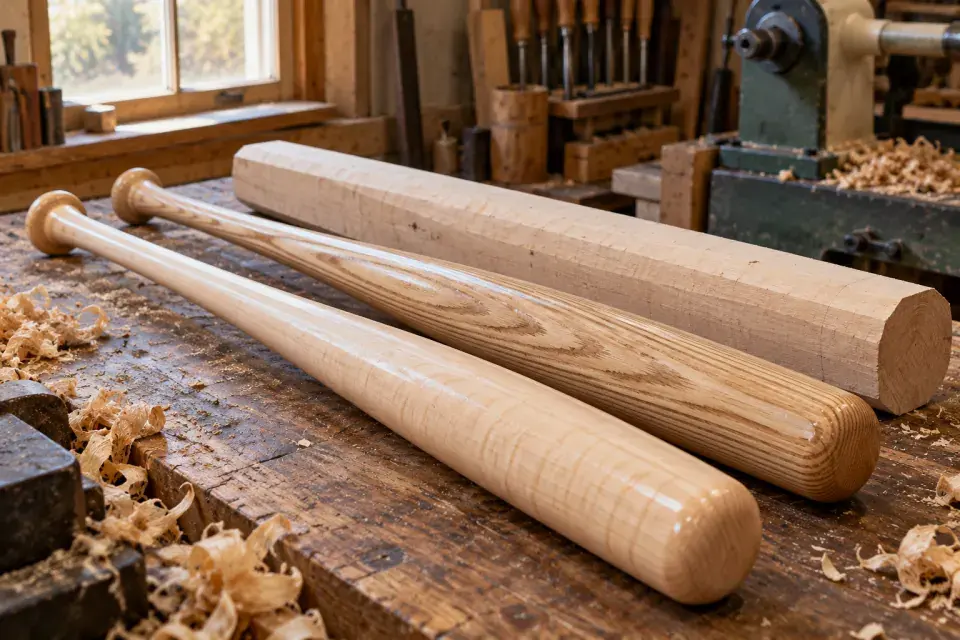
Which wood should you choose?
Maple, ash, and birch are practical reference points for modern wooden baseball bats. Hickory may score highly on general strength, but its weight can make it less suitable for a player's preferred swing. A bat-grade billet and proven profile matter more than topping a static-strength table.
Practical wood choices
These editorial choices account for the application as well as the numbers. They may differ from the automated property ranking below.
Maple
A common choice for a firm hitting surface. The billet's grain, density, and suitability for the intended bat profile require careful selection. A hard surface alone does not guarantee resistance to handle failure.
Species profiles:Sugar maple
Ash
A traditional option with visible grain and a different flex and wear character. Evaluate the actual billet and finished weight. Surface grain can help inspection, but does not remove the need for proper bat-grade selection.
Species profiles:White ash
Birch
Another established bat wood that offers a different working and playing feel. Match the billet to the desired profile and weight rather than assuming it is an exact middle ground between every ash and maple sample.
Species profiles:Yellow birch
What matters for this project
A bat is an impact-loaded object with a narrow handle and a relatively massive barrel. Grain slope, defects, density distribution, profile, and impact location all affect breakage. Modulus of rupture is a static clear-wood test, not a bat-impact test. Player preference and the intended competition also shape the choice.
What to check before you buy
For a playing bat, use a reputable finished product or stock explicitly selected for bat making. Ask about grain inspection, moisture condition, and suitability for the intended dimensions. Check the current requirements of the league or organization directly before ordering; a database species ranking cannot establish eligibility.
Building and looking after it
Follow an appropriate bat-making method and established profile rather than turning an arbitrary handle from general lumber. Keep grain continuous through critical transitions and inspect after machining. For use, follow the manufacturer's orientation and care guidance, and remove a bat from service when cracks or other damage appear.
Mistakes to avoid
Do not interpret a first-place hickory result as a universal modern bat recommendation. The scoring rule omits grain slope, impact behavior, profile, and the player's swing-weight target. A stronger species can still create an unsuitable finished bat.
Property comparison ranking
Density 580–820 kg/m³. Higher modulus of rupture gives a higher score.
This ranking compares selected properties. Use the practical choices above to check the other requirements of your project.
Species enter when the required fields are present and the rule gives a positive score. An absent wood may lack data or fall outside the scoring range; absence is not proof that it is unsuitable.
The order also uses an editorial availability multiplier, shown in the last column. It changes the order without removing a qualifying species. These scores compare selected properties; they do not evaluate every requirement of the finished project.
| # | Wood | Janka | Density | MOR | MOE | Shrinkage | T/R | Availability |
|---|---|---|---|---|---|---|---|---|
| 1 | Shagbark hickory | 1,880 lbf | 50.3 lb/ft³ | 20,200 lb/in² | 2.16 ×10⁶ lb/in² | 16.7% | 1.50 | |
| 2 | Mockernut hickory | 1,970 lbf | 50.3 lb/ft³ | 19,200 lb/in² | 2.22 ×10⁶ lb/in² | 17.8% | 1.43 | |
| 3 | Ramin | 1,300 lbf | 39.6 lb/ft³ | 18,500 lb/in² | 2.17 ×10⁶ lb/in² | 13.4% | 2.02 | |
| 4 | Cherrybark oak | 1,480 lbf | 47.6 lb/ft³ | 18,100 lb/in² | 2.28 ×10⁶ lb/in² | — | — | |
| 5 | Bitternut hickory | 1,461 lbf* | 46.1 lb/ft³ | 17,100 lb/in² | 1.79 ×10⁶ lb/in² | — | — | |
| 6 | Sweet birch | 1,470 lbf | 45.4 lb/ft³ | 16,900 lb/in² | 2.17 ×10⁶ lb/in² | 15.6% | 1.38 | |
| 7 | Merbau | 1,500 lbf | 50.0 lb/ft³ | 16,800 lb/in² | 2.23 ×10⁶ lb/in² | 7.8% | 1.70 | |
| 8 | Yellow birch | 1,260 lbf | 43.3 lb/ft³ | 16,600 lb/in² | 2.01 ×10⁶ lb/in² | 16.8% | 1.30 | |
| 9 | Slash pine | 869 lbf* | 41.3 lb/ft³ | 16,300 lb/in² | 1.98 ×10⁶ lb/in² | 12.1% | 1.41 | |
| 10 | Sugar maple | 1,450 lbf | 44.1 lb/ft³ | 15,800 lb/in² | 1.83 ×10⁶ lb/in² | 14.7% | 2.06 | |
| 11 | White ash | 1,320 lbf | 42.0 lb/ft³ | 15,400 lb/in² | 1.74 ×10⁶ lb/in² | 13.3% | 1.59 | |
| 12 | Sapele | 1,510 lbf | 42.0 lb/ft³ | 15,300 lb/in² | 1.82 ×10⁶ lb/in² | 14.0% | 1.61 | |
| 13 | White oak | 1,360 lbf | 47.6 lb/ft³ | 15,200 lb/in² | 1.78 ×10⁶ lb/in² | 16.3% | 1.88 | |
| 14 | American beech | 1,300 lbf | 44.8 lb/ft³ | 14,900 lb/in² | 1.72 ×10⁶ lb/in² | 17.2% | 2.16 | |
| 15 | Black walnut | 1,010 lbf | 38.5 lb/ft³ | 14,600 lb/in² | 1.68 ×10⁶ lb/in² | 12.8% | 1.42 | |
| 16 | Teak | 1,000 lbf | 40.0 lb/ft³ | 14,600 lb/in² | 1.55 ×10⁶ lb/in² | 7.0% | 2.32 | |
| 17 | Longleaf pine | 870 lbf | 41.3 lb/ft³ | 14,500 lb/in² | 1.98 ×10⁶ lb/in² | 12.2% | 1.47 | |
| 18 | Northern red oak | 1,290 lbf | 44.1 lb/ft³ | 14,300 lb/in² | 1.82 ×10⁶ lb/in² | 13.7% | 2.15 | |
| 19 | Green ash | 1,200 lbf | 39.1 lb/ft³ | 14,100 lb/in² | 1.66 ×10⁶ lb/in² | 12.5% | 1.54 | |
| 20 | Black locust | 1,700 lbf | 48.3 lb/ft³ | 19,400 lb/in² | 2.05 ×10⁶ lb/in² | 10.2% | 1.57 | |
| 21 | African Padauk | 1,538 lbf* | 46.0 lb/ft³ | 13,900 lb/in² | 1.56 ×10⁶ lb/in² | 7.6% | 1.58 | |
| 22 | Black oak | 1,210 lbf | 42.6 lb/ft³ | 13,900 lb/in² | 1.64 ×10⁶ lb/in² | 15.1% | 2.52 | |
| 23 | Swamp chestnut oak | 1,240 lbf | 46.8 lb/ft³ | 13,900 lb/in² | 1.77 ×10⁶ lb/in² | 16.4% | 2.08 | |
| 24 | Pecan hickory | 1,820 lbf | 46.1 lb/ft³ | 13,700 lb/in² | 1.73 ×10⁶ lb/in² | 13.6% | 1.82 | |
| 25 | Red maple | 950 lbf | 37.8 lb/ft³ | 13,400 lb/in² | 1.64 ×10⁶ lb/in² | 12.6% | 2.05 |
Before you choose a board
Use this ranking to compare the properties listed above. Grain direction, defects, moisture content, board dimensions, and construction also affect performance. Check the species page for the original measurements and any estimate marks, then inspect the actual stock you can buy.
The score does not assess decay resistance, food-contact suitability, heat resistance, or structural load capacity. For outdoor work, check durability and treatment requirements separately. For food-contact items and toys, check the intended finish and published safety information.
Read wood allergy and toxicity sourcesHow to read the measurements
Janka compares resistance to indentation. Density is the mass of a given volume of wood. Modulus of rupture (MOR) describes bending strength in a test specimen. Shrinkage figures describe the change from green to oven-dry wood, and T/R compares tangential with radial shrinkage. They are useful for comparison, but do not directly predict seasonal movement in your finished piece.
These are species-level reference values, not a test of the board you are buying or allowable structural design values. Grain, defects, moisture, dimensions, joints, and treatment can change the result. An asterisk beside Janka marks an estimate; open the species page for its source and method. Use the header settings to switch units.
Frequently asked questions
Why can hickory rank above maple?
The score rewards available bending-strength figures within a density range. It does not model a bat's final weight, swing balance, or tested impact performance, so editorial choices can differ from the numerical order.
Can a cracked bat be repaired for play?
Do not rely on a cosmetic repair to restore impact performance. Follow the maker's guidance and replace damaged playing equipment; a crack can indicate a compromised handle or barrel.
How should I compare two bats made from the same species?
Compare their actual length, weight, barrel profile, handle dimensions, balance, and intended use. Two maple bats can feel very different because the material is distributed differently along the profile. Evaluate the maker’s stock selection and construction as well as the species, and do not assume a heavier bat will automatically improve the player’s results.
Sources and further reading
The application advice is editorial guidance. The references below provide background; each wood's measured values have their own sources on its species page.
- USDA Forest Products Laboratory — Wood Handbook
Background on wood properties, moisture, construction, and finishing.