Best wood for cutting boards
Choose a durable, close-grained board that is easy to clean and kind to an edge.
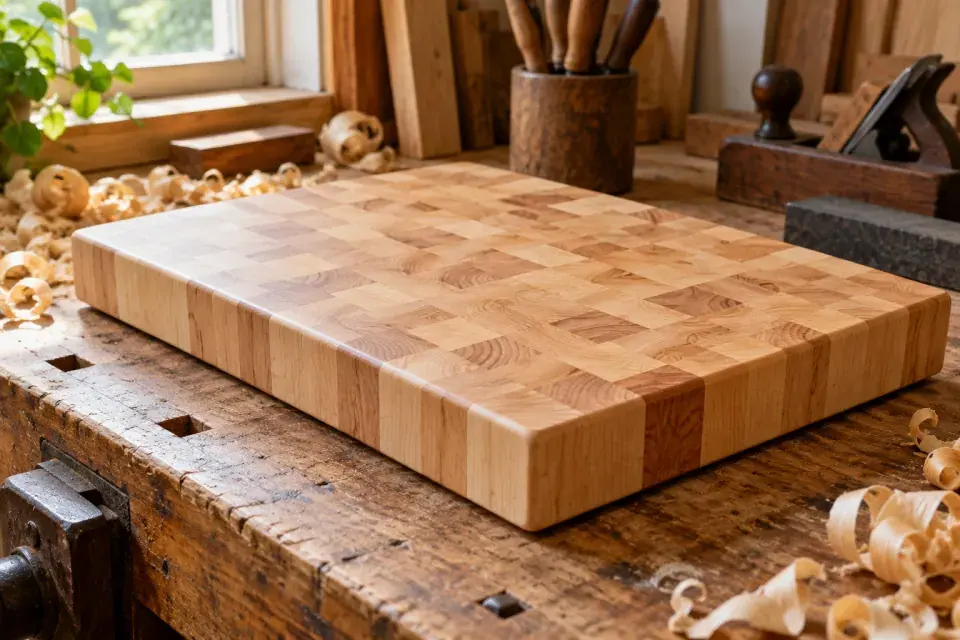
Which wood should you choose?
Hard maple is a practical starting point for a working cutting board. Cherry and walnut are useful alternatives when you prefer easier machining or a darker appearance. The best choice balances surface wear, grain, cleanability, and the way the board will be washed; the hardest wood in the database is not automatically the best board.
Practical wood choices
These editorial choices account for the application as well as the numbers. They may differ from the automated property ranking below.
Hard maple
A familiar choice for a pale, hard-wearing working surface. Choose sound, close-grained stock and distinguish hard maple from softer maple species. Its hardness makes flattening and sanding more work than with cherry.
Species profiles:Sugar mapleBlack maple
Cherry
A good option for a lighter board that is relatively pleasant to machine. It will show knife marks and dents sooner than hard maple, but a simple edge-grain board is easy to resurface.
Species profiles:Black cherry
Walnut
Useful when a dark surface and moderate hardness matter. Expect visible cutting wear; color alone says nothing about suitability. Verify the species and the intended food-contact use of every adhesive and finish.
Species profiles:Black walnut
What matters for this project
Start with grain and soundness, then compare hardness and movement. Open vessels, checks, knots, and failed glue lines make a board harder to maintain. An end-grain layout changes the cutting feel, but introduces more glue lines and demands careful milling. An edge-grain board is simpler to build and usually the sensible first project.
What to check before you buy
Buy dry, identified lumber of known history. Ask how much clear stock you can recover after removing checks and sap defects. Reclaimed boards with unknown coatings or treatment are a poor bargain for a food preparation surface. Compare the cost of usable strips rather than the price of the rough board alone.
Building and looking after it
Orient strips consistently, prepare tight glue joints, and follow the adhesive manufacturer's instructions for the intended use. Leave enough thickness for later flattening. Hand wash, dry promptly on both faces, and store with air circulation. Avoid soaking or dishwashers; a finish does not make a wooden board waterproof.
Mistakes to avoid
Do not read the ranking as a food-contact approval. It cannot evaluate extractives, contamination, grain anatomy, adhesive choice, or individual sensitivities. An unfamiliar tropical wood with excellent hardness still needs a separate suitability assessment.
Property comparison ranking
Janka 700–1,800 lbf. The score favors hardness near 1,200 lbf (double weight) plus lower volumetric shrinkage.
This score does not assess grain structure, food-contact suitability, treatments, adhesives, or cleaning and care. Use the practical choices above and verify the stock and finish for the intended application.
Species enter when the required fields are present and the rule gives a positive score. An absent wood may lack data or fall outside the scoring range; absence is not proof that it is unsuitable.
The order also uses an editorial availability multiplier, shown in the last column. It changes the order without removing a qualifying species. These scores compare selected properties; they do not evaluate every requirement of the finished project.
| # | Wood | Janka | Density | MOR | MOE | Shrinkage | T/R | Availability |
|---|---|---|---|---|---|---|---|---|
| 1 | Iroko | 1,260 lbf | 43.0 lb/ft³ | 12,400 lb/in² | 1.46 ×10⁶ lb/in² | 8.8% | 1.36 | |
| 2 | Green ash | 1,200 lbf | 39.1 lb/ft³ | 14,100 lb/in² | 1.66 ×10⁶ lb/in² | 12.5% | 1.54 | |
| 3 | Black maple | 1,180 lbf | 39.8 lb/ft³ | 13,300 lb/in² | 1.62 ×10⁶ lb/in² | 14.0% | 1.94 | |
| 4 | Black oak | 1,210 lbf | 42.6 lb/ft³ | 13,900 lb/in² | 1.64 ×10⁶ lb/in² | 15.1% | 2.52 | |
| 5 | Teak | 1,000 lbf | 40.0 lb/ft³ | 14,600 lb/in² | 1.55 ×10⁶ lb/in² | 7.0% | 2.32 | |
| 6 | Northern red oak | 1,290 lbf | 44.1 lb/ft³ | 14,300 lb/in² | 1.82 ×10⁶ lb/in² | 13.7% | 2.15 | |
| 7 | Ramin | 1,300 lbf | 39.6 lb/ft³ | 18,500 lb/in² | 2.17 ×10⁶ lb/in² | 13.4% | 2.02 | |
| 8 | Swamp chestnut oak | 1,240 lbf | 46.8 lb/ft³ | 13,900 lb/in² | 1.77 ×10⁶ lb/in² | 16.4% | 2.08 | |
| 9 | White ash | 1,320 lbf | 42.0 lb/ft³ | 15,400 lb/in² | 1.74 ×10⁶ lb/in² | 13.3% | 1.59 | |
| 10 | Keruing | 1,270 lbf | 54.2 lb/ft³ | 19,900 lb/in² | 2.07 ×10⁶ lb/in² | 16.1% | 2.10 | |
| 11 | Yellow birch | 1,260 lbf | 43.3 lb/ft³ | 16,600 lb/in² | 2.01 ×10⁶ lb/in² | 16.8% | 1.30 | |
| 12 | Chestnut oak | 1,130 lbf | 46.1 lb/ft³ | 13,300 lb/in² | 1.59 ×10⁶ lb/in² | 16.4% | 2.04 | |
| 13 | Rubberwood | 915 lbf* | 38.0 lb/ft³ | — | — | 7.4% | 2.22 | |
| 14 | Bur oak | 1,370 lbf | 44.8 lb/ft³ | 10,300 lb/in² | 1.03 ×10⁶ lb/in² | 12.7% | 2.00 | |
| 15 | Merbau | 1,500 lbf | 50.0 lb/ft³ | 16,800 lb/in² | 2.23 ×10⁶ lb/in² | 7.8% | 1.70 | |
| 16 | Black walnut | 1,010 lbf | 38.5 lb/ft³ | 14,600 lb/in² | 1.68 ×10⁶ lb/in² | 12.8% | 1.42 | |
| 17 | American beech | 1,300 lbf | 44.8 lb/ft³ | 14,900 lb/in² | 1.72 ×10⁶ lb/in² | 17.2% | 2.16 | |
| 18 | Southern red oak | 1,060 lbf | 41.3 lb/ft³ | 10,900 lb/in² | 1.49 ×10⁶ lb/in² | 16.1% | 2.40 | |
| 19 | Black cherry | 950 lbf | 35.0 lb/ft³ | 12,300 lb/in² | 1.49 ×10⁶ lb/in² | 11.5% | 1.92 | |
| 20 | African Padauk | 1,538 lbf* | 46.0 lb/ft³ | 13,900 lb/in² | 1.56 ×10⁶ lb/in² | 7.6% | 1.58 | |
| 21 | White oak | 1,360 lbf | 47.6 lb/ft³ | 15,200 lb/in² | 1.78 ×10⁶ lb/in² | 16.3% | 1.88 | |
| 22 | Red maple | 950 lbf | 37.8 lb/ft³ | 13,400 lb/in² | 1.64 ×10⁶ lb/in² | 12.6% | 2.05 | |
| 23 | African mahogany | 830 lbf | 32.0 lb/ft³ | 10,700 lb/in² | 1.40 ×10⁶ lb/in² | 8.8% | 1.80 | |
| 24 | Andaman Padauk | 1,630 lbf | 48.9 lb/ft³ | — | — | 6.4% | 1.33 | |
| 25 | True mahogany | 800 lbf | 41.0 lb/ft³ | 11,500 lb/in² | 1.50 ×10⁶ lb/in² | 7.8% | 1.37 |
Before you choose a board
Use this ranking to compare the properties listed above. Grain direction, defects, moisture content, board dimensions, and construction also affect performance. Check the species page for the original measurements and any estimate marks, then inspect the actual stock you can buy.
The score does not assess decay resistance, food-contact suitability, heat resistance, or structural load capacity. For outdoor work, check durability and treatment requirements separately. For food-contact items and toys, check the intended finish and published safety information.
Read wood allergy and toxicity sourcesHow to read the measurements
Janka compares resistance to indentation. Density is the mass of a given volume of wood. Modulus of rupture (MOR) describes bending strength in a test specimen. Shrinkage figures describe the change from green to oven-dry wood, and T/R compares tangential with radial shrinkage. They are useful for comparison, but do not directly predict seasonal movement in your finished piece.
These are species-level reference values, not a test of the board you are buying or allowable structural design values. Grain, defects, moisture, dimensions, joints, and treatment can change the result. An asterisk beside Janka marks an estimate; open the species page for its source and method. Use the header settings to switch units.
Frequently asked questions
Is end grain always better?
It can provide a pleasant cutting surface, but construction quality and cleaning matter more than the pattern. Choose edge grain if a simpler, thinner, easier-to-maintain board fits your use.
Can a scratched board be repaired?
Light wear can often be sanded or planed away. Deep cracks and separated joints require repair or replacement because resurfacing the face alone does not remove the defect.
Sources and further reading
The application advice is editorial guidance. The references below provide background; each wood's measured values have their own sources on its species page.
- USDA Forest Products Laboratory — Wood Handbook
Background on wood properties, moisture, construction, and finishing.