Best wood for raised garden beds
Prioritize ground-contact durability, reliable sourcing, and replaceable construction.
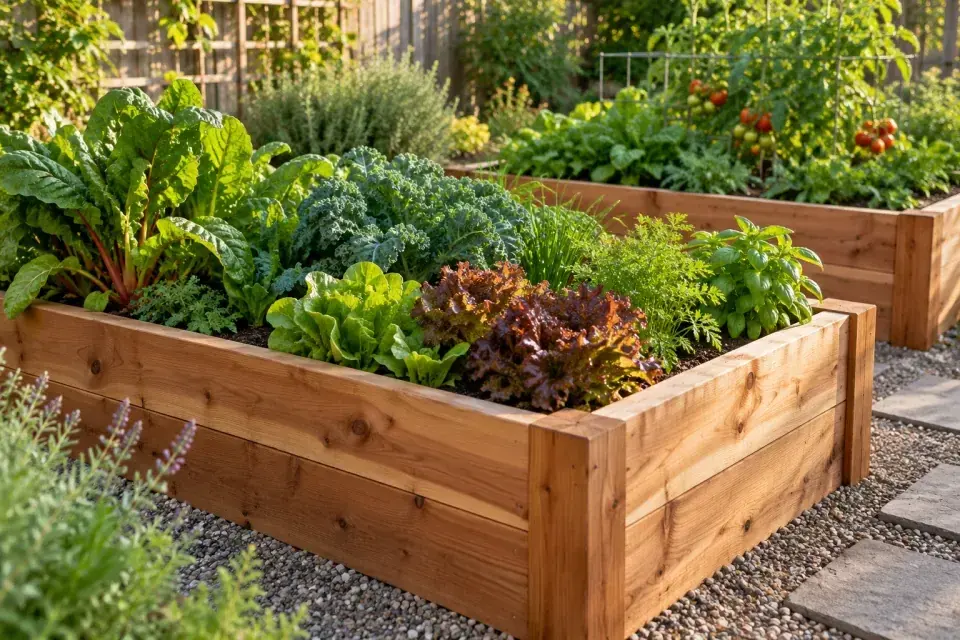
Which wood should you choose?
Cedar heartwood and redwood heartwood are useful choices for untreated raised beds. Plain pine or fir can make an economical, replaceable bed where a shorter life is acceptable. Soil contact is demanding, and low shrinkage by itself does not predict how long a board will last.
Practical wood choices
These editorial choices account for the application as well as the numbers. They may differ from the automated property ranking below.
Cedar
Light and easy to assemble, with durability that depends on species, heartwood content, and conditions. Ask which cedar is being sold. Thin boards still need support against the outward pressure of wet soil.
Species profiles:Western redcedar
Redwood
A workable alternative where locally available. The distinction between heartwood and sapwood is important, so do not buy on the redwood name alone. Compare grade and board thickness as well as price.
Species profiles:Young-growth redwood
Pine or fir
A reasonable low-cost material for beds designed to be repaired. Untreated softwood in wet soil can deteriorate relatively quickly. Easy replacement may be more useful than spending heavily on a permanent-looking structure.
Species profiles:Eastern white pineDouglas-fir
What matters for this project
Consider service life, soil pressure, and how easily boards can be changed. Ground contact is more severe than ordinary outdoor exposure. Dense wood is not necessarily durable, and a dry climate does not guarantee dry conditions inside an irrigated bed. Separate the species decision from any treatment decision.
What to check before you buy
Buy identified lumber with a known treatment history. For treated products, check the exact label and manufacturer's guidance for the intended garden application. Avoid old railway ties, unidentified reclaimed boards, and material with unknown coatings rather than trying to infer suitability from appearance.
Building and looking after it
Support long sides with posts or braces and avoid trapping water around fasteners. Design removable side boards if repair is likely. A liner may separate soil from timber, but it can also trap moisture if detailed poorly; plan drainage before installation. Keep sharp hardware away from working edges.
Mistakes to avoid
The ranking is a dimensional-property comparison, not a soil-contact durability or treatment-suitability assessment. Claims that every treated wood is unsuitable, or that every untreated wood is harmless, overlook the actual product and exposure.
Property comparison ranking
Density 320–750 kg/m³. The score combines low volumetric shrinkage (double weight) with density near 500 kg/m³.
This score does not assess resistance to soil-contact decay or the suitability of preservatives and coatings around food plants. Check the wood, treatment, and intended exposure before buying.
Species enter when the required fields are present and the rule gives a positive score. An absent wood may lack data or fall outside the scoring range; absence is not proof that it is unsuitable.
The order also uses an editorial availability multiplier, shown in the last column. It changes the order without removing a qualifying species. These scores compare selected properties; they do not evaluate every requirement of the finished project.
| # | Wood | Janka | Density | MOR | MOE | Shrinkage | T/R | Availability |
|---|---|---|---|---|---|---|---|---|
| 1 | Old-growth redwood | 480 lbf | 28.0 lb/ft³ | 10,000 lb/in² | 1.34 ×10⁶ lb/in² | 6.8% | 1.69 | |
| 2 | Eastern redcedar | 615 lbf* | 32.8 lb/ft³ | 8,800 lb/in² | 0.88 ×10⁶ lb/in² | 7.8% | 1.52 | |
| 3 | African mahogany | 830 lbf | 32.0 lb/ft³ | 10,700 lb/in² | 1.40 ×10⁶ lb/in² | 8.8% | 1.80 | |
| 4 | Incense cedar | 470 lbf | 25.8 lb/ft³ | 8,000 lb/in² | 1.04 ×10⁶ lb/in² | 7.7% | 1.58 | |
| 5 | Young-growth redwood | 420 lbf | 24.5 lb/ft³ | 7,900 lb/in² | 1.10 ×10⁶ lb/in² | 7.0% | 2.23 | |
| 6 | Port-Orford cedar | 630 lbf | 30.1 lb/ft³ | 12,700 lb/in² | 1.70 ×10⁶ lb/in² | 10.1% | 1.50 | |
| 7 | Jack pine | 570 lbf | 30.1 lb/ft³ | 9,900 lb/in² | 1.35 ×10⁶ lb/in² | 10.3% | 1.78 | |
| 8 | Rubberwood | 915 lbf* | 38.0 lb/ft³ | — | — | 7.4% | 2.22 | |
| 9 | Sugar pine | 380 lbf | 25.2 lb/ft³ | 8,200 lb/in² | 1.19 ×10⁶ lb/in² | 7.9% | 1.93 | |
| 10 | Eastern hemlock | 500 lbf | 28.0 lb/ft³ | 8,900 lb/in² | 1.20 ×10⁶ lb/in² | 9.7% | 2.27 | |
| 11 | Ponderosa pine | 460 lbf | 28.0 lb/ft³ | 9,400 lb/in² | 1.29 ×10⁶ lb/in² | 9.7% | 1.59 | |
| 12 | Western redcedar | 350 lbf | 22.3 lb/ft³ | 7,500 lb/in² | 1.11 ×10⁶ lb/in² | 6.8% | 2.08 | |
| 13 | Teak | 1,000 lbf | 40.0 lb/ft³ | 14,600 lb/in² | 1.55 ×10⁶ lb/in² | 7.0% | 2.32 | |
| 14 | Eastern white pine | 380 lbf | 24.5 lb/ft³ | 8,600 lb/in² | 1.24 ×10⁶ lb/in² | 8.2% | 2.90 | |
| 15 | Red pine | 560 lbf | 32.2 lb/ft³ | 11,000 lb/in² | 1.63 ×10⁶ lb/in² | 11.3% | 1.89 | |
| 16 | Black spruce | 530 lbf | 29.3 lb/ft³ | 10,800 lb/in² | 1.61 ×10⁶ lb/in² | 11.3% | 1.66 | |
| 17 | Northern white cedar | 320 lbf | 21.7 lb/ft³ | 6,500 lb/in² | 0.80 ×10⁶ lb/in² | 7.2% | 2.23 | |
| 18 | Spanish-cedar | 600 lbf | 35.0 lb/ft³ | 11,500 lb/in² | 1.44 ×10⁶ lb/in² | 10.3% | 1.50 | |
| 19 | Lodgepole pine | 480 lbf | 28.7 lb/ft³ | 9,400 lb/in² | 1.34 ×10⁶ lb/in² | 11.1% | 1.56 | |
| 20 | Western hemlock | 540 lbf | 31.5 lb/ft³ | 11,300 lb/in² | 1.63 ×10⁶ lb/in² | 12.4% | 1.86 | |
| 21 | Bigleaf maple | 850 lbf | 33.6 lb/ft³ | 10,700 lb/in² | 1.45 ×10⁶ lb/in² | 11.6% | 1.92 | |
| 22 | Silver maple | 700 lbf | 32.8 lb/ft³ | 8,900 lb/in² | 1.14 ×10⁶ lb/in² | 12.0% | 2.40 | |
| 23 | Okoume | 380 lbf | 28.0 lb/ft³ | 7,400 lb/in² | 1.14 ×10⁶ lb/in² | 11.3% | 1.49 | |
| 24 | True mahogany | 800 lbf | 41.0 lb/ft³ | 11,500 lb/in² | 1.50 ×10⁶ lb/in² | 7.8% | 1.37 | |
| 25 | Butternut | 490 lbf | 26.6 lb/ft³ | 8,100 lb/in² | 1.18 ×10⁶ lb/in² | 10.6% | 1.88 |
Before you choose a board
Use this ranking to compare the properties listed above. Grain direction, defects, moisture content, board dimensions, and construction also affect performance. Check the species page for the original measurements and any estimate marks, then inspect the actual stock you can buy.
The score does not assess decay resistance, food-contact suitability, heat resistance, or structural load capacity. For outdoor work, check durability and treatment requirements separately. For food-contact items and toys, check the intended finish and published safety information.
Read wood allergy and toxicity sourcesHow to read the measurements
Janka compares resistance to indentation. Density is the mass of a given volume of wood. Modulus of rupture (MOR) describes bending strength in a test specimen. Shrinkage figures describe the change from green to oven-dry wood, and T/R compares tangential with radial shrinkage. They are useful for comparison, but do not directly predict seasonal movement in your finished piece.
These are species-level reference values, not a test of the board you are buying or allowable structural design values. Grain, defects, moisture, dimensions, joints, and treatment can change the result. An asterisk beside Janka marks an estimate; open the species page for its source and method. Use the header settings to switch units.
Frequently asked questions
Is cedar rot-proof?
No. Suitable heartwood can offer useful durability, but prolonged moisture, sapwood, thin boards, and poor drainage can shorten life. Plan for inspection and eventual replacement.
Should I use thicker boards?
Thickness can improve resistance to bowing and leave more material as the surface deteriorates. Bracing, soil depth, and the span between supports still matter.
Can I build a raised bed from short offcuts?
Short pieces can work when every joint has suitable support and the wood has a known history. More joints create more fastening locations and potential movement, so draw the support arrangement first. Prefer a simple replaceable side panel over a patchwork wall that cannot resist soil pressure or be repaired without emptying the entire bed.
Sources and further reading
The application advice is editorial guidance. The references below provide background; each wood's measured values have their own sources on its species page.
- USDA Forest Products Laboratory — Wood Handbook
Background on wood properties, moisture, construction, and finishing.