Best wood for outdoor furniture
Match decay resistance, movement, weight, and maintenance to the exposure.
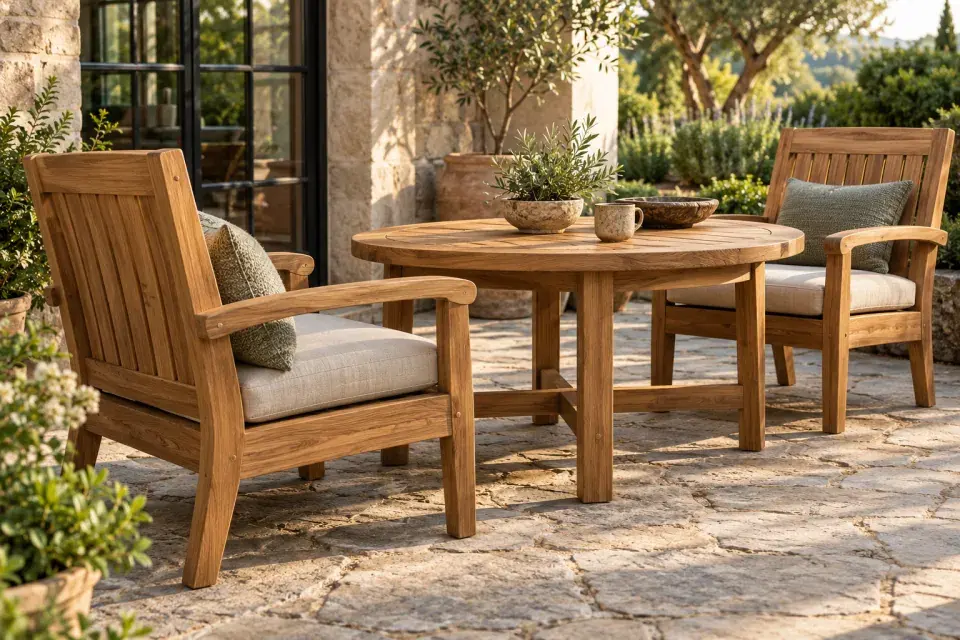
Which wood should you choose?
Teak and white oak are strong candidates for durable outdoor furniture; western red cedar suits lighter pieces when dent resistance is less important. Exposure matters: a chair under a roof has a different service life from one standing on damp soil. Select suitable heartwood and build joints that shed water.
Practical wood choices
These editorial choices account for the application as well as the numbers. They may differ from the automated property ranking below.
Teak
Useful where stability and natural durability justify the expense. Check the actual species, source, and usable heartwood content. Surface preparation and adhesive compatibility deserve attention when gluing oily stock.
Species profiles:Teak
White oak
A strong, widely useful furniture timber with better outdoor potential than red oak. It is heavy, and wide boards still move. Use joinery and hardware that suit both the load and repeated wetting.
Species profiles:White oak
Western red cedar
Lightweight and easy to machine for benches and casual seating. Its softness makes dents and fastener crushing more likely, so generous bearing areas and thoughtful joint design matter.
Species profiles:Western redcedar
What matters for this project
Decay resistance and moisture movement answer different questions. Low shrinkage may reduce joint stress, but it does not prove resistance to fungi. Heartwood and sapwood may perform differently in the same board. Decide whether the furniture will weather naturally or receive a maintained finish before specifying stock and construction.
What to check before you buy
Price the clear lengths needed for legs, rails, and slats, including waste around knots. Ask for species identification and responsible sourcing information. Choose stock dry enough for your construction method; very wet material can shrink after joints and fasteners are fitted.
Building and looking after it
Avoid flat pockets that retain water. Keep end grain off the ground, allow drainage between slats, and use corrosion-resistant hardware compatible with the wood. Give wide tops room to move. A clear finish needs renewal outdoors; cleaning and inspection remain useful even when you accept a gray weathered surface.
Mistakes to avoid
Do not select outdoor furniture wood on density alone. A dense, unstable species may split around fasteners, while a light but durable species may work well in a properly proportioned chair. The ranking does not include a decay-resistance field.
Property comparison ranking
Density at least 450 kg/m³. The score combines low volumetric shrinkage (double weight) with a low tangential-to-radial shrinkage ratio.
This score compares movement-related properties, not decay or insect resistance. Check published durability evidence, heartwood versus sapwood, exposure, construction, and maintenance before choosing outdoor stock.
Species enter when the required fields are present and the rule gives a positive score. An absent wood may lack data or fall outside the scoring range; absence is not proof that it is unsuitable.
The order also uses an editorial availability multiplier, shown in the last column. It changes the order without removing a qualifying species. These scores compare selected properties; they do not evaluate every requirement of the finished project.
| # | Wood | Janka | Density | MOR | MOE | Shrinkage | T/R | Availability |
|---|---|---|---|---|---|---|---|---|
| 1 | Andaman Padauk | 1,630 lbf | 48.9 lb/ft³ | — | — | 6.4% | 1.33 | |
| 2 | True mahogany | 800 lbf | 41.0 lb/ft³ | 11,500 lb/in² | 1.50 ×10⁶ lb/in² | 7.8% | 1.37 | |
| 3 | Cocobolo | 3,860 lbf* | 69.0 lb/ft³ | — | — | 7.0% | 1.59 | |
| 4 | Eastern redcedar | 615 lbf* | 32.8 lb/ft³ | 8,800 lb/in² | 0.88 ×10⁶ lb/in² | 7.8% | 1.52 | |
| 5 | African Padauk | 1,538 lbf* | 46.0 lb/ft³ | 13,900 lb/in² | 1.56 ×10⁶ lb/in² | 7.6% | 1.58 | |
| 6 | Iroko | 1,260 lbf | 43.0 lb/ft³ | 12,400 lb/in² | 1.46 ×10⁶ lb/in² | 8.8% | 1.36 | |
| 7 | Merbau | 1,500 lbf | 50.0 lb/ft³ | 16,800 lb/in² | 2.23 ×10⁶ lb/in² | 7.8% | 1.70 | |
| 8 | Port-Orford cedar | 630 lbf | 30.1 lb/ft³ | 12,700 lb/in² | 1.70 ×10⁶ lb/in² | 10.1% | 1.50 | |
| 9 | Spanish-cedar | 600 lbf | 35.0 lb/ft³ | 11,500 lb/in² | 1.44 ×10⁶ lb/in² | 10.3% | 1.50 | |
| 10 | African mahogany | 830 lbf | 32.0 lb/ft³ | 10,700 lb/in² | 1.40 ×10⁶ lb/in² | 8.8% | 1.80 | |
| 11 | Rubberwood | 915 lbf* | 38.0 lb/ft³ | — | — | 7.4% | 2.22 | |
| 12 | Teak | 1,000 lbf | 40.0 lb/ft³ | 14,600 lb/in² | 1.55 ×10⁶ lb/in² | 7.0% | 2.32 | |
| 13 | Lodgepole pine | 480 lbf | 28.7 lb/ft³ | 9,400 lb/in² | 1.34 ×10⁶ lb/in² | 11.1% | 1.56 | |
| 14 | Slash pine | 869 lbf* | 41.3 lb/ft³ | 16,300 lb/in² | 1.98 ×10⁶ lb/in² | 12.1% | 1.41 | |
| 15 | Jack pine | 570 lbf | 30.1 lb/ft³ | 9,900 lb/in² | 1.35 ×10⁶ lb/in² | 10.3% | 1.78 | |
| 16 | Indian rosewood | 3,170 lbf | 53.0 lb/ft³ | 16,900 lb/in² | 1.78 ×10⁶ lb/in² | 8.5% | 2.15 | |
| 17 | Ipe | 3,680 lbf | 70.0 lb/ft³ | 25,400 lb/in² | 3.14 ×10⁶ lb/in² | 13.2% | 1.21 | |
| 18 | Purpleheart | 1,860 lbf | 58.0 lb/ft³ | 19,200 lb/in² | 2.27 ×10⁶ lb/in² | 9.9% | 1.91 | |
| 19 | Longleaf pine | 870 lbf | 41.3 lb/ft³ | 14,500 lb/in² | 1.98 ×10⁶ lb/in² | 12.2% | 1.47 | |
| 20 | Black spruce | 530 lbf | 29.3 lb/ft³ | 10,800 lb/in² | 1.61 ×10⁶ lb/in² | 11.3% | 1.66 | |
| 21 | Black walnut | 1,010 lbf | 38.5 lb/ft³ | 14,600 lb/in² | 1.68 ×10⁶ lb/in² | 12.8% | 1.42 | |
| 22 | Loblolly pine | 690 lbf | 35.6 lb/ft³ | 12,800 lb/in² | 1.79 ×10⁶ lb/in² | 12.3% | 1.54 | |
| 23 | Green ash | 1,200 lbf | 39.1 lb/ft³ | 14,100 lb/in² | 1.66 ×10⁶ lb/in² | 12.5% | 1.54 | |
| 24 | Coast Douglas-fir | 710 lbf | 33.6 lb/ft³ | 12,400 lb/in² | 1.95 ×10⁶ lb/in² | 12.4% | 1.58 | |
| 25 | Shortleaf pine | 690 lbf | 35.6 lb/ft³ | 13,100 lb/in² | 1.75 ×10⁶ lb/in² | 12.3% | 1.67 |
Before you choose a board
Use this ranking to compare the properties listed above. Grain direction, defects, moisture content, board dimensions, and construction also affect performance. Check the species page for the original measurements and any estimate marks, then inspect the actual stock you can buy.
The score does not assess decay resistance, food-contact suitability, heat resistance, or structural load capacity. For outdoor work, check durability and treatment requirements separately. For food-contact items and toys, check the intended finish and published safety information.
Read wood allergy and toxicity sourcesHow to read the measurements
Janka compares resistance to indentation. Density is the mass of a given volume of wood. Modulus of rupture (MOR) describes bending strength in a test specimen. Shrinkage figures describe the change from green to oven-dry wood, and T/R compares tangential with radial shrinkage. They are useful for comparison, but do not directly predict seasonal movement in your finished piece.
These are species-level reference values, not a test of the board you are buying or allowable structural design values. Grain, defects, moisture, dimensions, joints, and treatment can change the result. An asterisk beside Janka marks an estimate; open the species page for its source and method. Use the header settings to switch units.
Frequently asked questions
Must outdoor furniture be sealed?
Not every suitable timber needs a film finish. Leaving it unfinished changes appearance and maintenance expectations; it does not remove the need for drainage, sound joinery, and periodic inspection.
Is cedar strong enough for a chair?
It can be, with dimensions and joints designed for its properties. Do not substitute it directly into slender parts sized for a stronger hardwood.
How should I compare the cost of different outdoor woods?
Include the usable heartwood, clear lengths, machining time, hardware, and expected maintenance in the comparison. A lighter timber may be easier to move but need larger parts; a dense timber may need more expensive tooling. Decide how long you expect to keep the piece and whether repairable slats or replaceable feet are part of the design.
Sources and further reading
The application advice is editorial guidance. The references below provide background; each wood's measured values have their own sources on its species page.
- USDA Forest Products Laboratory — Wood Handbook
Background on wood properties, moisture, construction, and finishing.