Best wood for bows
Start with a proven bow design and a sound stave with continuous fibers.
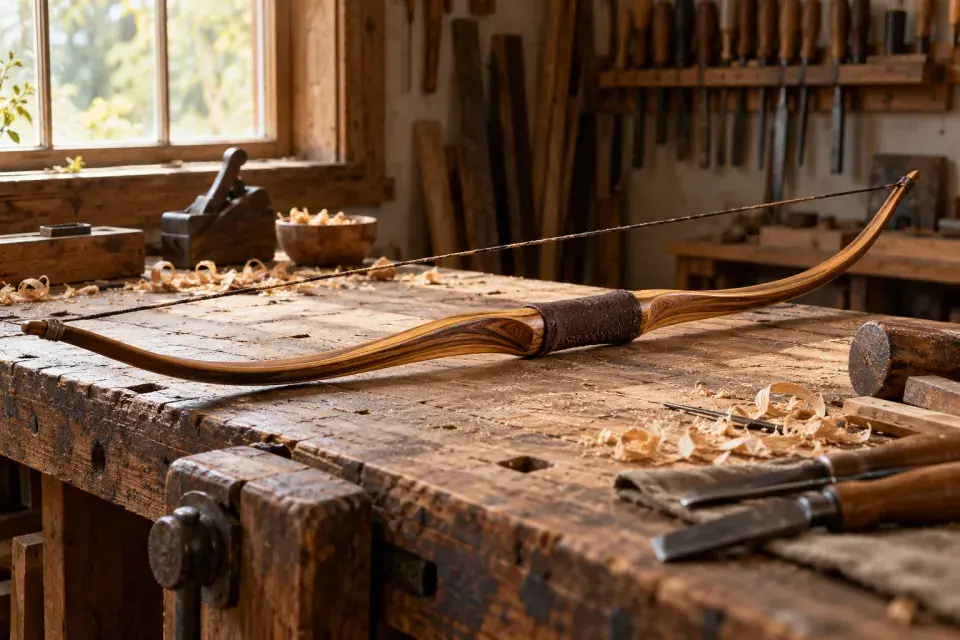
Which wood should you choose?
Hickory, Osage orange, and yew are established bow woods, but they suit different designs and working methods. A clear stave with appropriate grain is more valuable than an unusually high bending-strength score. For a first bow, follow a design and stave-selection method intended for the chosen species.
Practical wood choices
These editorial choices account for the application as well as the numbers. They may differ from the automated property ranking below.
Hickory
A practical option for many beginner designs when clear, straight-grained stock is available. It can make a durable back, but drying, moisture uptake, limb dimensions, and tillering still require care.
Species profiles:Shagbark hickory
Osage orange
A traditional self-bow material with demanding stave preparation. Following the back and working around knots takes experience. A premium stave does not make poor tillering forgiving.
Species profiles:Osage orange
Yew
A classic choice for particular longbow designs that use its sapwood and heartwood arrangement. Suitable staves are specialist material, and selection cannot be reduced to a density target.
Species profiles:European yewPacific yew
What matters for this project
Bow limbs experience repeated bending, with tension on one side and compression on the other. A static bending test does not capture all the relevant behavior. Grain continuity along the back, local defects, limb geometry, and moisture content can determine failure long before a species-average strength difference becomes useful.
What to check before you buy
Buy a stave or board selected for bow making, with adequate length and room for the intended layout. Inspect for runout, checks, knots, and drying damage. Ask how the stave was prepared and stored. Board bows and natural staves need different grain-reading methods; choose one approach and learn it thoroughly.
Building and looking after it
Use a proven layout and remove material gradually while checking limb bend. Do not bring an unfinished bow straight to full draw. Keep the work within the design's intended draw length and weight, and retire a bow that develops damage. Surface finish helps manage exposure but does not correct weak grain or a poor tiller.
Mistakes to avoid
The numerical shortlist is not a bow-safety assessment. It lacks tensile behavior, compression recovery, fatigue, stave defects, and backing details. Never substitute a ranked species into a slender bow design solely because its modulus of rupture is high.
Property comparison ranking
Density 550–950 kg/m³. Higher modulus of rupture gives a higher score.
This ranking compares selected properties. Use the practical choices above to check the other requirements of your project.
Species enter when the required fields are present and the rule gives a positive score. An absent wood may lack data or fall outside the scoring range; absence is not proof that it is unsuitable.
The order also uses an editorial availability multiplier, shown in the last column. It changes the order without removing a qualifying species. These scores compare selected properties; they do not evaluate every requirement of the finished project.
| # | Wood | Janka | Density | MOR | MOE | Shrinkage | T/R | Availability |
|---|---|---|---|---|---|---|---|---|
| 1 | Bubinga | 2,690 lbf | 55.9 lb/ft³ | 22,600 lb/in² | 2.48 ×10⁶ lb/in² | 14.2% | 1.45 | |
| 2 | Shagbark hickory | 1,880 lbf | 50.3 lb/ft³ | 20,200 lb/in² | 2.16 ×10⁶ lb/in² | 16.7% | 1.50 | |
| 3 | Keruing | 1,270 lbf | 54.2 lb/ft³ | 19,900 lb/in² | 2.07 ×10⁶ lb/in² | 16.1% | 2.10 | |
| 4 | Mockernut hickory | 1,970 lbf | 50.3 lb/ft³ | 19,200 lb/in² | 2.22 ×10⁶ lb/in² | 17.8% | 1.43 | |
| 5 | Purpleheart | 1,860 lbf | 58.0 lb/ft³ | 19,200 lb/in² | 2.27 ×10⁶ lb/in² | 9.9% | 1.91 | |
| 6 | Ramin | 1,300 lbf | 39.6 lb/ft³ | 18,500 lb/in² | 2.17 ×10⁶ lb/in² | 13.4% | 2.02 | |
| 7 | East African Olive | 2,740 lbf | 55.0 lb/ft³ | 25,300 lb/in² | 2.53 ×10⁶ lb/in² | — | — | |
| 8 | Cherrybark oak | 1,480 lbf | 47.6 lb/ft³ | 18,100 lb/in² | 2.28 ×10⁶ lb/in² | — | — | |
| 9 | Bitternut hickory | 1,461 lbf* | 46.1 lb/ft³ | 17,100 lb/in² | 1.79 ×10⁶ lb/in² | — | — | |
| 10 | Indian rosewood | 3,170 lbf | 53.0 lb/ft³ | 16,900 lb/in² | 1.78 ×10⁶ lb/in² | 8.5% | 2.15 | |
| 11 | Sweet birch | 1,470 lbf | 45.4 lb/ft³ | 16,900 lb/in² | 2.17 ×10⁶ lb/in² | 15.6% | 1.38 | |
| 12 | Merbau | 1,500 lbf | 50.0 lb/ft³ | 16,800 lb/in² | 2.23 ×10⁶ lb/in² | 7.8% | 1.70 | |
| 13 | Yellow birch | 1,260 lbf | 43.3 lb/ft³ | 16,600 lb/in² | 2.01 ×10⁶ lb/in² | 16.8% | 1.30 | |
| 14 | Slash pine | 869 lbf* | 41.3 lb/ft³ | 16,300 lb/in² | 1.98 ×10⁶ lb/in² | 12.1% | 1.41 | |
| 15 | Jarrah | 1,910 lbf | 54.0 lb/ft³ | 16,200 lb/in² | 1.88 ×10⁶ lb/in² | 18.7% | 1.43 | |
| 16 | Panga Panga | 1,630 lbf | 55.0 lb/ft³ | 16,200 lb/in² | 1.97 ×10⁶ lb/in² | — | 1.87 | |
| 17 | Sugar maple | 1,450 lbf | 44.1 lb/ft³ | 15,800 lb/in² | 1.83 ×10⁶ lb/in² | 14.7% | 2.06 | |
| 18 | White ash | 1,320 lbf | 42.0 lb/ft³ | 15,400 lb/in² | 1.74 ×10⁶ lb/in² | 13.3% | 1.59 | |
| 19 | Sapele | 1,510 lbf | 42.0 lb/ft³ | 15,300 lb/in² | 1.82 ×10⁶ lb/in² | 14.0% | 1.61 | |
| 20 | White oak | 1,360 lbf | 47.6 lb/ft³ | 15,200 lb/in² | 1.78 ×10⁶ lb/in² | 16.3% | 1.88 | |
| 21 | Kamassi | 2,730 lbf | 58.0 lb/ft³ | 20,970 lb/in² | 2.54 ×10⁶ lb/in² | — | — | |
| 22 | American beech | 1,300 lbf | 44.8 lb/ft³ | 14,900 lb/in² | 1.72 ×10⁶ lb/in² | 17.2% | 2.16 | |
| 23 | Black walnut | 1,010 lbf | 38.5 lb/ft³ | 14,600 lb/in² | 1.68 ×10⁶ lb/in² | 12.8% | 1.42 | |
| 24 | Teak | 1,000 lbf | 40.0 lb/ft³ | 14,600 lb/in² | 1.55 ×10⁶ lb/in² | 7.0% | 2.32 | |
| 25 | Longleaf pine | 870 lbf | 41.3 lb/ft³ | 14,500 lb/in² | 1.98 ×10⁶ lb/in² | 12.2% | 1.47 |
Before you choose a board
Use this ranking to compare the properties listed above. Grain direction, defects, moisture content, board dimensions, and construction also affect performance. Check the species page for the original measurements and any estimate marks, then inspect the actual stock you can buy.
The score does not assess decay resistance, food-contact suitability, heat resistance, or structural load capacity. For outdoor work, check durability and treatment requirements separately. For food-contact items and toys, check the intended finish and published safety information.
Read wood allergy and toxicity sourcesHow to read the measurements
Janka compares resistance to indentation. Density is the mass of a given volume of wood. Modulus of rupture (MOR) describes bending strength in a test specimen. Shrinkage figures describe the change from green to oven-dry wood, and T/R compares tangential with radial shrinkage. They are useful for comparison, but do not directly predict seasonal movement in your finished piece.
These are species-level reference values, not a test of the board you are buying or allowable structural design values. Grain, defects, moisture, dimensions, joints, and treatment can change the result. An asterisk beside Janka marks an estimate; open the species page for its source and method. Use the header settings to switch units.
Frequently asked questions
Is the strongest wood always the best bow wood?
No. Strength, elasticity, compression behavior, grain, and design must work together. A wood can have excellent test values yet be unsuitable for a particular stave or limb shape.
Can I make a bow from a hardware-store board?
Potentially, but selection is critical. Use a board-bow method that teaches grain inspection, suitable dimensions, and controlled tillering; ordinary grading does not certify bow suitability.
Does a backing make a questionable stave acceptable?
A backing changes how a bow is designed and built; it is not a universal repair for unsuitable grain or defects. Use a method developed for the particular combination of backing and core, including the adhesive and limb dimensions. If a stave is questionable, resolve its suitability before investing time in shaping and bringing it under load.
Sources and further reading
The application advice is editorial guidance. The references below provide background; each wood's measured values have their own sources on its species page.
- USDA Forest Products Laboratory — Wood Handbook
Background on wood properties, moisture, construction, and finishing.