Best wood for chair seats
Choose clear grain for a scooped seat and match it to the chair's structure.
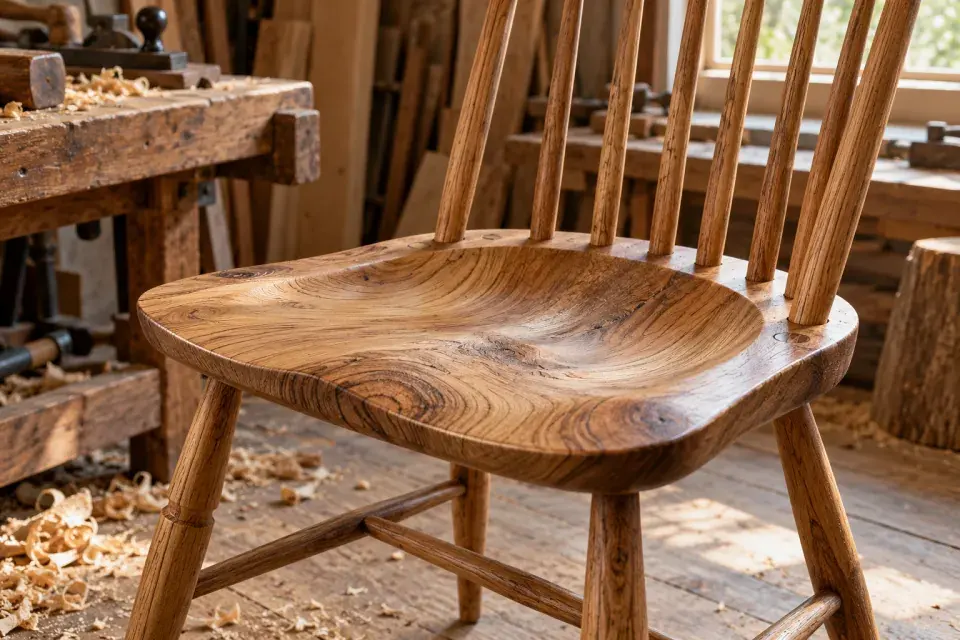
Which wood should you choose?
Elm, suitable pine, and poplar are useful seat woods in particular traditional chair designs. The seat needs enough material around leg and spindle joints while remaining comfortable to scoop. A species that is pleasant to carve can still be a poor choice if the blank contains pith, checks, or short grain at a socket.
Practical wood choices
These editorial choices account for the application as well as the numbers. They may differ from the automated property ranking below.
Elm
Its interlocking grain can be useful in traditional seats with several joints, though that grain can make shaping more demanding. Clear wide blanks may be difficult to source. Inspect drying checks and allow time for tool work.
Species profiles:American elm
Pine
Light and relatively easy to saddle for designs that allow adequate thickness. Select suitable clear stock instead of knotty framing lumber. Softness makes local crushing and joint fit important considerations.
Species profiles:Eastern white pine
Poplar
A workable option for painted seats and designs built around its properties. It is relatively easy to shape, but does not justify shrinking the seat dimensions or copying joints sized for a stronger material.
Species profiles:Yellow-poplar
What matters for this project
Seat shape and the location of joints determine which parts of the blank are critical. Check grain direction through the narrow edges and between sockets. A laminated seat can be practical, but glue-line quality and layout need attention. The ranking does not evaluate splitting resistance or the holding behavior of a tapered joint.
What to check before you buy
Choose the chair plan before ordering a blank. Allow room for the finished outline, saddling depth, and joint locations. Ask about drying and inspect both faces and end grain. Wide clear seat stock costs more because it must survive both shaping and the placement of multiple joints.
Building and looking after it
Lay out all joints before removing the saddle. Preserve adequate thickness beneath the deepest part and around sockets. Use the angles, tapers, and assembly method specified by the design. Shape the surface for comfort with a full-size trial rather than relying on a decorative contour.
Mistakes to avoid
A chair is a loaded assembly. Neither a moderate Janka number nor a high bending score certifies the seat or its joints. Avoid placing a hidden check or loose knot where a leg or spindle transfers load.
Property comparison ranking
Janka 450–1,300 lbf. The score combines hardness near 800 lbf with bending strength divided by 25,000.
This ranking compares selected properties. Use the practical choices above to check the other requirements of your project.
Species enter when the required fields are present and the rule gives a positive score. An absent wood may lack data or fall outside the scoring range; absence is not proof that it is unsuitable.
The order also uses an editorial availability multiplier, shown in the last column. It changes the order without removing a qualifying species. These scores compare selected properties; they do not evaluate every requirement of the finished project.
| # | Wood | Janka | Density | MOR | MOE | Shrinkage | T/R | Availability |
|---|---|---|---|---|---|---|---|---|
| 1 | Slash pine | 869 lbf* | 41.3 lb/ft³ | 16,300 lb/in² | 1.98 ×10⁶ lb/in² | 12.1% | 1.41 | |
| 2 | True mahogany | 800 lbf | 41.0 lb/ft³ | 11,500 lb/in² | 1.50 ×10⁶ lb/in² | 7.8% | 1.37 | |
| 3 | Western larch | 830 lbf | 36.3 lb/ft³ | 13,000 lb/in² | 1.87 ×10⁶ lb/in² | 14.0% | 2.02 | |
| 4 | Longleaf pine | 870 lbf | 41.3 lb/ft³ | 14,500 lb/in² | 1.98 ×10⁶ lb/in² | 12.2% | 1.47 | |
| 5 | American elm | 830 lbf | 35.0 lb/ft³ | 11,800 lb/in² | 1.34 ×10⁶ lb/in² | 14.6% | 2.26 | |
| 6 | Black ash | 850 lbf | 34.3 lb/ft³ | 12,600 lb/in² | 1.60 ×10⁶ lb/in² | 15.2% | 1.56 | |
| 7 | Sweetgum | 850 lbf | 36.3 lb/ft³ | 12,500 lb/in² | 1.64 ×10⁶ lb/in² | 15.8% | 1.92 | |
| 8 | Radiata pine | 750 lbf | 31.5 lb/ft³ | 11,700 lb/in² | 1.48 ×10⁶ lb/in² | — | — | |
| 9 | African mahogany | 830 lbf | 32.0 lb/ft³ | 10,700 lb/in² | 1.40 ×10⁶ lb/in² | 8.8% | 1.80 | |
| 10 | Black tupelo | 810 lbf | 35.0 lb/ft³ | 9,600 lb/in² | 1.20 ×10⁶ lb/in² | 14.4% | 1.71 | |
| 11 | American sycamore | 770 lbf | 34.3 lb/ft³ | 10,000 lb/in² | 1.42 ×10⁶ lb/in² | 14.1% | 1.68 | |
| 12 | Bigleaf maple | 850 lbf | 33.6 lb/ft³ | 10,700 lb/in² | 1.45 ×10⁶ lb/in² | 11.6% | 1.92 | |
| 13 | Coast Douglas-fir | 710 lbf | 33.6 lb/ft³ | 12,400 lb/in² | 1.95 ×10⁶ lb/in² | 12.4% | 1.58 | |
| 14 | Shortleaf pine | 690 lbf | 35.6 lb/ft³ | 13,100 lb/in² | 1.75 ×10⁶ lb/in² | 12.3% | 1.67 | |
| 15 | Loblolly pine | 690 lbf | 35.6 lb/ft³ | 12,800 lb/in² | 1.79 ×10⁶ lb/in² | 12.3% | 1.54 | |
| 16 | Hackberry | 880 lbf | 37.1 lb/ft³ | 11,000 lb/in² | 1.19 ×10⁶ lb/in² | 13.8% | 1.85 | |
| 17 | Paper birch | 910 lbf | 38.5 lb/ft³ | 12,300 lb/in² | 1.59 ×10⁶ lb/in² | 16.2% | 1.37 | |
| 18 | Red maple | 950 lbf | 37.8 lb/ft³ | 13,400 lb/in² | 1.64 ×10⁶ lb/in² | 12.6% | 2.05 | |
| 19 | Douglas-fir | 645 lbf* | 33.9 lb/ft³ | 12,800 lb/in² | 1.97 ×10⁶ lb/in² | — | — | |
| 20 | Black cherry | 950 lbf | 35.0 lb/ft³ | 12,300 lb/in² | 1.49 ×10⁶ lb/in² | 11.5% | 1.92 | |
| 21 | Teak | 1,000 lbf | 40.0 lb/ft³ | 14,600 lb/in² | 1.55 ×10⁶ lb/in² | 7.0% | 2.32 | |
| 22 | Port-Orford cedar | 630 lbf | 30.1 lb/ft³ | 12,700 lb/in² | 1.70 ×10⁶ lb/in² | 10.1% | 1.50 | |
| 23 | Black walnut | 1,010 lbf | 38.5 lb/ft³ | 14,600 lb/in² | 1.68 ×10⁶ lb/in² | 12.8% | 1.42 | |
| 24 | Silver maple | 700 lbf | 32.8 lb/ft³ | 8,900 lb/in² | 1.14 ×10⁶ lb/in² | 12.0% | 2.40 | |
| 25 | Spanish-cedar | 600 lbf | 35.0 lb/ft³ | 11,500 lb/in² | 1.44 ×10⁶ lb/in² | 10.3% | 1.50 |
Before you choose a board
Use this ranking to compare the properties listed above. Grain direction, defects, moisture content, board dimensions, and construction also affect performance. Check the species page for the original measurements and any estimate marks, then inspect the actual stock you can buy.
The score does not assess decay resistance, food-contact suitability, heat resistance, or structural load capacity. For outdoor work, check durability and treatment requirements separately. For food-contact items and toys, check the intended finish and published safety information.
Read wood allergy and toxicity sourcesHow to read the measurements
Janka compares resistance to indentation. Density is the mass of a given volume of wood. Modulus of rupture (MOR) describes bending strength in a test specimen. Shrinkage figures describe the change from green to oven-dry wood, and T/R compares tangential with radial shrinkage. They are useful for comparison, but do not directly predict seasonal movement in your finished piece.
These are species-level reference values, not a test of the board you are buying or allowable structural design values. Grain, defects, moisture, dimensions, joints, and treatment can change the result. An asterisk beside Janka marks an estimate; open the species page for its source and method. Use the header settings to switch units.
Frequently asked questions
Can I glue up a seat blank?
Yes, where the design allows it and the joints are sound. Arrange the blank so critical sockets and thin areas remain well supported, and use properly prepared, dry stock.
Is a harder seat more durable?
Hardness helps with dents, but can make carving difficult. Seat thickness, grain continuity, joint design, and the complete chair structure are more useful guides to durability.
Should the seat and legs use the same wood?
They can, but many chair designs assign different timbers to different tasks. A seat may favor carving and joint placement while legs favor strength and continuous grain. Follow the design’s material assumptions and joint method. Choosing complementary species can make practical sense, but it requires more thought than substituting whatever offcuts happen to be available.
Sources and further reading
The application advice is editorial guidance. The references below provide background; each wood's measured values have their own sources on its species page.
- USDA Forest Products Laboratory — Wood Handbook
Background on wood properties, moisture, construction, and finishing.