Best wood for chess pieces
Choose fine detail, balanced sets, and reliable contrast rather than density alone.
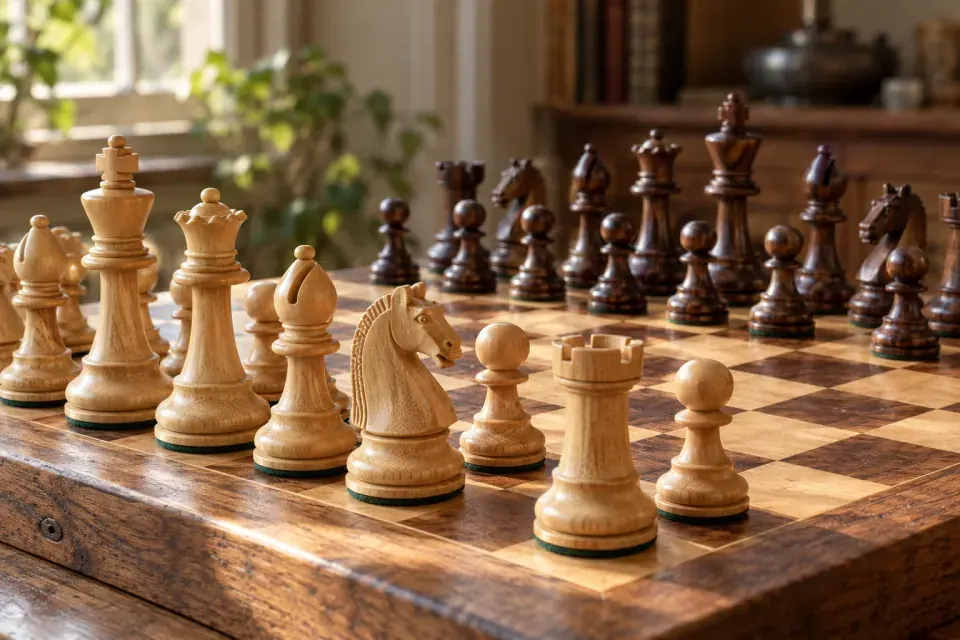
Which wood should you choose?
Boxwood is a traditional choice for detailed pale pieces. Maple and walnut are useful accessible options for a contrasting handmade set, while ebony offers a dark dense material at greater cost and machining difficulty. Size, base shape, and any added weight influence handling as much as species density.
Practical wood choices
These editorial choices account for the application as well as the numbers. They may differ from the automated property ranking below.
Boxwood
Fine texture suits turned collars and small carved details. Clear blanks can be expensive, so compare usable sizes carefully. Check that the trade name identifies the material rather than assuming every pale substitute behaves the same way.
Species profiles:Common boxwood
Maple and walnut
A practical contrasting pair for a first set. They differ in weight and cutting feel, so adjust the design or weighting to produce a consistent handling experience. Plain grain is easier for small features than dramatic figure.
Species profiles:Sugar mapleBlack walnut
Ebony
A dense dark option that can support crisp detail but may chip or check. Natural color variation is common. Verify sourcing and stock condition, and allow for demanding cutting and sanding.
Species profiles:African ebony
What matters for this project
Design around the narrowest collars, finials, and the knight's carved features. Fine even texture matters more there than maximum hardness. A broad stable base helps pieces stand, and extra base weight is a separate construction choice. Consider how the finished pieces contrast with the actual board under ordinary light.
What to check before you buy
Order enough consistent stock for the complete set plus practice and replacement pieces. Allow room for mounting waste. Match color and grain deliberately, and inspect small blanks for end checks. A single attractive blank is less useful than a reliable batch of suitable material.
Building and looking after it
Make patterns or gauges so repeated pieces share dimensions. Leave fragile details until the main shape is established, and use sharp tools with light cuts. Fit base weights securely where used and test stability before applying felt. Choose a finish that tolerates handling without obscuring detail.
Mistakes to avoid
Density does not predict carving quality, resistance to chipping, or the final balance of a piece. Very heavy wood may be unnecessary in a small set. Avoid loose weights and glued repairs in delicate details that will be handled repeatedly.
Property comparison ranking
Janka at least 1,400 lbf. The score combines hardness divided by 4,000 with density divided by 1,200.
This ranking compares selected properties. Use the practical choices above to check the other requirements of your project.
Species enter when the required fields are present and the rule gives a positive score. An absent wood may lack data or fall outside the scoring range; absence is not proof that it is unsuitable.
The order also uses an editorial availability multiplier, shown in the last column. It changes the order without removing a qualifying species. These scores compare selected properties; they do not evaluate every requirement of the finished project.
| # | Wood | Janka | Density | MOR | MOE | Shrinkage | T/R | Availability |
|---|---|---|---|---|---|---|---|---|
| 1 | Cocobolo | 3,860 lbf* | 69.0 lb/ft³ | — | — | 7.0% | 1.59 | |
| 2 | Ipe | 3,680 lbf | 70.0 lb/ft³ | 25,400 lb/in² | 3.14 ×10⁶ lb/in² | 13.2% | 1.21 | |
| 3 | Cumaru | 3,415 lbf | 66.8 lb/ft³ | 24,371 lb/in² | 2.43 ×10⁶ lb/in² | 13.5% | 1.56 | |
| 4 | Verawood | 5,180 lbf* | 78.0 lb/ft³ | — | — | — | — | |
| 5 | Lignumvitae | 4,500 lbf | 80.0 lb/ft³ | — | — | — | — | |
| 6 | Indian rosewood | 3,170 lbf | 53.0 lb/ft³ | 16,900 lb/in² | 1.78 ×10⁶ lb/in² | 8.5% | 2.15 | |
| 7 | Bubinga | 2,690 lbf | 55.9 lb/ft³ | 22,600 lb/in² | 2.48 ×10⁶ lb/in² | 14.2% | 1.45 | |
| 8 | Canalete | 2,200 lbf | 58.2 lb/ft³ | — | — | 11.6% | 1.85 | |
| 9 | Siamese rosewood | 3,441 lbf* | 68.7 lb/ft³ | — | — | — | — | |
| 10 | Azobe | 3,350 lbf | 70.0 lb/ft³ | 24,500 lb/in² | 2.47 ×10⁶ lb/in² | 17.0% | 1.31 | |
| 11 | Olive | 3,336 lbf* | 67.7 lb/ft³ | — | — | — | — | |
| 12 | Zebrano | 2,139 lbf* | 53.0 lb/ft³ | — | — | — | — | |
| 13 | Purpleheart | 1,860 lbf | 58.0 lb/ft³ | 19,200 lb/in² | 2.27 ×10⁶ lb/in² | 9.9% | 1.91 | |
| 14 | Marishballi | 3,570 lbf | 62.0 lb/ft³ | 27,700 lb/in² | 3.34 ×10⁶ lb/in² | 17.2% | 1.56 | |
| 15 | Jarrah | 1,910 lbf | 54.0 lb/ft³ | 16,200 lb/in² | 1.88 ×10⁶ lb/in² | 18.7% | 1.43 | |
| 16 | African ebony | 3,220 lbf | 63.0 lb/ft³ | 21,200 lb/in² | — | 20.0% | 1.17 | |
| 17 | Holywood | 5,728 lbf* | 87.1 lb/ft³ | — | — | — | — | |
| 18 | Lignum-vitae | 5,728 lbf* | 87.1 lb/ft³ | — | — | — | — | |
| 19 | Mockernut hickory | 1,970 lbf | 50.3 lb/ft³ | 19,200 lb/in² | 2.22 ×10⁶ lb/in² | 17.8% | 1.43 | |
| 20 | Honduras Rosewood | 3,097 lbf* | 63.0 lb/ft³ | — | — | — | — | |
| 21 | Panga Panga | 1,630 lbf | 55.0 lb/ft³ | 16,200 lb/in² | 1.97 ×10⁶ lb/in² | — | 1.87 | |
| 22 | Shagbark hickory | 1,880 lbf | 50.3 lb/ft³ | 20,200 lb/in² | 2.16 ×10⁶ lb/in² | 16.7% | 1.50 | |
| 23 | Partridgewood | 5,868 lbf* | 78.0 lb/ft³ | — | — | — | — | |
| 24 | Brazilian rosewood | 2,720 lbf | 64.1 lb/ft³ | 19,000 lb/in² | 1.88 ×10⁶ lb/in² | 8.5% | 1.59 | |
| 25 | Common boxwood | 2,779 lbf* | 62.2 lb/ft³ | — | — | — | — |
Before you choose a board
Use this ranking to compare the properties listed above. Grain direction, defects, moisture content, board dimensions, and construction also affect performance. Check the species page for the original measurements and any estimate marks, then inspect the actual stock you can buy.
The score does not assess decay resistance, food-contact suitability, heat resistance, or structural load capacity. For outdoor work, check durability and treatment requirements separately. For food-contact items and toys, check the intended finish and published safety information.
Read wood allergy and toxicity sourcesHow to read the measurements
Janka compares resistance to indentation. Density is the mass of a given volume of wood. Modulus of rupture (MOR) describes bending strength in a test specimen. Shrinkage figures describe the change from green to oven-dry wood, and T/R compares tangential with radial shrinkage. They are useful for comparison, but do not directly predict seasonal movement in your finished piece.
These are species-level reference values, not a test of the board you are buying or allowable structural design values. Grain, defects, moisture, dimensions, joints, and treatment can change the result. An asterisk beside Janka marks an estimate; open the species page for its source and method. Use the header settings to switch units.
Frequently asked questions
Do dark pieces have to be ebony?
No. Walnut or a suitable stained wood can provide contrast. Test the complete finish for handling and color transfer before finishing the set.
Should every piece weigh the same?
Usually the design scales weight with size while keeping each piece stable. Consistency between matching pieces is more useful than making a pawn weigh as much as a king.
How can I keep a whole set visually consistent?
Plan the complete set before cutting and reserve matched stock for repeated pieces. Use templates, gauges, and finish samples to control dimensions and color. Make a spare pawn or keep a suitable blank for future replacement. Consistency comes from the stock selection and making process, even when natural grain variation is intentionally part of the set.
Sources and further reading
The application advice is editorial guidance. The references below provide background; each wood's measured values have their own sources on its species page.
- USDA Forest Products Laboratory — Wood Handbook
Background on wood properties, moisture, construction, and finishing.