Best wood for turning pens
Look for sound small blanks that drill cleanly and survive thin walls.
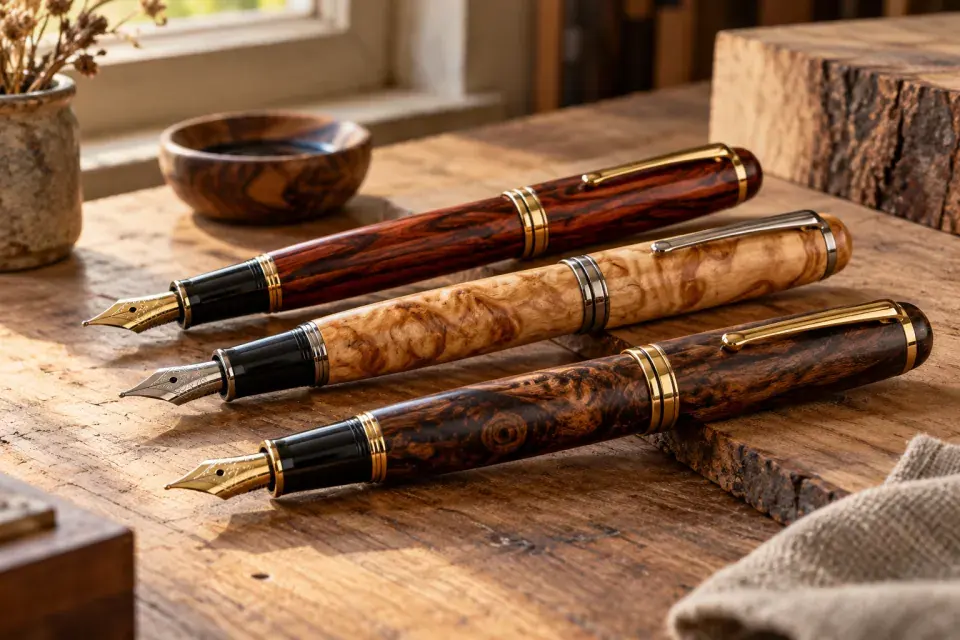
Which wood should you choose?
Walnut and maple are sensible first pen woods; olive and stabilized figured blanks add visual interest as your technique develops. Dense tropical woods may polish well, but their weight, brittleness, oils, and dust can complicate a small project. Blank integrity matters more than winning a density ranking.
Practical wood choices
These editorial choices account for the application as well as the numbers. They may differ from the automated property ranking below.
Walnut
A straightforward choice for practicing drilling, tube bonding, and finishing. Its relatively open texture may need additional surface preparation depending on the finish. Clear straight-grained blanks are inexpensive compared with premium burls.
Species profiles:Black walnut
Maple
Pale color and fine texture suit clean, understated pens. Highly figured maple is more demanding than plain maple, especially when the wall becomes thin around the tube. Keep sharp tools and take light finishing cuts.
Species profiles:Sugar maple
Olive or stabilized figure
Useful for a prominent grain pattern in a small object. Inspect for checks and voids and confirm treatment details. Figure that looks attractive in a square blank may change considerably after turning.
Species profiles:Olive
What matters for this project
The pen kit determines the tube size, wall thickness, and final balance. A very dense wood adds weight without necessarily improving strength in a thin barrel. Compare the grain scale with the diameter: large figure can disappear, while a restrained pattern can become surprisingly clear after shaping.
What to check before you buy
Check the kit's required blank dimensions before ordering. Buy extra length for squaring the ends and reject checks near the drilling path. Keep matched halves in sequence if grain continuity matters. Stabilized and dyed blanks should come with handling information from the supplier.
Building and looking after it
Drill with support and clear chips to avoid excessive heat. Prepare and bond the tubes according to the adhesive and kit instructions. Square the ends carefully, turn with light cuts, and test the chosen finish on a spare piece. Keep polishing heat under control and avoid rounding mating shoulders.
Mistakes to avoid
Do not confuse a high hardness score with resistance to chipping at a thin edge. Oily wood may require special bond preparation, and brittle blanks can fail even when they are exceptionally dense. Hardware fit is independent of species choice.
Property comparison ranking
Janka at least 1,600 lbf. The score combines hardness divided by 4,000 with density divided by 1,200.
This ranking compares selected properties. Use the practical choices above to check the other requirements of your project.
Species enter when the required fields are present and the rule gives a positive score. An absent wood may lack data or fall outside the scoring range; absence is not proof that it is unsuitable.
The order also uses an editorial availability multiplier, shown in the last column. It changes the order without removing a qualifying species. These scores compare selected properties; they do not evaluate every requirement of the finished project.
| # | Wood | Janka | Density | MOR | MOE | Shrinkage | T/R | Availability |
|---|---|---|---|---|---|---|---|---|
| 1 | Cocobolo | 3,860 lbf* | 69.0 lb/ft³ | — | — | 7.0% | 1.59 | |
| 2 | Ipe | 3,680 lbf | 70.0 lb/ft³ | 25,400 lb/in² | 3.14 ×10⁶ lb/in² | 13.2% | 1.21 | |
| 3 | Cumaru | 3,415 lbf | 66.8 lb/ft³ | 24,371 lb/in² | 2.43 ×10⁶ lb/in² | 13.5% | 1.56 | |
| 4 | Verawood | 5,180 lbf* | 78.0 lb/ft³ | — | — | — | — | |
| 5 | Lignumvitae | 4,500 lbf | 80.0 lb/ft³ | — | — | — | — | |
| 6 | Indian rosewood | 3,170 lbf | 53.0 lb/ft³ | 16,900 lb/in² | 1.78 ×10⁶ lb/in² | 8.5% | 2.15 | |
| 7 | Bubinga | 2,690 lbf | 55.9 lb/ft³ | 22,600 lb/in² | 2.48 ×10⁶ lb/in² | 14.2% | 1.45 | |
| 8 | Canalete | 2,200 lbf | 58.2 lb/ft³ | — | — | 11.6% | 1.85 | |
| 9 | Siamese rosewood | 3,441 lbf* | 68.7 lb/ft³ | — | — | — | — | |
| 10 | Azobe | 3,350 lbf | 70.0 lb/ft³ | 24,500 lb/in² | 2.47 ×10⁶ lb/in² | 17.0% | 1.31 | |
| 11 | Olive | 3,336 lbf* | 67.7 lb/ft³ | — | — | — | — | |
| 12 | Zebrano | 2,139 lbf* | 53.0 lb/ft³ | — | — | — | — | |
| 13 | Purpleheart | 1,860 lbf | 58.0 lb/ft³ | 19,200 lb/in² | 2.27 ×10⁶ lb/in² | 9.9% | 1.91 | |
| 14 | Marishballi | 3,570 lbf | 62.0 lb/ft³ | 27,700 lb/in² | 3.34 ×10⁶ lb/in² | 17.2% | 1.56 | |
| 15 | Jarrah | 1,910 lbf | 54.0 lb/ft³ | 16,200 lb/in² | 1.88 ×10⁶ lb/in² | 18.7% | 1.43 | |
| 16 | African ebony | 3,220 lbf | 63.0 lb/ft³ | 21,200 lb/in² | — | 20.0% | 1.17 | |
| 17 | Holywood | 5,728 lbf* | 87.1 lb/ft³ | — | — | — | — | |
| 18 | Lignum-vitae | 5,728 lbf* | 87.1 lb/ft³ | — | — | — | — | |
| 19 | Mockernut hickory | 1,970 lbf | 50.3 lb/ft³ | 19,200 lb/in² | 2.22 ×10⁶ lb/in² | 17.8% | 1.43 | |
| 20 | Honduras Rosewood | 3,097 lbf* | 63.0 lb/ft³ | — | — | — | — | |
| 21 | Panga Panga | 1,630 lbf | 55.0 lb/ft³ | 16,200 lb/in² | 1.97 ×10⁶ lb/in² | — | 1.87 | |
| 22 | Shagbark hickory | 1,880 lbf | 50.3 lb/ft³ | 20,200 lb/in² | 2.16 ×10⁶ lb/in² | 16.7% | 1.50 | |
| 23 | Partridgewood | 5,868 lbf* | 78.0 lb/ft³ | — | — | — | — | |
| 24 | Brazilian rosewood | 2,720 lbf | 64.1 lb/ft³ | 19,000 lb/in² | 1.88 ×10⁶ lb/in² | 8.5% | 1.59 | |
| 25 | Common boxwood | 2,779 lbf* | 62.2 lb/ft³ | — | — | — | — |
Before you choose a board
Use this ranking to compare the properties listed above. Grain direction, defects, moisture content, board dimensions, and construction also affect performance. Check the species page for the original measurements and any estimate marks, then inspect the actual stock you can buy.
The score does not assess decay resistance, food-contact suitability, heat resistance, or structural load capacity. For outdoor work, check durability and treatment requirements separately. For food-contact items and toys, check the intended finish and published safety information.
Read wood allergy and toxicity sourcesHow to read the measurements
Janka compares resistance to indentation. Density is the mass of a given volume of wood. Modulus of rupture (MOR) describes bending strength in a test specimen. Shrinkage figures describe the change from green to oven-dry wood, and T/R compares tangential with radial shrinkage. They are useful for comparison, but do not directly predict seasonal movement in your finished piece.
These are species-level reference values, not a test of the board you are buying or allowable structural design values. Grain, defects, moisture, dimensions, joints, and treatment can change the result. An asterisk beside Janka marks an estimate; open the species page for its source and method. Use the header settings to switch units.
Frequently asked questions
Does every pen need a thick glossy finish?
No. Choose a finish for the intended feel and wear, and follow its handling instructions. Thin oils, waxes, and film finishes produce different surfaces and maintenance needs.
Are burls good beginner blanks?
Plain sound wood is easier to learn on. Burls may contain voids and abrupt grain changes that become difficult near the tube, even after stabilization.
How should I choose the first pen blank?
Start with plain, sound stock that is large enough for the kit and easy to replace. That lets you concentrate on drilling, tube bonding, shoulder fit, and finish without managing hidden voids. Save a matching offcut for testing the finish and keep notes on the blank, adhesive, and kit so a successful result can be repeated.
Sources and further reading
The application advice is editorial guidance. The references below provide background; each wood's measured values have their own sources on its species page.
- USDA Forest Products Laboratory — Wood Handbook
Background on wood properties, moisture, construction, and finishing.