Best wood for guitar necks
Evaluate straight grain, stiffness, drying, and the complete neck design.
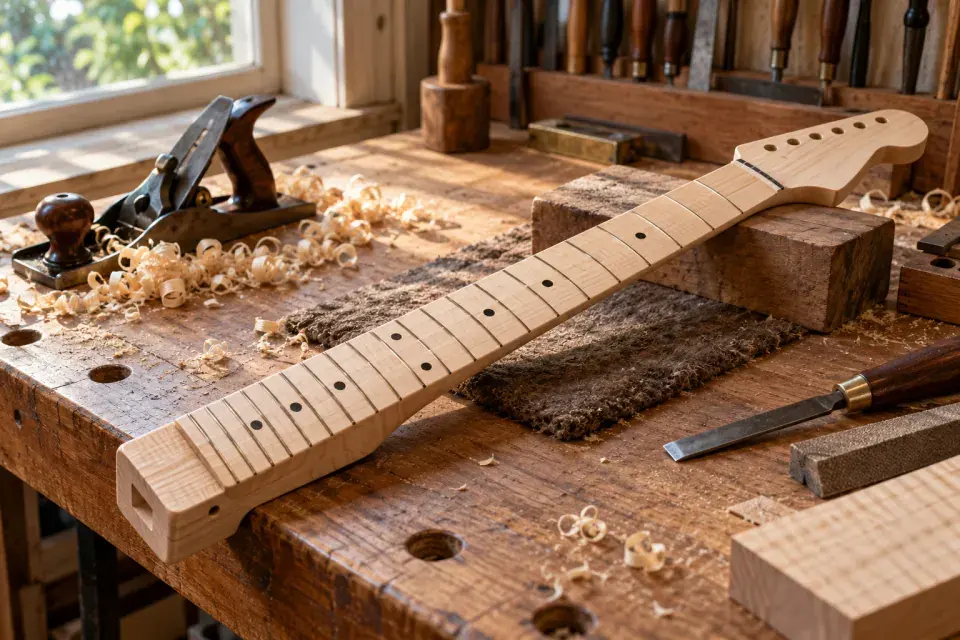
Which wood should you choose?
Hard maple and genuine mahogany are established starting points for guitar necks. The right choice depends on scale length, string load, neck dimensions, reinforcement, and the desired weight. Buy neck-quality stock rather than treating a high species-average stiffness as a guarantee that any board will stay straight.
Practical wood choices
These editorial choices account for the application as well as the numbers. They may differ from the automated property ranking below.
Hard maple
A firm option for bolt-on and other neck designs, with good potential stiffness. Plain, straight-grained stock is easier to evaluate than heavily figured maple. Figure adds visual appeal but can complicate machining and grain assessment.
Species profiles:Sugar mapleBlack maple
Genuine mahogany
Often chosen for relatively light, workable neck stock. Trade names can refer to different timbers, so confirm the species and drying history. The neck profile and reinforcement still need to suit the instrument.
Species profiles:True mahogany
Laminated neck stock
A construction option that can use carefully selected pieces and control grain arrangement. A laminate does not automatically outperform a sound one-piece neck; preparation, adhesive quality, and design determine the result.
What matters for this project
Longitudinal stiffness helps limit deflection, while moisture response affects seasonal relief. Grain runout, local defects, and residual drying stress are not captured by a species average. The truss rod, fretboard, headstock transition, and neck joint all contribute to performance. Choose them as a system rather than as independent upgrades.
What to check before you buy
Ask for stock intended for necks, with enough thickness and length for the actual headstock and heel arrangement. Inspect both faces and both edges for runout and checks. Let the blank acclimate in the workshop before final machining, and plan a second check after rough shaping releases material.
Building and looking after it
Establish stable reference surfaces, rough out in stages, and verify straightness before fitting reinforcement and the fretboard. Maintain sufficient material at transitions and hardware routes. Use a proven design for your first neck. A finish moderates moisture exchange but does not stop seasonal movement completely.
Mistakes to avoid
Do not choose on modulus of elasticity alone or claim that a particular cut guarantees stability. Nor can this ranking predict playing feel or tone. The actual blank and the dimensions of the finished neck can outweigh differences between species.
Property comparison ranking
Density 450–850 kg/m³. Higher modulus of elasticity gives a higher score.
This ranking compares selected properties. Use the practical choices above to check the other requirements of your project.
Species enter when the required fields are present and the rule gives a positive score. An absent wood may lack data or fall outside the scoring range; absence is not proof that it is unsuitable.
The order also uses an editorial availability multiplier, shown in the last column. It changes the order without removing a qualifying species. These scores compare selected properties; they do not evaluate every requirement of the finished project.
| # | Wood | Janka | Density | MOR | MOE | Shrinkage | T/R | Availability |
|---|---|---|---|---|---|---|---|---|
| 1 | Cherrybark oak | 1,480 lbf | 47.6 lb/ft³ | 18,100 lb/in² | 2.28 ×10⁶ lb/in² | — | — | |
| 2 | Merbau | 1,500 lbf | 50.0 lb/ft³ | 16,800 lb/in² | 2.23 ×10⁶ lb/in² | 7.8% | 1.70 | |
| 3 | Mockernut hickory | 1,970 lbf | 50.3 lb/ft³ | 19,200 lb/in² | 2.22 ×10⁶ lb/in² | 17.8% | 1.43 | |
| 4 | Ramin | 1,300 lbf | 39.6 lb/ft³ | 18,500 lb/in² | 2.17 ×10⁶ lb/in² | 13.4% | 2.02 | |
| 5 | Sweet birch | 1,470 lbf | 45.4 lb/ft³ | 16,900 lb/in² | 2.17 ×10⁶ lb/in² | 15.6% | 1.38 | |
| 6 | Shagbark hickory | 1,880 lbf | 50.3 lb/ft³ | 20,200 lb/in² | 2.16 ×10⁶ lb/in² | 16.7% | 1.50 | |
| 7 | Yellow birch | 1,260 lbf | 43.3 lb/ft³ | 16,600 lb/in² | 2.01 ×10⁶ lb/in² | 16.8% | 1.30 | |
| 8 | Longleaf pine | 870 lbf | 41.3 lb/ft³ | 14,500 lb/in² | 1.98 ×10⁶ lb/in² | 12.2% | 1.47 | |
| 9 | Slash pine | 869 lbf* | 41.3 lb/ft³ | 16,300 lb/in² | 1.98 ×10⁶ lb/in² | 12.1% | 1.41 | |
| 10 | Douglas-fir | 645 lbf* | 33.9 lb/ft³ | 12,800 lb/in² | 1.97 ×10⁶ lb/in² | — | — | |
| 11 | Coast Douglas-fir | 710 lbf | 33.6 lb/ft³ | 12,400 lb/in² | 1.95 ×10⁶ lb/in² | 12.4% | 1.58 | |
| 12 | Western larch | 830 lbf | 36.3 lb/ft³ | 13,000 lb/in² | 1.87 ×10⁶ lb/in² | 14.0% | 2.02 | |
| 13 | Sugar maple | 1,450 lbf | 44.1 lb/ft³ | 15,800 lb/in² | 1.83 ×10⁶ lb/in² | 14.7% | 2.06 | |
| 14 | Northern red oak | 1,290 lbf | 44.1 lb/ft³ | 14,300 lb/in² | 1.82 ×10⁶ lb/in² | 13.7% | 2.15 | |
| 15 | Sapele | 1,510 lbf | 42.0 lb/ft³ | 15,300 lb/in² | 1.82 ×10⁶ lb/in² | 14.0% | 1.61 | |
| 16 | Bitternut hickory | 1,461 lbf* | 46.1 lb/ft³ | 17,100 lb/in² | 1.79 ×10⁶ lb/in² | — | — | |
| 17 | Loblolly pine | 690 lbf | 35.6 lb/ft³ | 12,800 lb/in² | 1.79 ×10⁶ lb/in² | 12.3% | 1.54 | |
| 18 | Indian rosewood | 3,170 lbf | 53.0 lb/ft³ | 16,900 lb/in² | 1.78 ×10⁶ lb/in² | 8.5% | 2.15 | |
| 19 | White oak | 1,360 lbf | 47.6 lb/ft³ | 15,200 lb/in² | 1.78 ×10⁶ lb/in² | 16.3% | 1.88 | |
| 20 | Swamp chestnut oak | 1,240 lbf | 46.8 lb/ft³ | 13,900 lb/in² | 1.77 ×10⁶ lb/in² | 16.4% | 2.08 | |
| 21 | Shortleaf pine | 690 lbf | 35.6 lb/ft³ | 13,100 lb/in² | 1.75 ×10⁶ lb/in² | 12.3% | 1.67 | |
| 22 | White ash | 1,320 lbf | 42.0 lb/ft³ | 15,400 lb/in² | 1.74 ×10⁶ lb/in² | 13.3% | 1.59 | |
| 23 | Pecan hickory | 1,820 lbf | 46.1 lb/ft³ | 13,700 lb/in² | 1.73 ×10⁶ lb/in² | 13.6% | 1.82 | |
| 24 | American beech | 1,300 lbf | 44.8 lb/ft³ | 14,900 lb/in² | 1.72 ×10⁶ lb/in² | 17.2% | 2.16 | |
| 25 | Port-Orford cedar | 630 lbf | 30.1 lb/ft³ | 12,700 lb/in² | 1.70 ×10⁶ lb/in² | 10.1% | 1.50 |
Before you choose a board
Use this ranking to compare the properties listed above. Grain direction, defects, moisture content, board dimensions, and construction also affect performance. Check the species page for the original measurements and any estimate marks, then inspect the actual stock you can buy.
The score does not assess decay resistance, food-contact suitability, heat resistance, or structural load capacity. For outdoor work, check durability and treatment requirements separately. For food-contact items and toys, check the intended finish and published safety information.
Read wood allergy and toxicity sourcesHow to read the measurements
Janka compares resistance to indentation. Density is the mass of a given volume of wood. Modulus of rupture (MOR) describes bending strength in a test specimen. Shrinkage figures describe the change from green to oven-dry wood, and T/R compares tangential with radial shrinkage. They are useful for comparison, but do not directly predict seasonal movement in your finished piece.
These are species-level reference values, not a test of the board you are buying or allowable structural design values. Grain, defects, moisture, dimensions, joints, and treatment can change the result. An asterisk beside Janka marks an estimate; open the species page for its source and method. Use the header settings to switch units.
Frequently asked questions
Must a neck be quartersawn?
It is one useful selection approach, but sound flatsawn and laminated necks are also used. Continuous grain, drying, dimensions, and reinforcement deserve equal attention.
Is a truss rod a substitute for good wood?
No. It provides adjustment within a designed neck system. It cannot reliably correct every twist, unstable blank, weak transition, or poorly executed joint.
When should I check a neck blank for movement?
Check it before machining, after the first substantial material removal, and again before final assembly. These checks can reveal a blank that changes shape as drying stress is released. Allow workshop conditions to remain reasonably consistent while evaluating it; repeated straightening without understanding the cause can leave too little material for the intended profile.
Sources and further reading
The application advice is editorial guidance. The references below provide background; each wood's measured values have their own sources on its species page.
- USDA Forest Products Laboratory — Wood Handbook
Background on wood properties, moisture, construction, and finishing.