Best wood for kitchen cabinets
Match the face wood and panel construction to paint, clear finish, and daily use.
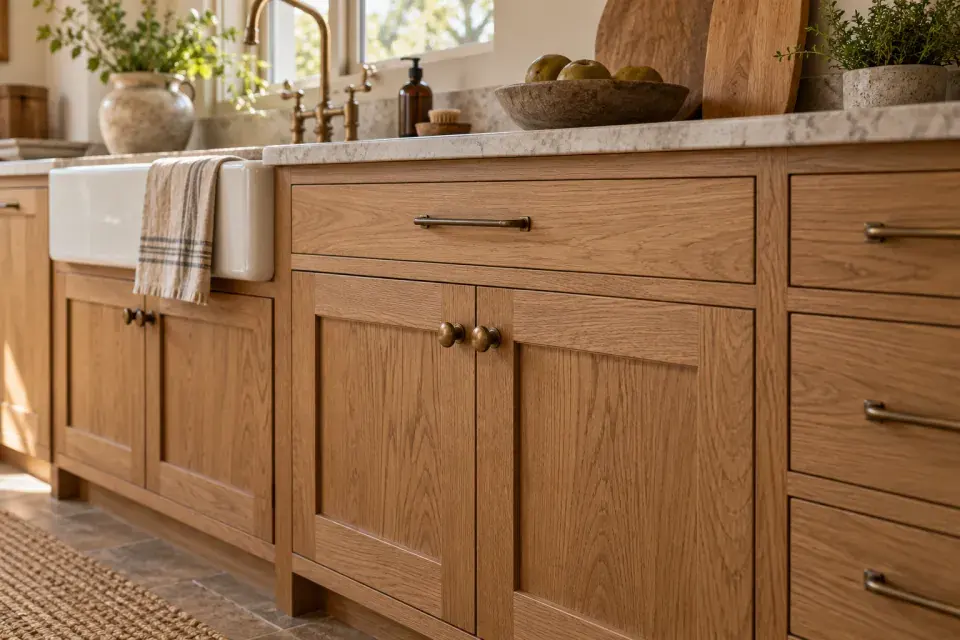
Which wood should you choose?
Maple, oak, and cherry are practical cabinet-face choices, while poplar is useful for many painted frames. Stable sheet goods often make more sense for cabinet boxes and broad panels. Plan the construction and finish first; a cabinet is rarely best made from one species of solid wood throughout.
Practical wood choices
These editorial choices account for the application as well as the numbers. They may differ from the automated property ranking below.
Maple
A fine-textured option for clean-looking doors and frames. Hardness varies by species, and stain can emphasize uneven absorption. Use a full finish sample rather than judging a bare board.
Species profiles:Sugar maple
Oak
A robust choice when visible grain is part of the design. Open pores affect painted and filled finishes. Quartered or rift-cut material can give a different appearance and movement pattern from plain-sawn stock.
Species profiles:White oakNorthern red oak
Cherry
Useful for warm clear-finished cabinetry and detailed profiles. Expect natural color change and board variation. A consistent appearance requires layout planning, especially across a long run of doors.
Species profiles:Black cherry
What matters for this project
A cabinet door does carry loads through its hinges and joints, even if it is not a structural building element. Door size, weight, panel construction, and hinge placement matter. A low shrinkage ratio alone cannot predict whether a wide slab door will stay flat. Painted and clear-finished cabinets also have different surface priorities.
What to check before you buy
Match doors and visible frames from compatible batches, and inspect large samples under the room's lighting. For boxes and panels, compare core quality, face veneer, thickness, and edge treatment. Confirm moisture condition and allow stock to acclimate before machining the final joinery.
Building and looking after it
Use a suitable frame-and-panel or engineered-panel design. Allow floating solid panels to move and select hinges for the finished door's size and weight. Seal and detail edges around sinks and dishwashers carefully. Fit doors after the construction has settled, and follow coating cure times before routine cleaning.
Mistakes to avoid
Do not glue a large solid panel rigidly into a frame or assume all cabinet parts are unloaded. The ranking does not include paint behavior, screw holding, panel flatness, hinge design, or resistance to water at exposed edges.
Property comparison ranking
Janka 650–1,700 lbf. The score favors a lower tangential-to-radial shrinkage ratio.
This ranking compares selected properties. Use the practical choices above to check the other requirements of your project.
Species enter when the required fields are present and the rule gives a positive score. An absent wood may lack data or fall outside the scoring range; absence is not proof that it is unsuitable.
The order also uses an editorial availability multiplier, shown in the last column. It changes the order without removing a qualifying species. These scores compare selected properties; they do not evaluate every requirement of the finished project.
| # | Wood | Janka | Density | MOR | MOE | Shrinkage | T/R | Availability |
|---|---|---|---|---|---|---|---|---|
| 1 | Yellow birch | 1,260 lbf | 43.3 lb/ft³ | 16,600 lb/in² | 2.01 ×10⁶ lb/in² | 16.8% | 1.30 | |
| 2 | Andaman Padauk | 1,630 lbf | 48.9 lb/ft³ | — | — | 6.4% | 1.33 | |
| 3 | Iroko | 1,260 lbf | 43.0 lb/ft³ | 12,400 lb/in² | 1.46 ×10⁶ lb/in² | 8.8% | 1.36 | |
| 4 | Paper birch | 910 lbf | 38.5 lb/ft³ | 12,300 lb/in² | 1.59 ×10⁶ lb/in² | 16.2% | 1.37 | |
| 5 | True mahogany | 800 lbf | 41.0 lb/ft³ | 11,500 lb/in² | 1.50 ×10⁶ lb/in² | 7.8% | 1.37 | |
| 6 | Sweet birch | 1,470 lbf | 45.4 lb/ft³ | 16,900 lb/in² | 2.17 ×10⁶ lb/in² | 15.6% | 1.38 | |
| 7 | Slash pine | 869 lbf* | 41.3 lb/ft³ | 16,300 lb/in² | 1.98 ×10⁶ lb/in² | 12.1% | 1.41 | |
| 8 | Black walnut | 1,010 lbf | 38.5 lb/ft³ | 14,600 lb/in² | 1.68 ×10⁶ lb/in² | 12.8% | 1.42 | |
| 9 | Longleaf pine | 870 lbf | 41.3 lb/ft³ | 14,500 lb/in² | 1.98 ×10⁶ lb/in² | 12.2% | 1.47 | |
| 10 | Loblolly pine | 690 lbf | 35.6 lb/ft³ | 12,800 lb/in² | 1.79 ×10⁶ lb/in² | 12.3% | 1.54 | |
| 11 | Green ash | 1,200 lbf | 39.1 lb/ft³ | 14,100 lb/in² | 1.66 ×10⁶ lb/in² | 12.5% | 1.54 | |
| 12 | Black ash | 850 lbf | 34.3 lb/ft³ | 12,600 lb/in² | 1.60 ×10⁶ lb/in² | 15.2% | 1.56 | |
| 13 | African Padauk | 1,538 lbf* | 46.0 lb/ft³ | 13,900 lb/in² | 1.56 ×10⁶ lb/in² | 7.6% | 1.58 | |
| 14 | Coast Douglas-fir | 710 lbf | 33.6 lb/ft³ | 12,400 lb/in² | 1.95 ×10⁶ lb/in² | 12.4% | 1.58 | |
| 15 | White ash | 1,320 lbf | 42.0 lb/ft³ | 15,400 lb/in² | 1.74 ×10⁶ lb/in² | 13.3% | 1.59 | |
| 16 | Sapele | 1,510 lbf | 42.0 lb/ft³ | 15,300 lb/in² | 1.82 ×10⁶ lb/in² | 14.0% | 1.61 | |
| 17 | Shortleaf pine | 690 lbf | 35.6 lb/ft³ | 13,100 lb/in² | 1.75 ×10⁶ lb/in² | 12.3% | 1.67 | |
| 18 | American sycamore | 770 lbf | 34.3 lb/ft³ | 10,000 lb/in² | 1.42 ×10⁶ lb/in² | 14.1% | 1.68 | |
| 19 | Merbau | 1,500 lbf | 50.0 lb/ft³ | 16,800 lb/in² | 2.23 ×10⁶ lb/in² | 7.8% | 1.70 | |
| 20 | Black tupelo | 810 lbf | 35.0 lb/ft³ | 9,600 lb/in² | 1.20 ×10⁶ lb/in² | 14.4% | 1.71 | |
| 21 | Southern magnolia | 1,020 lbf | 35.0 lb/ft³ | 11,200 lb/in² | 1.40 ×10⁶ lb/in² | 12.3% | 1.22 | |
| 22 | Caribbean pine | 1,240 lbf | 38.0 lb/ft³ | 16,700 lb/in² | 2.24 ×10⁶ lb/in² | 12.9% | 1.24 | |
| 23 | African mahogany | 830 lbf | 32.0 lb/ft³ | 10,700 lb/in² | 1.40 ×10⁶ lb/in² | 8.8% | 1.80 | |
| 24 | Hackberry | 880 lbf | 37.1 lb/ft³ | 11,000 lb/in² | 1.19 ×10⁶ lb/in² | 13.8% | 1.85 | |
| 25 | Tatajuba | 1,660 lbf | 55.1 lb/ft³ | 18,050 lb/in² | 1.68 ×10⁶ lb/in² | 9.5% | 1.41 |
Before you choose a board
Use this ranking to compare the properties listed above. Grain direction, defects, moisture content, board dimensions, and construction also affect performance. Check the species page for the original measurements and any estimate marks, then inspect the actual stock you can buy.
The score does not assess decay resistance, food-contact suitability, heat resistance, or structural load capacity. For outdoor work, check durability and treatment requirements separately. For food-contact items and toys, check the intended finish and published safety information.
Read wood allergy and toxicity sourcesHow to read the measurements
Janka compares resistance to indentation. Density is the mass of a given volume of wood. Modulus of rupture (MOR) describes bending strength in a test specimen. Shrinkage figures describe the change from green to oven-dry wood, and T/R compares tangential with radial shrinkage. They are useful for comparison, but do not directly predict seasonal movement in your finished piece.
These are species-level reference values, not a test of the board you are buying or allowable structural design values. Grain, defects, moisture, dimensions, joints, and treatment can change the result. An asterisk beside Janka marks an estimate; open the species page for its source and method. Use the header settings to switch units.
Frequently asked questions
Is solid wood better than plywood for cabinet boxes?
Quality plywood can provide flat, stable box panels with efficient use of material. Solid wood is valuable for many frames and doors, but is not inherently the better choice for every cabinet part.
What should I use for painted doors?
Choose a construction and substrate intended for the paint system. Fine-textured solid frames and suitable engineered panels can reduce visible grain; test the actual materials and edge preparation.
How should I compare cabinet door samples?
Look at several doors or larger panels under the kitchen’s actual lighting. Check the edge profile, finish texture, grain matching, and the feel of the hardware as well as color. Ask how the finish handles routine cleaning and whether replacement doors can be matched later. A small stain chip cannot represent an entire run of cabinets.
Sources and further reading
The application advice is editorial guidance. The references below provide background; each wood's measured values have their own sources on its species page.
- USDA Forest Products Laboratory — Wood Handbook
Background on wood properties, moisture, construction, and finishing.