Best wood for knife handles and scales
Choose stable scales with sound grain and a secure bond to the tang.
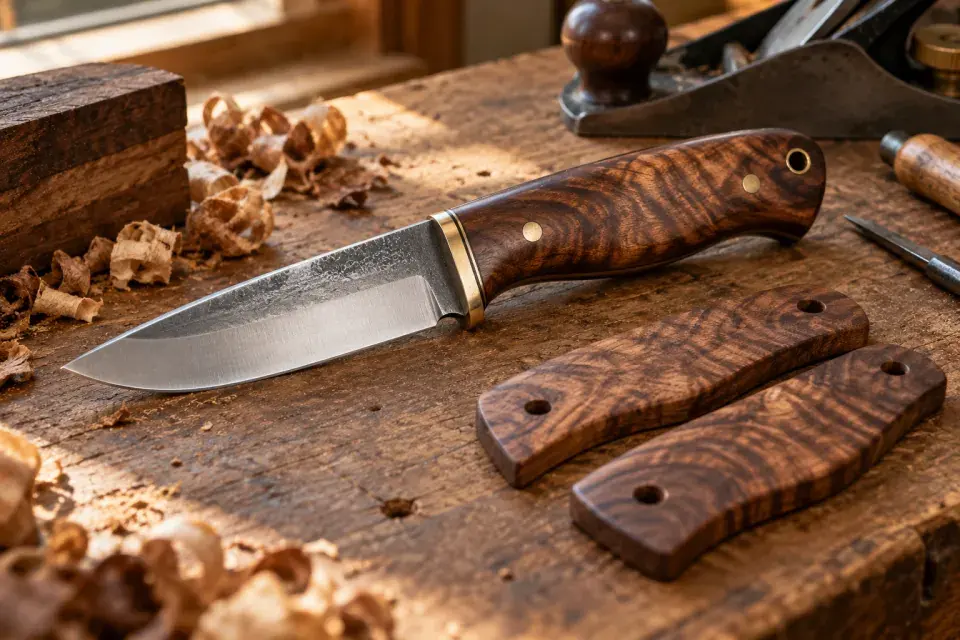
Which wood should you choose?
Walnut, hard maple, and appropriately stabilized figured wood are practical starting points for knife handles. Dense woods such as cocobolo can polish beautifully, but adhesive preparation and sensitizing dust require more consideration. A stable, comfortable handle is usually more useful than the heaviest possible one.
Practical wood choices
These editorial choices account for the application as well as the numbers. They may differ from the automated property ranking below.
Walnut
Easy to shape and comfortable for a balanced handle. It is less dent-resistant than very hard tropical species, but readily available clear stock makes it a sensible first set of scales.
Species profiles:Black walnut
Hard maple
A firm, fine-textured option that suits crisp shaping. Plain straight-grained maple is easier to evaluate than highly figured material. Check that the blank is dry before fitting it to metal.
Species profiles:Sugar mapleBlack maple
Stabilized figured wood
Useful for attractive figure that might otherwise move or absorb moisture. Stabilization quality varies, and resin treatment changes the material; check the supplier's suitability and finishing guidance for the intended knife.
What matters for this project
Think about the whole knife's balance, wet grip, and handle geometry. A glossy dense handle may be slippery, and a decorative burl may contain voids or short grain. Low movement helps keep scales flush with the tang, but adhesive choice, pin placement, and preparation also determine the result.
What to check before you buy
Buy matched scales large enough for final shaping and a little waste. Inspect both sides for cracks, resin voids, and grain runout. Ask whether material is natural, dyed, or stabilized; its treatment changes machining and bonding expectations. For an unfamiliar species, review the site's separate occupational health information.
Building and looking after it
Flatten the mating faces and prepare both wood and tang for the chosen adhesive. Follow its instructions for oily wood and cure time. Use mechanical retention where the design calls for it, soften pressure points, and test the grip before polishing. Keep wood-handled knives out of prolonged soaking.
Mistakes to avoid
Do not assume a high Janka figure proves impact toughness or a waterproof handle. Nor does an attractive polish prove good grip. Cracks crossing a pin hole can become failure points even in a dense species.
Property comparison ranking
Janka at least 1,400 lbf. The score combines hardness divided by 4,000 with lower volumetric shrinkage.
This ranking compares selected properties. Use the practical choices above to check the other requirements of your project.
Species enter when the required fields are present and the rule gives a positive score. An absent wood may lack data or fall outside the scoring range; absence is not proof that it is unsuitable.
The order also uses an editorial availability multiplier, shown in the last column. It changes the order without removing a qualifying species. These scores compare selected properties; they do not evaluate every requirement of the finished project.
| # | Wood | Janka | Density | MOR | MOE | Shrinkage | T/R | Availability |
|---|---|---|---|---|---|---|---|---|
| 1 | Cocobolo | 3,860 lbf* | 69.0 lb/ft³ | — | — | 7.0% | 1.59 | |
| 2 | Indian rosewood | 3,170 lbf | 53.0 lb/ft³ | 16,900 lb/in² | 1.78 ×10⁶ lb/in² | 8.5% | 2.15 | |
| 3 | Ipe | 3,680 lbf | 70.0 lb/ft³ | 25,400 lb/in² | 3.14 ×10⁶ lb/in² | 13.2% | 1.21 | |
| 4 | Cumaru | 3,415 lbf | 66.8 lb/ft³ | 24,371 lb/in² | 2.43 ×10⁶ lb/in² | 13.5% | 1.56 | |
| 5 | Andaman Padauk | 1,630 lbf | 48.9 lb/ft³ | — | — | 6.4% | 1.33 | |
| 6 | African Padauk | 1,538 lbf* | 46.0 lb/ft³ | 13,900 lb/in² | 1.56 ×10⁶ lb/in² | 7.6% | 1.58 | |
| 7 | Merbau | 1,500 lbf | 50.0 lb/ft³ | 16,800 lb/in² | 2.23 ×10⁶ lb/in² | 7.8% | 1.70 | |
| 8 | Canalete | 2,200 lbf | 58.2 lb/ft³ | — | — | 11.6% | 1.85 | |
| 9 | Purpleheart | 1,860 lbf | 58.0 lb/ft³ | 19,200 lb/in² | 2.27 ×10⁶ lb/in² | 9.9% | 1.91 | |
| 10 | Bubinga | 2,690 lbf | 55.9 lb/ft³ | 22,600 lb/in² | 2.48 ×10⁶ lb/in² | 14.2% | 1.45 | |
| 11 | Brazilian rosewood | 2,720 lbf | 64.1 lb/ft³ | 19,000 lb/in² | 1.88 ×10⁶ lb/in² | 8.5% | 1.59 | |
| 12 | Pecan hickory | 1,820 lbf | 46.1 lb/ft³ | 13,700 lb/in² | 1.73 ×10⁶ lb/in² | 13.6% | 1.82 | |
| 13 | Goncalo alves | 2,160 lbf | 67.7 lb/ft³ | 16,600 lb/in² | 2.23 ×10⁶ lb/in² | 10.0% | 1.90 | |
| 14 | Marishballi | 3,570 lbf | 62.0 lb/ft³ | 27,700 lb/in² | 3.34 ×10⁶ lb/in² | 17.2% | 1.56 | |
| 15 | Wallaba | 2,040 lbf | 58.0 lb/ft³ | 19,100 lb/in² | 2.28 ×10⁶ lb/in² | 10.0% | 1.92 | |
| 16 | Azobe | 3,350 lbf | 70.0 lb/ft³ | 24,500 lb/in² | 2.47 ×10⁶ lb/in² | 17.0% | 1.31 | |
| 17 | Sucupira | 2,448 lbf* | 58.7 lb/ft³ | 19,400 lb/in² | — | 13.4% | 1.56 | |
| 18 | Sapele | 1,510 lbf | 42.0 lb/ft³ | 15,300 lb/in² | 1.82 ×10⁶ lb/in² | 14.0% | 1.61 | |
| 19 | Tatajuba | 1,660 lbf | 55.1 lb/ft³ | 18,050 lb/in² | 1.68 ×10⁶ lb/in² | 9.5% | 1.41 | |
| 20 | Black locust | 1,700 lbf | 48.3 lb/ft³ | 19,400 lb/in² | 2.05 ×10⁶ lb/in² | 10.2% | 1.57 | |
| 21 | Macawood | 3,150 lbf | 64.0 lb/ft³ | 27,600 lb/in² | 3.20 ×10⁶ lb/in² | 6.5% | 1.30 | |
| 22 | Shagbark hickory | 1,880 lbf | 50.3 lb/ft³ | 20,200 lb/in² | 2.16 ×10⁶ lb/in² | 16.7% | 1.50 | |
| 23 | Sugar maple | 1,450 lbf | 44.1 lb/ft³ | 15,800 lb/in² | 1.83 ×10⁶ lb/in² | 14.7% | 2.06 | |
| 24 | Afrormosia | 1,560 lbf | 43.0 lb/ft³ | 18,400 lb/in² | 1.94 ×10⁶ lb/in² | 10.7% | 2.13 | |
| 25 | Peroba rosa | 1,730 lbf | 51.5 lb/ft³ | 12,100 lb/in² | 1.53 ×10⁶ lb/in² | 11.6% | 1.68 |
Before you choose a board
Use this ranking to compare the properties listed above. Grain direction, defects, moisture content, board dimensions, and construction also affect performance. Check the species page for the original measurements and any estimate marks, then inspect the actual stock you can buy.
The score does not assess decay resistance, food-contact suitability, heat resistance, or structural load capacity. For outdoor work, check durability and treatment requirements separately. For food-contact items and toys, check the intended finish and published safety information.
Read wood allergy and toxicity sourcesHow to read the measurements
Janka compares resistance to indentation. Density is the mass of a given volume of wood. Modulus of rupture (MOR) describes bending strength in a test specimen. Shrinkage figures describe the change from green to oven-dry wood, and T/R compares tangential with radial shrinkage. They are useful for comparison, but do not directly predict seasonal movement in your finished piece.
These are species-level reference values, not a test of the board you are buying or allowable structural design values. Grain, defects, moisture, dimensions, joints, and treatment can change the result. An asterisk beside Janka marks an estimate; open the species page for its source and method. Use the header settings to switch units.
Frequently asked questions
Do all wood scales need stabilization?
No. Sound, seasoned wood can work well without it. Stabilization is most useful for particular porous, fragile, or highly figured blanks, and it is not a remedy for every structural defect.
Can oily wood be glued?
Often, but use the adhesive manufacturer's preparation method and test the bond. A generic cleaning step is not a substitute for compatibility with the actual wood and adhesive.
How can I test the handle shape before finishing?
Shape a simple mockup or leave the final scales slightly oversized and check the grip in several working positions. Look for pressure points at pins, the butt, and the transition to the blade. A comfortable dry grip is only part of the assessment; the intended use may also require evaluating control with damp hands.
Sources and further reading
The application advice is editorial guidance. The references below provide background; each wood's measured values have their own sources on its species page.
- USDA Forest Products Laboratory — Wood Handbook
Background on wood properties, moisture, construction, and finishing.