Best wood for laser engraving
Choose a known laser-compatible material and test contrast on the actual stock.
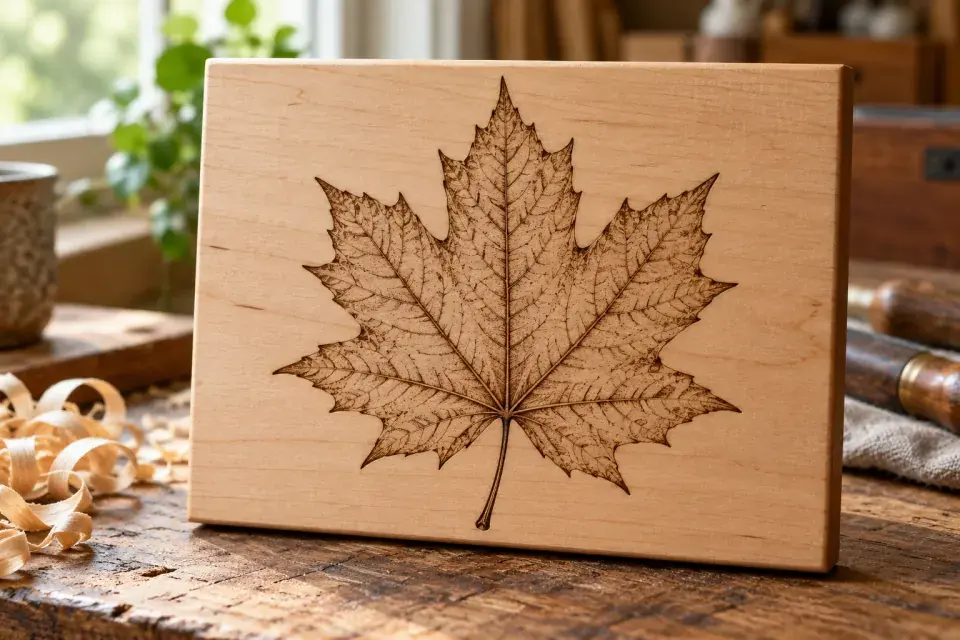
Which wood should you choose?
Maple, basswood, and alder are useful starting points for wood engraving. Pale, relatively even surfaces can make fine marks easier to read, but contrast varies with grain, finish, machine, and settings. Material identification and laser compatibility come before density or appearance.
Practical wood choices
These editorial choices account for the application as well as the numbers. They may differ from the automated property ranking below.
Maple
A pale surface for detailed work, with species and grain variation affecting the result. Fine areas can look clean when the stock and settings are matched. Test the exact board rather than relying on a generic maple preset.
Species profiles:Sugar maple
Basswood
A relatively soft option often used for craft work and test panels. The surface can bruise or fuzz, so preparation matters. Check whether a purchased panel is solid wood or a laminated product.
Species profiles:American basswood
Alder
A workable engraving material that can give useful contrast. Color and grain vary across boards, and resin or defects can interrupt a fine image. Select the visible face before preparing the artwork.
Species profiles:Red alder
What matters for this project
Laser response depends on more than bulk density. Earlywood and latewood can char differently, and coatings, glue lines, or fillers change the process. A pale background helps visible contrast but does not establish machine compatibility. Follow the laser manufacturer's approved-material guidance and extraction requirements.
What to check before you buy
Buy identified, uncoated stock or a panel explicitly documented for the machine and process. Ask about adhesives and surface treatments in sheet products. Avoid unidentified reclaimed, pressure-treated, painted, or resin-filled material unless the exact composition and compatibility have been established.
Building and looking after it
Make a small test grid on an offcut from the same batch and record the successful settings. Keep focus, flatness, and surface preparation consistent. Use the machine's required extraction and fire precautions, supervise operation, and clean residue using an appropriate method before applying any final coating.
Mistakes to avoid
The ranking is not a laser-material approval. Hardness cannot predict emissions, fire behavior, or compatibility with adhesives and coatings. Never assume that a material is suitable simply because the visible face looks like ordinary wood.
Property comparison ranking
Density 380–720 kg/m³. The score combines density near 500 kg/m³ with hardness near 800 lbf; it does not assess color or resin content.
This ranking compares selected properties. Use the practical choices above to check the other requirements of your project.
Species enter when the required fields are present and the rule gives a positive score. An absent wood may lack data or fall outside the scoring range; absence is not proof that it is unsuitable.
The order also uses an editorial availability multiplier, shown in the last column. It changes the order without removing a qualifying species. These scores compare selected properties; they do not evaluate every requirement of the finished project.
| # | Wood | Janka | Density | MOR | MOE | Shrinkage | T/R | Availability |
|---|---|---|---|---|---|---|---|---|
| 1 | Radiata pine | 750 lbf | 31.5 lb/ft³ | 11,700 lb/in² | 1.48 ×10⁶ lb/in² | — | — | |
| 2 | African mahogany | 830 lbf | 32.0 lb/ft³ | 10,700 lb/in² | 1.40 ×10⁶ lb/in² | 8.8% | 1.80 | |
| 3 | Bigleaf maple | 850 lbf | 33.6 lb/ft³ | 10,700 lb/in² | 1.45 ×10⁶ lb/in² | 11.6% | 1.92 | |
| 4 | American sycamore | 770 lbf | 34.3 lb/ft³ | 10,000 lb/in² | 1.42 ×10⁶ lb/in² | 14.1% | 1.68 | |
| 5 | Black tupelo | 810 lbf | 35.0 lb/ft³ | 9,600 lb/in² | 1.20 ×10⁶ lb/in² | 14.4% | 1.71 | |
| 6 | English walnut | 714 lbf* | 33.1 lb/ft³ | — | — | — | — | |
| 7 | Silver maple | 700 lbf | 32.8 lb/ft³ | 8,900 lb/in² | 1.14 ×10⁶ lb/in² | 12.0% | 2.40 | |
| 8 | Black ash | 850 lbf | 34.3 lb/ft³ | 12,600 lb/in² | 1.60 ×10⁶ lb/in² | 15.2% | 1.56 | |
| 9 | American elm | 830 lbf | 35.0 lb/ft³ | 11,800 lb/in² | 1.34 ×10⁶ lb/in² | 14.6% | 2.26 | |
| 10 | Coast Douglas-fir | 710 lbf | 33.6 lb/ft³ | 12,400 lb/in² | 1.95 ×10⁶ lb/in² | 12.4% | 1.58 | |
| 11 | Port-Orford cedar | 630 lbf | 30.1 lb/ft³ | 12,700 lb/in² | 1.70 ×10⁶ lb/in² | 10.1% | 1.50 | |
| 12 | Western larch | 830 lbf | 36.3 lb/ft³ | 13,000 lb/in² | 1.87 ×10⁶ lb/in² | 14.0% | 2.02 | |
| 13 | Sweetgum | 850 lbf | 36.3 lb/ft³ | 12,500 lb/in² | 1.64 ×10⁶ lb/in² | 15.8% | 1.92 | |
| 14 | Eastern redcedar | 615 lbf* | 32.8 lb/ft³ | 8,800 lb/in² | 0.88 ×10⁶ lb/in² | 7.8% | 1.52 | |
| 15 | Scots pine | 621 lbf* | 33.1 lb/ft³ | — | — | — | — | |
| 16 | Douglas-fir | 645 lbf* | 33.9 lb/ft³ | 12,800 lb/in² | 1.97 ×10⁶ lb/in² | — | — | |
| 17 | Western hemlock | 540 lbf | 31.5 lb/ft³ | 11,300 lb/in² | 1.63 ×10⁶ lb/in² | 12.4% | 1.86 | |
| 18 | Jack pine | 570 lbf | 30.1 lb/ft³ | 9,900 lb/in² | 1.35 ×10⁶ lb/in² | 10.3% | 1.78 | |
| 19 | Red pine | 560 lbf | 32.2 lb/ft³ | 11,000 lb/in² | 1.63 ×10⁶ lb/in² | 11.3% | 1.89 | |
| 20 | Loblolly pine | 690 lbf | 35.6 lb/ft³ | 12,800 lb/in² | 1.79 ×10⁶ lb/in² | 12.3% | 1.54 | |
| 21 | Shortleaf pine | 690 lbf | 35.6 lb/ft³ | 13,100 lb/in² | 1.75 ×10⁶ lb/in² | 12.3% | 1.67 | |
| 22 | Black cherry | 950 lbf | 35.0 lb/ft³ | 12,300 lb/in² | 1.49 ×10⁶ lb/in² | 11.5% | 1.92 | |
| 23 | Hackberry | 880 lbf | 37.1 lb/ft³ | 11,000 lb/in² | 1.19 ×10⁶ lb/in² | 13.8% | 1.85 | |
| 24 | Red alder | 590 lbf | 28.7 lb/ft³ | 9,800 lb/in² | 1.38 ×10⁶ lb/in² | 12.6% | 1.66 | |
| 25 | Baldcypress | 510 lbf | 32.2 lb/ft³ | 10,600 lb/in² | 1.44 ×10⁶ lb/in² | — | — |
Before you choose a board
Use this ranking to compare the properties listed above. Grain direction, defects, moisture content, board dimensions, and construction also affect performance. Check the species page for the original measurements and any estimate marks, then inspect the actual stock you can buy.
The score does not assess decay resistance, food-contact suitability, heat resistance, or structural load capacity. For outdoor work, check durability and treatment requirements separately. For food-contact items and toys, check the intended finish and published safety information.
Read wood allergy and toxicity sourcesHow to read the measurements
Janka compares resistance to indentation. Density is the mass of a given volume of wood. Modulus of rupture (MOR) describes bending strength in a test specimen. Shrinkage figures describe the change from green to oven-dry wood, and T/R compares tangential with radial shrinkage. They are useful for comparison, but do not directly predict seasonal movement in your finished piece.
These are species-level reference values, not a test of the board you are buying or allowable structural design values. Grain, defects, moisture, dimensions, joints, and treatment can change the result. An asterisk beside Janka marks an estimate; open the species page for its source and method. Use the header settings to switch units.
Frequently asked questions
Will one preset work for every maple board?
No. Moisture, species, surface, and machine conditions can change the result. A same-batch test is more reliable than reusing settings without checking.
Should I engrave before finishing?
Often that simplifies material identification and cleanup, but follow the machine and finish guidance. Unknown coatings should not be treated as harmless because the substrate is wood.
How do I make results repeatable across a batch?
Keep the stock source, surface preparation, focus, and settings consistent, and test pieces from more than one board. Record which face was used and any masking or cleanup method. Allow for natural grain differences in the artwork rather than expecting every mark to match perfectly. A batch check can reveal variation that a single successful sample misses.
Sources and further reading
The application advice is editorial guidance. The references below provide background; each wood's measured values have their own sources on its species page.
- USDA Forest Products Laboratory — Wood Handbook
Background on wood properties, moisture, construction, and finishing.