Best wood for smoking pipes
Separate traditional pipe materials from woods that merely rank well numerically.
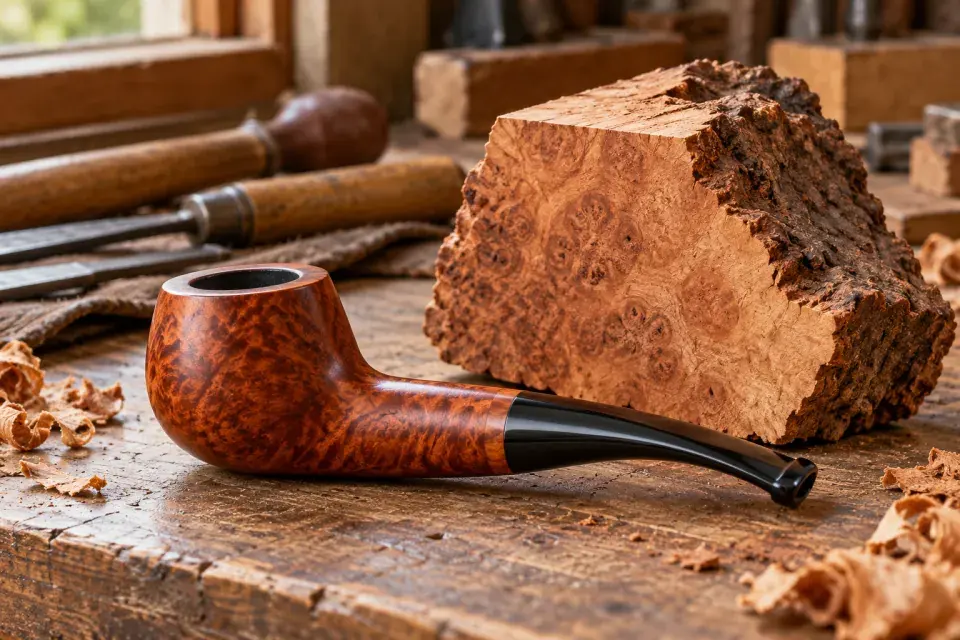
Which wood should you choose?
Briar is the traditional starting material for many wooden smoking-pipe bowls. A dense furniture wood with low shrinkage is not an equivalent substitute. The table below cannot establish suitability for a combustion chamber and should be read only as a comparison of mechanical properties.
Practical wood choices
These editorial choices account for the application as well as the numbers. They may differ from the automated property ranking below.
Prepared briar
Specialist blocks are selected and processed for pipe making. Buy from a supplier who can explain the material's preparation and intended use. Grade may reflect visible defects and figure, but hidden flaws still need inspection.
Traditional alternative materials
Some makers use materials such as meerschaum or corncob, which are outside this wood-property ranking. Their use highlights why hardness and density alone cannot determine bowl suitability.
Practice blanks
Ordinary sound wood can be used to practice shaping an unlit display object. That does not make it appropriate for a working bowl. Keep visual mockups clearly separate from material chosen for actual service.
What matters for this project
A working bowl faces heat, localized combustion, moisture, and repeated cycling. Janka, bulk density, and green-to-dry shrinkage are not heat-performance tests and provide no assessment of substances released during use. Geometry, chamber walls, defects, and preparation are also outside the database. No numerical rank here certifies exposure suitability.
What to check before you buy
Choose identified specialist stock with a documented preparation history rather than an unknown burl. Ask about checks, voids, and the usable area after shaping. Decorative resin-stabilized or dyed blanks are not interchangeable with untreated pipe-making stock. A premium-looking exterior cannot reveal every internal flaw.
Building and looking after it
For material and chamber construction, use an established specialist method and appropriate stock. Inspect the block as material is removed, preserving the intended geometry and rejecting defects that compromise the chamber. Do not rely on a decorative coating to make unsuitable wood withstand combustion.
Mistakes to avoid
Do not recommend random dense woods from this ranking for smoking. The database lacks heat resistance, extractive chemistry, combustion emissions, and pipe-specific performance. Traditional use of a material is also not evidence that smoking is harmless.
Property comparison ranking
Janka at least 1,200 lbf. The score combines low volumetric shrinkage (double weight) with hardness divided by 4,000; it does not assess heat resistance.
This ranking compares selected properties. Use the practical choices above to check the other requirements of your project.
Species enter when the required fields are present and the rule gives a positive score. An absent wood may lack data or fall outside the scoring range; absence is not proof that it is unsuitable.
The order also uses an editorial availability multiplier, shown in the last column. It changes the order without removing a qualifying species. These scores compare selected properties; they do not evaluate every requirement of the finished project.
| # | Wood | Janka | Density | MOR | MOE | Shrinkage | T/R | Availability |
|---|---|---|---|---|---|---|---|---|
| 1 | Cocobolo | 3,860 lbf* | 69.0 lb/ft³ | — | — | 7.0% | 1.59 | |
| 2 | Indian rosewood | 3,170 lbf | 53.0 lb/ft³ | 16,900 lb/in² | 1.78 ×10⁶ lb/in² | 8.5% | 2.15 | |
| 3 | Andaman Padauk | 1,630 lbf | 48.9 lb/ft³ | — | — | 6.4% | 1.33 | |
| 4 | African Padauk | 1,538 lbf* | 46.0 lb/ft³ | 13,900 lb/in² | 1.56 ×10⁶ lb/in² | 7.6% | 1.58 | |
| 5 | Ipe | 3,680 lbf | 70.0 lb/ft³ | 25,400 lb/in² | 3.14 ×10⁶ lb/in² | 13.2% | 1.21 | |
| 6 | Merbau | 1,500 lbf | 50.0 lb/ft³ | 16,800 lb/in² | 2.23 ×10⁶ lb/in² | 7.8% | 1.70 | |
| 7 | Cumaru | 3,415 lbf | 66.8 lb/ft³ | 24,371 lb/in² | 2.43 ×10⁶ lb/in² | 13.5% | 1.56 | |
| 8 | Purpleheart | 1,860 lbf | 58.0 lb/ft³ | 19,200 lb/in² | 2.27 ×10⁶ lb/in² | 9.9% | 1.91 | |
| 9 | Iroko | 1,260 lbf | 43.0 lb/ft³ | 12,400 lb/in² | 1.46 ×10⁶ lb/in² | 8.8% | 1.36 | |
| 10 | Canalete | 2,200 lbf | 58.2 lb/ft³ | — | — | 11.6% | 1.85 | |
| 11 | Brazilian rosewood | 2,720 lbf | 64.1 lb/ft³ | 19,000 lb/in² | 1.88 ×10⁶ lb/in² | 8.5% | 1.59 | |
| 12 | Bubinga | 2,690 lbf | 55.9 lb/ft³ | 22,600 lb/in² | 2.48 ×10⁶ lb/in² | 14.2% | 1.45 | |
| 13 | Goncalo alves | 2,160 lbf | 67.7 lb/ft³ | 16,600 lb/in² | 2.23 ×10⁶ lb/in² | 10.0% | 1.90 | |
| 14 | Pecan hickory | 1,820 lbf | 46.1 lb/ft³ | 13,700 lb/in² | 1.73 ×10⁶ lb/in² | 13.6% | 1.82 | |
| 15 | Wallaba | 2,040 lbf | 58.0 lb/ft³ | 19,100 lb/in² | 2.28 ×10⁶ lb/in² | 10.0% | 1.92 | |
| 16 | Bur oak | 1,370 lbf | 44.8 lb/ft³ | 10,300 lb/in² | 1.03 ×10⁶ lb/in² | 12.7% | 2.00 | |
| 17 | Tatajuba | 1,660 lbf | 55.1 lb/ft³ | 18,050 lb/in² | 1.68 ×10⁶ lb/in² | 9.5% | 1.41 | |
| 18 | Green ash | 1,200 lbf | 39.1 lb/ft³ | 14,100 lb/in² | 1.66 ×10⁶ lb/in² | 12.5% | 1.54 | |
| 19 | Black locust | 1,700 lbf | 48.3 lb/ft³ | 19,400 lb/in² | 2.05 ×10⁶ lb/in² | 10.2% | 1.57 | |
| 20 | White ash | 1,320 lbf | 42.0 lb/ft³ | 15,400 lb/in² | 1.74 ×10⁶ lb/in² | 13.3% | 1.59 | |
| 21 | Ramin | 1,300 lbf | 39.6 lb/ft³ | 18,500 lb/in² | 2.17 ×10⁶ lb/in² | 13.4% | 2.02 | |
| 22 | Sapele | 1,510 lbf | 42.0 lb/ft³ | 15,300 lb/in² | 1.82 ×10⁶ lb/in² | 14.0% | 1.61 | |
| 23 | Macawood | 3,150 lbf | 64.0 lb/ft³ | 27,600 lb/in² | 3.20 ×10⁶ lb/in² | 6.5% | 1.30 | |
| 24 | Northern red oak | 1,290 lbf | 44.1 lb/ft³ | 14,300 lb/in² | 1.82 ×10⁶ lb/in² | 13.7% | 2.15 | |
| 25 | Afrormosia | 1,560 lbf | 43.0 lb/ft³ | 18,400 lb/in² | 1.94 ×10⁶ lb/in² | 10.7% | 2.13 |
Before you choose a board
Use this ranking to compare the properties listed above. Grain direction, defects, moisture content, board dimensions, and construction also affect performance. Check the species page for the original measurements and any estimate marks, then inspect the actual stock you can buy.
The score does not assess decay resistance, food-contact suitability, heat resistance, or structural load capacity. For outdoor work, check durability and treatment requirements separately. For food-contact items and toys, check the intended finish and published safety information.
Read wood allergy and toxicity sourcesHow to read the measurements
Janka compares resistance to indentation. Density is the mass of a given volume of wood. Modulus of rupture (MOR) describes bending strength in a test specimen. Shrinkage figures describe the change from green to oven-dry wood, and T/R compares tangential with radial shrinkage. They are useful for comparison, but do not directly predict seasonal movement in your finished piece.
These are species-level reference values, not a test of the board you are buying or allowable structural design values. Grain, defects, moisture, dimensions, joints, and treatment can change the result. An asterisk beside Janka marks an estimate; open the species page for its source and method. Use the header settings to switch units.
Frequently asked questions
Why is briar not necessarily first in the table?
The dataset and scoring rule were built around general wood properties, not pipe-making criteria. A specialized material may be missing the required figures or poorly represented by them.
Can stabilization make any wood suitable?
No. Resin impregnation changes the material and does not establish suitability near combustion. A stronger or more polishable blank is not evidence of acceptable performance in a chamber.
Does an attractive burl indicate a suitable pipe block?
No. Figure describes appearance and fiber arrangement, not thermal performance or internal integrity. A burl can contain inclusions and checks hidden below a polished face. For a working bowl, start with specialist material and inspect it throughout shaping. Use decorative but unsuitable blanks only for clearly identified nonfunctional display work or practice pieces.
Sources and further reading
The application advice is editorial guidance. The references below provide background; each wood's measured values have their own sources on its species page.
- USDA Forest Products Laboratory — Wood Handbook
Background on wood properties, moisture, construction, and finishing.