Best wood for stair treads
Evaluate the tread as a loaded component with suitable support and traction.
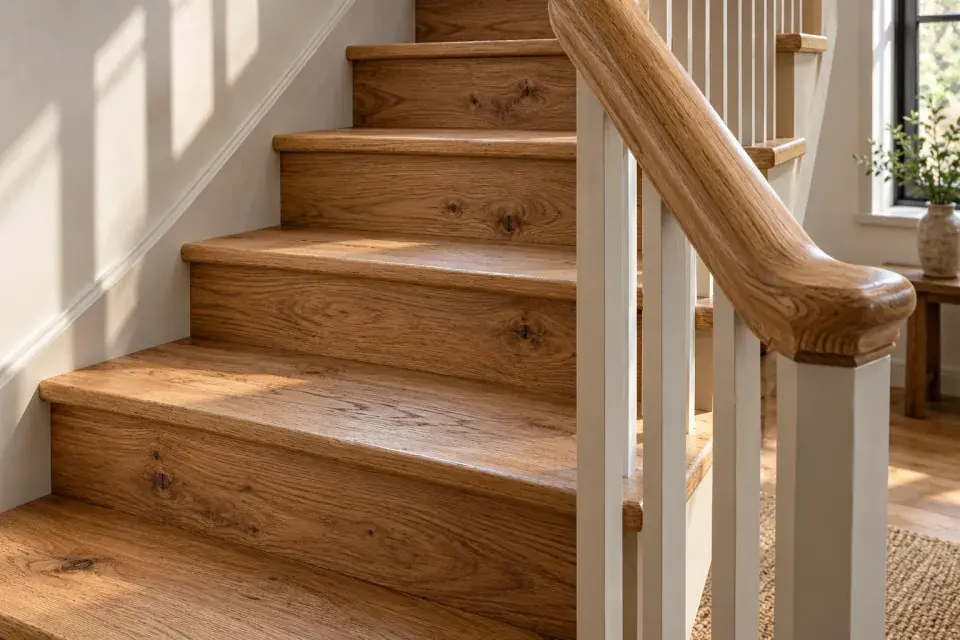
Which wood should you choose?
Oak, hard maple, and hickory are useful tread woods when supplied and installed for the stair design. Hardness helps with wear, but tread dimensions, support, connections, nosing, and finish all affect performance. A finished tread product is often a more reliable starting point than an unspecified rough board.
Practical wood choices
These editorial choices account for the application as well as the numbers. They may differ from the automated property ranking below.
Oak
Commonly available as purpose-made treads, making matching, sizing, and replacement easier. White and red oak differ. Check the actual construction, edge profile, and supplied finish instead of choosing on color alone.
Species profiles:White oakNorthern red oak
Hard maple
A firm pale surface that can suit a restrained interior. Fine grain highlights finish quality and individual marks. Confirm the finish's suitability for stairs and the manufacturer's installation method.
Species profiles:Sugar mapleBlack maple
Hickory
A hard option with prominent variation. It can be demanding to machine and match. Review multiple pieces together so grain and color transitions across the flight are intentional.
Species profiles:Shagbark hickory
What matters for this project
A tread spans supports and receives repeated concentrated loads. Clear-wood strength measurements are not allowable design values for that assembly. Thickness, span, defects, fastening, and the stair configuration need a suitable specification. Surface traction and consistent geometry matter independently of the wood's hardness.
What to check before you buy
Check actual dimensions, construction, nosing, moisture condition, and matching riser or landing products. Verify whether a tread is solid, laminated, or veneered. Avoid assuming that a flooring offcut can substitute directly for a structural tread.
Building and looking after it
Follow the stair design and product installation guidance. Maintain consistent finished geometry, provide the specified support, and use compatible fasteners and adhesives. Allow finishes to cure before traffic. Inspect for looseness, splitting, and worn surface conditions, and address squeaks by finding their cause rather than concealing movement.
Mistakes to avoid
The ranking is not a structural approval or a slip-resistance rating. A very hard wood installed with an unsuitable glossy coating or inadequate support can still be a poor stair choice. Dimensions and connections must come from the design.
Property comparison ranking
Janka at least 1,100 lbf and bending strength at least 13,000 psi. The score combines hardness divided by 4,000 with bending strength divided by 30,000.
This ranking compares selected properties. Use the practical choices above to check the other requirements of your project.
Species enter when the required fields are present and the rule gives a positive score. An absent wood may lack data or fall outside the scoring range; absence is not proof that it is unsuitable.
The order also uses an editorial availability multiplier, shown in the last column. It changes the order without removing a qualifying species. These scores compare selected properties; they do not evaluate every requirement of the finished project.
| # | Wood | Janka | Density | MOR | MOE | Shrinkage | T/R | Availability |
|---|---|---|---|---|---|---|---|---|
| 1 | Ipe | 3,680 lbf | 70.0 lb/ft³ | 25,400 lb/in² | 3.14 ×10⁶ lb/in² | 13.2% | 1.21 | |
| 2 | Cumaru | 3,415 lbf | 66.8 lb/ft³ | 24,371 lb/in² | 2.43 ×10⁶ lb/in² | 13.5% | 1.56 | |
| 3 | Bubinga | 2,690 lbf | 55.9 lb/ft³ | 22,600 lb/in² | 2.48 ×10⁶ lb/in² | 14.2% | 1.45 | |
| 4 | Indian rosewood | 3,170 lbf | 53.0 lb/ft³ | 16,900 lb/in² | 1.78 ×10⁶ lb/in² | 8.5% | 2.15 | |
| 5 | Marishballi | 3,570 lbf | 62.0 lb/ft³ | 27,700 lb/in² | 3.34 ×10⁶ lb/in² | 17.2% | 1.56 | |
| 6 | Azobe | 3,350 lbf | 70.0 lb/ft³ | 24,500 lb/in² | 2.47 ×10⁶ lb/in² | 17.0% | 1.31 | |
| 7 | Shagbark hickory | 1,880 lbf | 50.3 lb/ft³ | 20,200 lb/in² | 2.16 ×10⁶ lb/in² | 16.7% | 1.50 | |
| 8 | Mockernut hickory | 1,970 lbf | 50.3 lb/ft³ | 19,200 lb/in² | 2.22 ×10⁶ lb/in² | 17.8% | 1.43 | |
| 9 | Purpleheart | 1,860 lbf | 58.0 lb/ft³ | 19,200 lb/in² | 2.27 ×10⁶ lb/in² | 9.9% | 1.91 | |
| 10 | East African Olive | 2,740 lbf | 55.0 lb/ft³ | 25,300 lb/in² | 2.53 ×10⁶ lb/in² | — | — | |
| 11 | African ebony | 3,220 lbf | 63.0 lb/ft³ | 21,200 lb/in² | — | 20.0% | 1.17 | |
| 12 | Greenheart | 2,350 lbf | 64.1 lb/ft³ | 24,900 lb/in² | 3.25 ×10⁶ lb/in² | 17.1% | 1.09 | |
| 13 | Jarrah | 1,910 lbf | 54.0 lb/ft³ | 16,200 lb/in² | 1.88 ×10⁶ lb/in² | 18.7% | 1.43 | |
| 14 | Kamassi | 2,730 lbf | 58.0 lb/ft³ | 20,970 lb/in² | 2.54 ×10⁶ lb/in² | — | — | |
| 15 | Keruing | 1,270 lbf | 54.2 lb/ft³ | 19,900 lb/in² | 2.07 ×10⁶ lb/in² | 16.1% | 2.10 | |
| 16 | Cherrybark oak | 1,480 lbf | 47.6 lb/ft³ | 18,100 lb/in² | 2.28 ×10⁶ lb/in² | — | — | |
| 17 | Panga Panga | 1,630 lbf | 55.0 lb/ft³ | 16,200 lb/in² | 1.97 ×10⁶ lb/in² | — | 1.87 | |
| 18 | Brazilian rosewood | 2,720 lbf | 64.1 lb/ft³ | 19,000 lb/in² | 1.88 ×10⁶ lb/in² | 8.5% | 1.59 | |
| 19 | Ramin | 1,300 lbf | 39.6 lb/ft³ | 18,500 lb/in² | 2.17 ×10⁶ lb/in² | 13.4% | 2.02 | |
| 20 | Bitternut hickory | 1,461 lbf* | 46.1 lb/ft³ | 17,100 lb/in² | 1.79 ×10⁶ lb/in² | — | — | |
| 21 | Merbau | 1,500 lbf | 50.0 lb/ft³ | 16,800 lb/in² | 2.23 ×10⁶ lb/in² | 7.8% | 1.70 | |
| 22 | Sweet birch | 1,470 lbf | 45.4 lb/ft³ | 16,900 lb/in² | 2.17 ×10⁶ lb/in² | 15.6% | 1.38 | |
| 23 | Pecan hickory | 1,820 lbf | 46.1 lb/ft³ | 13,700 lb/in² | 1.73 ×10⁶ lb/in² | 13.6% | 1.82 | |
| 24 | Sucupira | 2,448 lbf* | 58.7 lb/ft³ | 19,400 lb/in² | — | 13.4% | 1.56 | |
| 25 | Sugar maple | 1,450 lbf | 44.1 lb/ft³ | 15,800 lb/in² | 1.83 ×10⁶ lb/in² | 14.7% | 2.06 |
Before you choose a board
Use this ranking to compare the properties listed above. Grain direction, defects, moisture content, board dimensions, and construction also affect performance. Check the species page for the original measurements and any estimate marks, then inspect the actual stock you can buy.
The score does not assess decay resistance, food-contact suitability, heat resistance, or structural load capacity. For outdoor work, check durability and treatment requirements separately. For food-contact items and toys, check the intended finish and published safety information.
Read wood allergy and toxicity sourcesHow to read the measurements
Janka compares resistance to indentation. Density is the mass of a given volume of wood. Modulus of rupture (MOR) describes bending strength in a test specimen. Shrinkage figures describe the change from green to oven-dry wood, and T/R compares tangential with radial shrinkage. They are useful for comparison, but do not directly predict seasonal movement in your finished piece.
These are species-level reference values, not a test of the board you are buying or allowable structural design values. Grain, defects, moisture, dimensions, joints, and treatment can change the result. An asterisk beside Janka marks an estimate; open the species page for its source and method. Use the header settings to switch units.
Frequently asked questions
Does a harder tread last longer?
It may resist dents better, but finish wear, grit, support, and maintenance influence service life. A sound ordinary tread can outlast a poorly installed harder one.
Can I use glued-up treads?
Suitable manufactured or well-specified laminated treads can work. Their construction and installation must match the intended application; a generic panel glue-up is not automatically a rated tread.
How should landing material relate to the treads?
Coordinate appearance and finished geometry, but specify each component for its own construction. A landing may use flooring over a supported subfloor while a tread spans stair supports. Similar color does not mean the products are interchangeable. Check transitions, nosing details, and finish compatibility before buying so the completed flight remains consistent and the materials suit their respective loads.
Sources and further reading
The application advice is editorial guidance. The references below provide background; each wood's measured values have their own sources on its species page.
- USDA Forest Products Laboratory — Wood Handbook
Background on wood properties, moisture, construction, and finishing.