Best wood for turning bowls
Match the blank's grain, drying history, and defects to your bowl design.
Which wood should you choose?
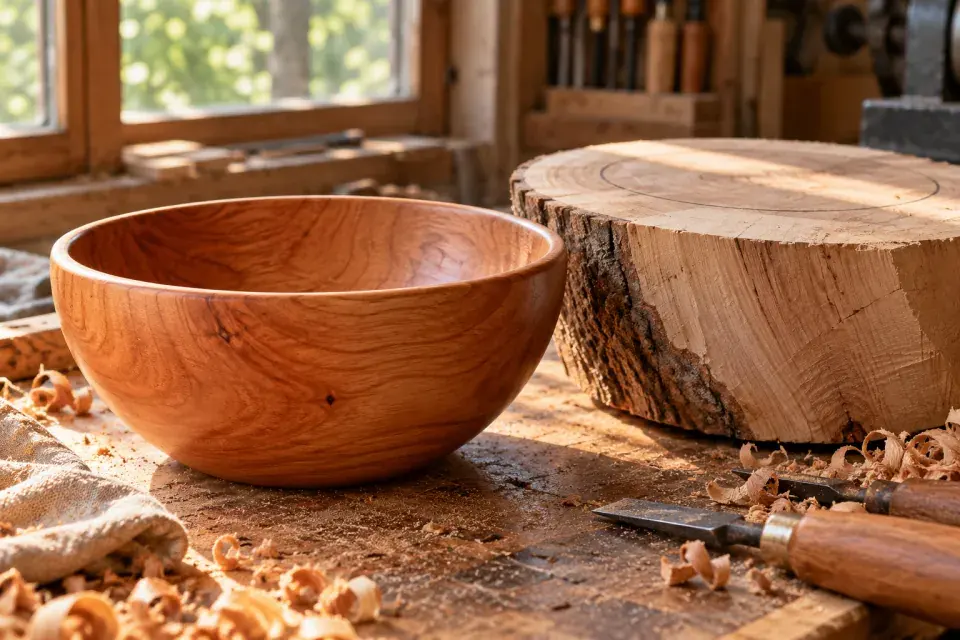
Cherry, maple, and walnut are useful bowl woods with different cutting feel and appearance. For a first bowl, a sound, evenly dried blank is a better investment than dramatic figure. Green turning adds another decision: whether to accept drying distortion or rough-turn and finish after the blank stabilizes.
Practical wood choices
These editorial choices account for the application as well as the numbers. They may differ from the automated property ranking below.
Cherry
A versatile bowl timber that can cut cleanly and develops a warm color. Choose clear stock while learning tool presentation. Natural color differences may become more prominent after exposure to light.
Species profiles:Black cherry
Maple
Suitable for pale bowls and figured work, with substantial variation between species and blanks. Hard maple takes more cutting effort than softer maples. Figure may increase tearout even when the wood is sound.
Species profiles:Sugar maple
Walnut
Offers dark color and generally manageable machining. Sapwood contrast can be part of the design. Check bark inclusions and hidden checks rather than allowing appearance to decide the purchase.
Species profiles:Black walnut
What matters for this project
A low tangential-to-radial shrinkage ratio suggests more even directional movement, but does not guarantee a round bowl or prevent cracking. Total shrinkage, grain orientation, wall thickness, moisture gradients, and defects all matter. A bowl with the pith through its center has different drying risks from a blank cut clear of it.
What to check before you buy
Ask whether the blank is green, air-dried, or kiln-dried and whether the stated size includes a wax coating or damaged edges. Inspect the end grain closely. Large natural-edge and burled blanks can hide voids; leave them until you can evaluate mounting and balance confidently.
Building and looking after it
Use an appropriate secure mounting method and follow lathe and tool guidance. Remove defective material before increasing speed. For two-stage turning, rough the bowl with reasonably even walls, dry it gradually, then remount and finish. For once-turned green bowls, expect some distortion and design around it.
Mistakes to avoid
Do not rank blank safety by species. A crack, loose inclusion, or poor mounting can dominate every property in the table. The ratio also says nothing about food-contact suitability if the bowl will be used for serving.
Property comparison ranking
Janka 600–2,200 lbf. The score favors a lower tangential-to-radial shrinkage ratio.
This ranking compares selected properties. Use the practical choices above to check the other requirements of your project.
Species enter when the required fields are present and the rule gives a positive score. An absent wood may lack data or fall outside the scoring range; absence is not proof that it is unsuitable.
The order also uses an editorial availability multiplier, shown in the last column. It changes the order without removing a qualifying species. These scores compare selected properties; they do not evaluate every requirement of the finished project.
| # | Wood | Janka | Density | MOR | MOE | Shrinkage | T/R | Availability |
|---|---|---|---|---|---|---|---|---|
| 1 | Yellow birch | 1,260 lbf | 43.3 lb/ft³ | 16,600 lb/in² | 2.01 ×10⁶ lb/in² | 16.8% | 1.30 | |
| 2 | Andaman Padauk | 1,630 lbf | 48.9 lb/ft³ | — | — | 6.4% | 1.33 | |
| 3 | Iroko | 1,260 lbf | 43.0 lb/ft³ | 12,400 lb/in² | 1.46 ×10⁶ lb/in² | 8.8% | 1.36 | |
| 4 | Paper birch | 910 lbf | 38.5 lb/ft³ | 12,300 lb/in² | 1.59 ×10⁶ lb/in² | 16.2% | 1.37 | |
| 5 | True mahogany | 800 lbf | 41.0 lb/ft³ | 11,500 lb/in² | 1.50 ×10⁶ lb/in² | 7.8% | 1.37 | |
| 6 | Sweet birch | 1,470 lbf | 45.4 lb/ft³ | 16,900 lb/in² | 2.17 ×10⁶ lb/in² | 15.6% | 1.38 | |
| 7 | Slash pine | 869 lbf* | 41.3 lb/ft³ | 16,300 lb/in² | 1.98 ×10⁶ lb/in² | 12.1% | 1.41 | |
| 8 | Black walnut | 1,010 lbf | 38.5 lb/ft³ | 14,600 lb/in² | 1.68 ×10⁶ lb/in² | 12.8% | 1.42 | |
| 9 | Jarrah | 1,910 lbf | 54.0 lb/ft³ | 16,200 lb/in² | 1.88 ×10⁶ lb/in² | 18.7% | 1.43 | |
| 10 | Mockernut hickory | 1,970 lbf | 50.3 lb/ft³ | 19,200 lb/in² | 2.22 ×10⁶ lb/in² | 17.8% | 1.43 | |
| 11 | Longleaf pine | 870 lbf | 41.3 lb/ft³ | 14,500 lb/in² | 1.98 ×10⁶ lb/in² | 12.2% | 1.47 | |
| 12 | Shagbark hickory | 1,880 lbf | 50.3 lb/ft³ | 20,200 lb/in² | 2.16 ×10⁶ lb/in² | 16.7% | 1.50 | |
| 13 | Spanish-cedar | 600 lbf | 35.0 lb/ft³ | 11,500 lb/in² | 1.44 ×10⁶ lb/in² | 10.3% | 1.50 | |
| 14 | Port-Orford cedar | 630 lbf | 30.1 lb/ft³ | 12,700 lb/in² | 1.70 ×10⁶ lb/in² | 10.1% | 1.50 | |
| 15 | Eastern redcedar | 615 lbf* | 32.8 lb/ft³ | 8,800 lb/in² | 0.88 ×10⁶ lb/in² | 7.8% | 1.52 | |
| 16 | Loblolly pine | 690 lbf | 35.6 lb/ft³ | 12,800 lb/in² | 1.79 ×10⁶ lb/in² | 12.3% | 1.54 | |
| 17 | Green ash | 1,200 lbf | 39.1 lb/ft³ | 14,100 lb/in² | 1.66 ×10⁶ lb/in² | 12.5% | 1.54 | |
| 18 | Black ash | 850 lbf | 34.3 lb/ft³ | 12,600 lb/in² | 1.60 ×10⁶ lb/in² | 15.2% | 1.56 | |
| 19 | African Padauk | 1,538 lbf* | 46.0 lb/ft³ | 13,900 lb/in² | 1.56 ×10⁶ lb/in² | 7.6% | 1.58 | |
| 20 | Coast Douglas-fir | 710 lbf | 33.6 lb/ft³ | 12,400 lb/in² | 1.95 ×10⁶ lb/in² | 12.4% | 1.58 | |
| 21 | White ash | 1,320 lbf | 42.0 lb/ft³ | 15,400 lb/in² | 1.74 ×10⁶ lb/in² | 13.3% | 1.59 | |
| 22 | Sapele | 1,510 lbf | 42.0 lb/ft³ | 15,300 lb/in² | 1.82 ×10⁶ lb/in² | 14.0% | 1.61 | |
| 23 | Shortleaf pine | 690 lbf | 35.6 lb/ft³ | 13,100 lb/in² | 1.75 ×10⁶ lb/in² | 12.3% | 1.67 | |
| 24 | American sycamore | 770 lbf | 34.3 lb/ft³ | 10,000 lb/in² | 1.42 ×10⁶ lb/in² | 14.1% | 1.68 | |
| 25 | Merbau | 1,500 lbf | 50.0 lb/ft³ | 16,800 lb/in² | 2.23 ×10⁶ lb/in² | 7.8% | 1.70 |
Before you choose a board
Use this ranking to compare the properties listed above. Grain direction, defects, moisture content, board dimensions, and construction also affect performance. Check the species page for the original measurements and any estimate marks, then inspect the actual stock you can buy.
The score does not assess decay resistance, food-contact suitability, heat resistance, or structural load capacity. For outdoor work, check durability and treatment requirements separately. For food-contact items and toys, check the intended finish and published safety information.
Read wood allergy and toxicity sourcesHow to read the measurements
Janka compares resistance to indentation. Density is the mass of a given volume of wood. Modulus of rupture (MOR) describes bending strength in a test specimen. Shrinkage figures describe the change from green to oven-dry wood, and T/R compares tangential with radial shrinkage. They are useful for comparison, but do not directly predict seasonal movement in your finished piece.
These are species-level reference values, not a test of the board you are buying or allowable structural design values. Grain, defects, moisture, dimensions, joints, and treatment can change the result. An asterisk beside Janka marks an estimate; open the species page for its source and method. Use the header settings to switch units.
Frequently asked questions
Is green wood better for bowls?
It can be easier to cut and makes large blanks affordable, but drying is part of the project. Dry stock is more predictable for final dimensions, although thick dry blanks cost more.
Why did a low-shrinkage bowl crack?
Species averages cannot describe every moisture gradient or defect. Uneven thickness, pith, rapid drying, and an existing check can still lead to cracking.
Should I keep the bark edge on a bowl?
A natural edge is a design choice that requires sound material and appropriate turning technique. Bark can separate during machining or later use. Inspect its attachment and any underlying defects before deciding on the outline, and do not treat a visually continuous bark ring as proof that every part of it is securely bonded to the wood.
Sources and further reading
The application advice is editorial guidance. The references below provide background; each wood's measured values have their own sources on its species page.
- USDA Forest Products Laboratory — Wood Handbook
Background on wood properties, moisture, construction, and finishing.