Best wood for workbench tops
Balance a flat, repairable work surface with mass and reliable workholding.
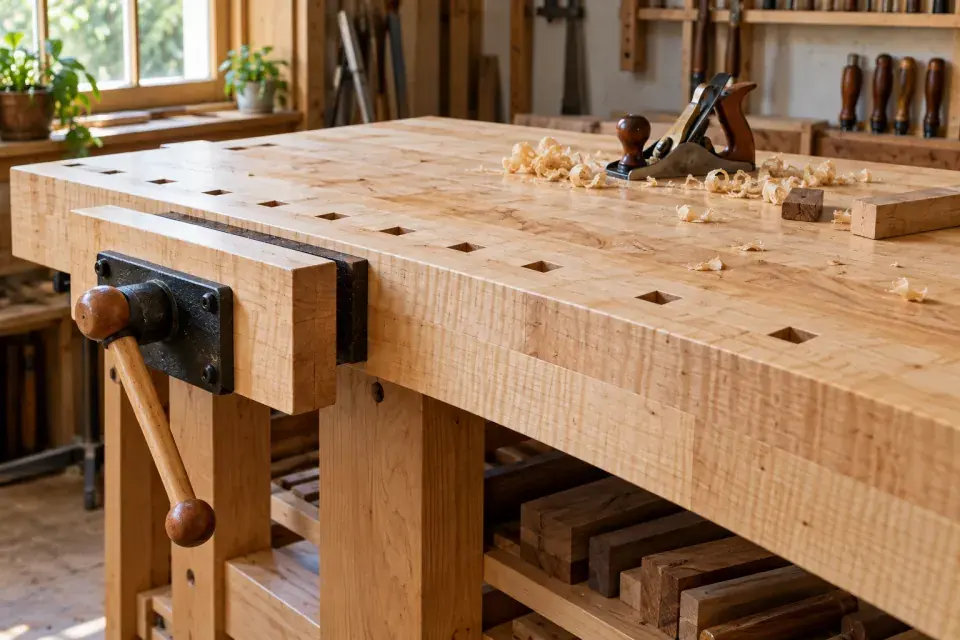
Which wood should you choose?
Hard maple and beech make durable traditional bench tops. Dry construction softwood can also make an excellent affordable bench when the design provides enough thickness and mass. Choose for your workholding and repair needs, rather than seeking a surface that will never dent.
Practical wood choices
These editorial choices account for the application as well as the numbers. They may differ from the automated property ranking below.
Hard maple
A firm, fine-textured top that tolerates daily use and cleanly machined dog holes. It is heavy and can be expensive in thick stock. Laminating narrower pieces often makes the material easier to source.
Species profiles:Sugar mapleBlack maple
Beech
A familiar bench material where readily available. It machines well for a substantial top but needs dry stock and movement allowance. Seasonal flatness still needs attention.
Species profiles:American beechEuropean beech
Dry softwood
A useful budget option for a thick laminated bench. Its surface dents more readily, which can be acceptable when protecting workpieces matters. Select clear pieces and remove unstable pith rather than using every part of a framing board.
What matters for this project
A bench top serves workholding first. Plan the vise, dog holes, holdfasts, overhang, and understructure before buying wood. Tool compatibility can dictate top thickness. Hardness helps resist dents but does not guarantee a flat top or a rigid bench; lamination, moisture condition, and the base carry much of that responsibility.
What to check before you buy
Compare the cost per usable dry strip, allowing for milling and defect removal. Thick stock can hide moisture gradients. Check straightness after rough milling and allow the pieces to settle before final glue-up. Avoid laminations with loose knots at dog holes or the working edge.
Building and looking after it
Prepare close-fitting joints and keep laminations aligned during glue-up. Flatten after the top has settled on its base. Connect the top so that width can change without splitting, and leave access for future vise maintenance. Choose a finish that suits grip and repair rather than a slippery decorative coating.
Mistakes to avoid
Crushing strength parallel to grain is not a direct test of a hammer dent across the face. Treat the ranking as a comparison of available properties, not a complete workbench specification. A very hard top may damage a dropped workpiece before it dents itself.
Property comparison ranking
Janka at least 950 lbf. The score combines hardness divided by 4,000 and crushing strength divided by 15,000.
This ranking compares selected properties. Use the practical choices above to check the other requirements of your project.
Species enter when the required fields are present and the rule gives a positive score. An absent wood may lack data or fall outside the scoring range; absence is not proof that it is unsuitable.
The order also uses an editorial availability multiplier, shown in the last column. It changes the order without removing a qualifying species. These scores compare selected properties; they do not evaluate every requirement of the finished project.
| # | Wood | Janka | Density | MOR | MOE | Shrinkage | T/R | Availability |
|---|---|---|---|---|---|---|---|---|
| 1 | Cumaru | 3,415 lbf | 66.8 lb/ft³ | 24,371 lb/in² | 2.43 ×10⁶ lb/in² | 13.5% | 1.56 | |
| 2 | Ipe | 3,680 lbf | 70.0 lb/ft³ | 25,400 lb/in² | 3.14 ×10⁶ lb/in² | 13.2% | 1.21 | |
| 3 | Indian rosewood | 3,170 lbf | 53.0 lb/ft³ | 16,900 lb/in² | 1.78 ×10⁶ lb/in² | 8.5% | 2.15 | |
| 4 | Bubinga | 2,690 lbf | 55.9 lb/ft³ | 22,600 lb/in² | 2.48 ×10⁶ lb/in² | 14.2% | 1.45 | |
| 5 | Lignumvitae | 4,500 lbf | 80.0 lb/ft³ | — | — | — | — | |
| 6 | Marishballi | 3,570 lbf | 62.0 lb/ft³ | 27,700 lb/in² | 3.34 ×10⁶ lb/in² | 17.2% | 1.56 | |
| 7 | Azobe | 3,350 lbf | 70.0 lb/ft³ | 24,500 lb/in² | 2.47 ×10⁶ lb/in² | 17.0% | 1.31 | |
| 8 | Purpleheart | 1,860 lbf | 58.0 lb/ft³ | 19,200 lb/in² | 2.27 ×10⁶ lb/in² | 9.9% | 1.91 | |
| 9 | Mockernut hickory | 1,970 lbf | 50.3 lb/ft³ | 19,200 lb/in² | 2.22 ×10⁶ lb/in² | 17.8% | 1.43 | |
| 10 | Shagbark hickory | 1,880 lbf | 50.3 lb/ft³ | 20,200 lb/in² | 2.16 ×10⁶ lb/in² | 16.7% | 1.50 | |
| 11 | East African Olive | 2,740 lbf | 55.0 lb/ft³ | 25,300 lb/in² | 2.53 ×10⁶ lb/in² | — | — | |
| 12 | Panga Panga | 1,630 lbf | 55.0 lb/ft³ | 16,200 lb/in² | 1.97 ×10⁶ lb/in² | — | 1.87 | |
| 13 | Jarrah | 1,910 lbf | 54.0 lb/ft³ | 16,200 lb/in² | 1.88 ×10⁶ lb/in² | 18.7% | 1.43 | |
| 14 | African ebony | 3,220 lbf | 63.0 lb/ft³ | 21,200 lb/in² | — | 20.0% | 1.17 | |
| 15 | Greenheart | 2,350 lbf | 64.1 lb/ft³ | 24,900 lb/in² | 3.25 ×10⁶ lb/in² | 17.1% | 1.09 | |
| 16 | Keruing | 1,270 lbf | 54.2 lb/ft³ | 19,900 lb/in² | 2.07 ×10⁶ lb/in² | 16.1% | 2.10 | |
| 17 | Rhodesian-Teak | 2,990 lbf | 56.0 lb/ft³ | 12,220 lb/in² | 1.23 ×10⁶ lb/in² | — | — | |
| 18 | Ramin | 1,300 lbf | 39.6 lb/ft³ | 18,500 lb/in² | 2.17 ×10⁶ lb/in² | 13.4% | 2.02 | |
| 19 | Kamassi | 2,730 lbf | 58.0 lb/ft³ | 20,970 lb/in² | 2.54 ×10⁶ lb/in² | — | — | |
| 20 | Pecan hickory | 1,820 lbf | 46.1 lb/ft³ | 13,700 lb/in² | 1.73 ×10⁶ lb/in² | 13.6% | 1.82 | |
| 21 | Sucupira | 2,448 lbf* | 58.7 lb/ft³ | 19,400 lb/in² | — | 13.4% | 1.56 | |
| 22 | Bitternut hickory | 1,461 lbf* | 46.1 lb/ft³ | 17,100 lb/in² | 1.79 ×10⁶ lb/in² | — | — | |
| 23 | Cherrybark oak | 1,480 lbf | 47.6 lb/ft³ | 18,100 lb/in² | 2.28 ×10⁶ lb/in² | — | — | |
| 24 | Brazilian rosewood | 2,720 lbf | 64.1 lb/ft³ | 19,000 lb/in² | 1.88 ×10⁶ lb/in² | 8.5% | 1.59 | |
| 25 | East Indian Satinwood | 2,600 lbf | 61.0 lb/ft³ | 16,500 lb/in² | 2.02 ×10⁶ lb/in² | — | 1.29 |
Before you choose a board
Use this ranking to compare the properties listed above. Grain direction, defects, moisture content, board dimensions, and construction also affect performance. Check the species page for the original measurements and any estimate marks, then inspect the actual stock you can buy.
The score does not assess decay resistance, food-contact suitability, heat resistance, or structural load capacity. For outdoor work, check durability and treatment requirements separately. For food-contact items and toys, check the intended finish and published safety information.
Read wood allergy and toxicity sourcesHow to read the measurements
Janka compares resistance to indentation. Density is the mass of a given volume of wood. Modulus of rupture (MOR) describes bending strength in a test specimen. Shrinkage figures describe the change from green to oven-dry wood, and T/R compares tangential with radial shrinkage. They are useful for comparison, but do not directly predict seasonal movement in your finished piece.
These are species-level reference values, not a test of the board you are buying or allowable structural design values. Grain, defects, moisture, dimensions, joints, and treatment can change the result. An asterisk beside Janka marks an estimate; open the species page for its source and method. Use the header settings to switch units.
Frequently asked questions
Is a softwood bench a compromise?
It can be the right choice for budget, availability, and easy repair. Sufficient mass, good joinery, and dependable workholding matter more than a premium species name.
Will a laminated top stop moving?
No. Lamination can make large stock easier to assemble and select, but a solid-wood top still responds to humidity. Its connection to the base must allow that movement.
Should I replace a bench top when it becomes dented?
Normal dents and cuts are expected on a working bench. First assess whether the top remains flat enough for your work and whether the workholding still functions. Local repairs or occasional flattening may restore it. Replacement makes more sense when damage compromises dog holes, vise mounting, or the remaining thickness required by the design.
Sources and further reading
The application advice is editorial guidance. The references below provide background; each wood's measured values have their own sources on its species page.
- USDA Forest Products Laboratory — Wood Handbook
Background on wood properties, moisture, construction, and finishing.