Best wood for boat building
Specify each boat part separately: planking, frames, spars, and brightwork differ.
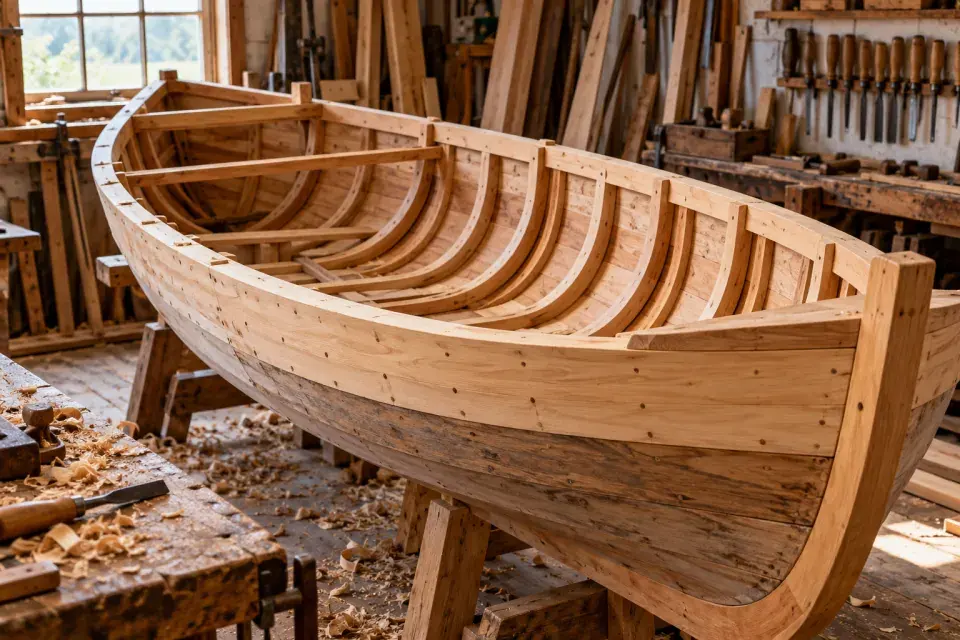
Which wood should you choose?
There is no single best boat wood. Cedar is useful for some lightweight planking systems, white oak for suitable frames, and marine plywood for designs built around sheet construction. Select the timber named by a proven boat design before using a general property table to compare alternatives.
Practical wood choices
These editorial choices account for the application as well as the numbers. They may differ from the automated property ranking below.
Cedar
Useful in particular lightweight strip and planking methods. Species and construction system matter, as does the protective laminate or coating where specified. Softness affects handling, fastening, and resistance to local damage.
Species profiles:Western redcedar
White oak
A traditional candidate for certain frames and structural parts. It is heavy and must be selected and joined for the chosen building method. Adhesive compatibility and bending requirements deserve specific attention.
Species profiles:White oak
Marine plywood
A panel product for suitable plywood boat designs. Check the actual standard, core quality, species, and design requirements. A marine label does not make exposed edges permanently waterproof.
What matters for this project
Separate stiffness, bending strength, decay resistance, fastener behavior, and weight. A good hull-planking timber may be unsuitable for a spar or frame. Species averages also omit knots, grain slope, glue bond quality, and the stresses at joints. The designer's scantlings and construction method provide the needed context.
What to check before you buy
Use suppliers familiar with the intended marine application. Ask for appropriate lengths, grain, moisture condition, and grade. For bent parts, confirm the stock's suitability before purchasing kiln-dried material. For plywood, inspect edges and verify the declared standard rather than relying on a decorative face.
Building and looking after it
Follow a proven plan, including adhesives, fasteners, coatings, drainage, and ventilation. Seal and maintain edges and penetrations according to the construction system. Allow inspection access where possible. Substitutions in structural parts should be assessed against the design rather than made from a ranked list.
Mistakes to avoid
Low shrinkage and high bending strength do not establish marine durability or structural approval. The table cannot account for sustained wetting, marine organisms, glue systems, or fastener corrosion. It is a research aid rather than a set of boatbuilding scantlings.
Property comparison ranking
Bending strength at least 10,000 psi. The score combines low volumetric shrinkage (double weight) with bending strength divided by 25,000.
This ranking compares selected properties. Use the practical choices above to check the other requirements of your project.
Species enter when the required fields are present and the rule gives a positive score. An absent wood may lack data or fall outside the scoring range; absence is not proof that it is unsuitable.
The order also uses an editorial availability multiplier, shown in the last column. It changes the order without removing a qualifying species. These scores compare selected properties; they do not evaluate every requirement of the finished project.
| # | Wood | Janka | Density | MOR | MOE | Shrinkage | T/R | Availability |
|---|---|---|---|---|---|---|---|---|
| 1 | Merbau | 1,500 lbf | 50.0 lb/ft³ | 16,800 lb/in² | 2.23 ×10⁶ lb/in² | 7.8% | 1.70 | |
| 2 | Teak | 1,000 lbf | 40.0 lb/ft³ | 14,600 lb/in² | 1.55 ×10⁶ lb/in² | 7.0% | 2.32 | |
| 3 | Indian rosewood | 3,170 lbf | 53.0 lb/ft³ | 16,900 lb/in² | 1.78 ×10⁶ lb/in² | 8.5% | 2.15 | |
| 4 | African Padauk | 1,538 lbf* | 46.0 lb/ft³ | 13,900 lb/in² | 1.56 ×10⁶ lb/in² | 7.6% | 1.58 | |
| 5 | Purpleheart | 1,860 lbf | 58.0 lb/ft³ | 19,200 lb/in² | 2.27 ×10⁶ lb/in² | 9.9% | 1.91 | |
| 6 | Old-growth redwood | 480 lbf | 28.0 lb/ft³ | 10,000 lb/in² | 1.34 ×10⁶ lb/in² | 6.8% | 1.69 | |
| 7 | Ipe | 3,680 lbf | 70.0 lb/ft³ | 25,400 lb/in² | 3.14 ×10⁶ lb/in² | 13.2% | 1.21 | |
| 8 | True mahogany | 800 lbf | 41.0 lb/ft³ | 11,500 lb/in² | 1.50 ×10⁶ lb/in² | 7.8% | 1.37 | |
| 9 | Cumaru | 3,415 lbf | 66.8 lb/ft³ | 24,371 lb/in² | 2.43 ×10⁶ lb/in² | 13.5% | 1.56 | |
| 10 | Iroko | 1,260 lbf | 43.0 lb/ft³ | 12,400 lb/in² | 1.46 ×10⁶ lb/in² | 8.8% | 1.36 | |
| 11 | African mahogany | 830 lbf | 32.0 lb/ft³ | 10,700 lb/in² | 1.40 ×10⁶ lb/in² | 8.8% | 1.80 | |
| 12 | Port-Orford cedar | 630 lbf | 30.1 lb/ft³ | 12,700 lb/in² | 1.70 ×10⁶ lb/in² | 10.1% | 1.50 | |
| 13 | Bubinga | 2,690 lbf | 55.9 lb/ft³ | 22,600 lb/in² | 2.48 ×10⁶ lb/in² | 14.2% | 1.45 | |
| 14 | Slash pine | 869 lbf* | 41.3 lb/ft³ | 16,300 lb/in² | 1.98 ×10⁶ lb/in² | 12.1% | 1.41 | |
| 15 | Spanish-cedar | 600 lbf | 35.0 lb/ft³ | 11,500 lb/in² | 1.44 ×10⁶ lb/in² | 10.3% | 1.50 | |
| 16 | Ramin | 1,300 lbf | 39.6 lb/ft³ | 18,500 lb/in² | 2.17 ×10⁶ lb/in² | 13.4% | 2.02 | |
| 17 | Brazilian rosewood | 2,720 lbf | 64.1 lb/ft³ | 19,000 lb/in² | 1.88 ×10⁶ lb/in² | 8.5% | 1.59 | |
| 18 | Longleaf pine | 870 lbf | 41.3 lb/ft³ | 14,500 lb/in² | 1.98 ×10⁶ lb/in² | 12.2% | 1.47 | |
| 19 | Black cherry | 950 lbf | 35.0 lb/ft³ | 12,300 lb/in² | 1.49 ×10⁶ lb/in² | 11.5% | 1.92 | |
| 20 | Green ash | 1,200 lbf | 39.1 lb/ft³ | 14,100 lb/in² | 1.66 ×10⁶ lb/in² | 12.5% | 1.54 | |
| 21 | Red pine | 560 lbf | 32.2 lb/ft³ | 11,000 lb/in² | 1.63 ×10⁶ lb/in² | 11.3% | 1.89 | |
| 22 | Black walnut | 1,010 lbf | 38.5 lb/ft³ | 14,600 lb/in² | 1.68 ×10⁶ lb/in² | 12.8% | 1.42 | |
| 23 | Black spruce | 530 lbf | 29.3 lb/ft³ | 10,800 lb/in² | 1.61 ×10⁶ lb/in² | 11.3% | 1.66 | |
| 24 | Shortleaf pine | 690 lbf | 35.6 lb/ft³ | 13,100 lb/in² | 1.75 ×10⁶ lb/in² | 12.3% | 1.67 | |
| 25 | White ash | 1,320 lbf | 42.0 lb/ft³ | 15,400 lb/in² | 1.74 ×10⁶ lb/in² | 13.3% | 1.59 |
Before you choose a board
Use this ranking to compare the properties listed above. Grain direction, defects, moisture content, board dimensions, and construction also affect performance. Check the species page for the original measurements and any estimate marks, then inspect the actual stock you can buy.
The score does not assess decay resistance, food-contact suitability, heat resistance, or structural load capacity. For outdoor work, check durability and treatment requirements separately. For food-contact items and toys, check the intended finish and published safety information.
Read wood allergy and toxicity sourcesHow to read the measurements
Janka compares resistance to indentation. Density is the mass of a given volume of wood. Modulus of rupture (MOR) describes bending strength in a test specimen. Shrinkage figures describe the change from green to oven-dry wood, and T/R compares tangential with radial shrinkage. They are useful for comparison, but do not directly predict seasonal movement in your finished piece.
These are species-level reference values, not a test of the board you are buying or allowable structural design values. Grain, defects, moisture, dimensions, joints, and treatment can change the result. An asterisk beside Janka marks an estimate; open the species page for its source and method. Use the header settings to switch units.
Frequently asked questions
Is marine plywood waterproof?
A suitable glue bond does not make the wood itself immune to water uptake or decay. The panel still needs the protection, edge treatment, and maintenance required by the design.
Can I substitute a stronger species?
Extra strength can come with different weight, stiffness, movement, and fastening behavior. Review the substitution for the specific part and construction system, ideally with the designer.
Can one species serve every part of a small boat?
A design may use one material in several places, but that does not make it a universal choice. Planking, frames, spars, interior joinery, and rub rails face different loads and exposure. Follow the material schedule for the particular design, and evaluate any proposed simplification for each component rather than assuming that buying one timber is automatically more efficient.
Sources and further reading
The application advice is editorial guidance. The references below provide background; each wood's measured values have their own sources on its species page.
- USDA Forest Products Laboratory — Wood Handbook
Background on wood properties, moisture, construction, and finishing.