Best wood for furniture and dining tables
Choose for the parts, joinery, finish, and daily wear of the actual piece.
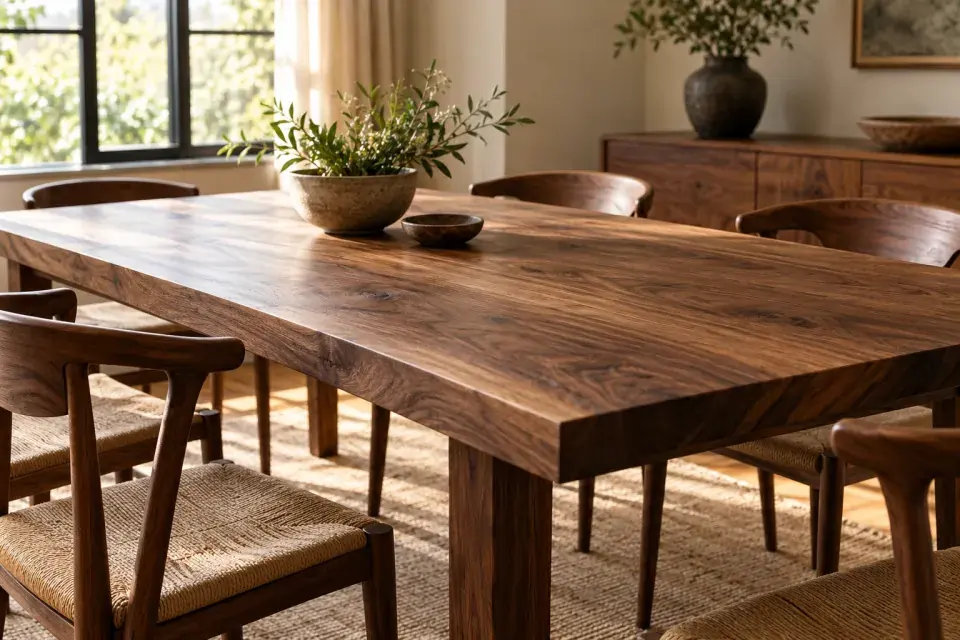
Which wood should you choose?
White oak, walnut, and cherry are versatile furniture woods. Oak suits robust pieces with visible grain, walnut gives a darker surface with moderate weight, and cherry is pleasant to work for refined joinery. A dining tabletop, drawer side, and chair rail need different properties, so one species need not do every job.
Practical wood choices
These editorial choices account for the application as well as the numbers. They may differ from the automated property ranking below.
White oak
A firm timber for tables, cabinets, and frames. Its open texture and distinctive ray figure influence the finish. Wide tops need movement allowance regardless of how strong the wood is.
Species profiles:White oak
Walnut
A useful balance of workability and appearance for indoor furniture. Expect dents under hard use and color variation between boards. Plan the layout around sapwood and grain before cutting.
Species profiles:Black walnut
Cherry
Well suited to detailed joinery and a smooth natural finish. Its color develops with light exposure, so match boards thoughtfully. It is not as dent-resistant as the hardest furniture timbers.
Species profiles:Black cherry
What matters for this project
Begin with the piece's structure. Long shelves need stiffness and suitable support; tabletops need width stability and wear resistance; slender chair parts need continuous grain and sound joints. The table favors a few measurable properties but does not evaluate joinery, figure, or how well a finish will suit the design.
What to check before you buy
Buy for a cutting list with realistic milling and matching allowance. Clear short parts may come from a less expensive grade, while long rails demand more careful selection. Check moisture and straightness after rough milling, and reserve the best grain for visible faces and loaded narrow parts.
Building and looking after it
Use joints appropriate to each load and allow solid panels to change width. Tabletop fasteners and frame-and-panel construction solve different movement problems. Make a sample of the complete finish schedule before applying it to the piece, and let coatings cure before heavy service.
Mistakes to avoid
Do not restrain a wide top rigidly across its grain or assume a low shrinkage figure removes the need for movement. Very hard wood may increase tool wear and weight without improving the furniture's intended function.
Property comparison ranking
Janka at least 850 lbf. The score combines hardness near 1,300 lbf, low volumetric shrinkage, and a low tangential-to-radial shrinkage ratio.
This ranking compares selected properties. Use the practical choices above to check the other requirements of your project.
Species enter when the required fields are present and the rule gives a positive score. An absent wood may lack data or fall outside the scoring range; absence is not proof that it is unsuitable.
The order also uses an editorial availability multiplier, shown in the last column. It changes the order without removing a qualifying species. These scores compare selected properties; they do not evaluate every requirement of the finished project.
| # | Wood | Janka | Density | MOR | MOE | Shrinkage | T/R | Availability |
|---|---|---|---|---|---|---|---|---|
| 1 | Iroko | 1,260 lbf | 43.0 lb/ft³ | 12,400 lb/in² | 1.46 ×10⁶ lb/in² | 8.8% | 1.36 | |
| 2 | Andaman Padauk | 1,630 lbf | 48.9 lb/ft³ | — | — | 6.4% | 1.33 | |
| 3 | African Padauk | 1,538 lbf* | 46.0 lb/ft³ | 13,900 lb/in² | 1.56 ×10⁶ lb/in² | 7.6% | 1.58 | |
| 4 | Merbau | 1,500 lbf | 50.0 lb/ft³ | 16,800 lb/in² | 2.23 ×10⁶ lb/in² | 7.8% | 1.70 | |
| 5 | White ash | 1,320 lbf | 42.0 lb/ft³ | 15,400 lb/in² | 1.74 ×10⁶ lb/in² | 13.3% | 1.59 | |
| 6 | Green ash | 1,200 lbf | 39.1 lb/ft³ | 14,100 lb/in² | 1.66 ×10⁶ lb/in² | 12.5% | 1.54 | |
| 7 | Yellow birch | 1,260 lbf | 43.3 lb/ft³ | 16,600 lb/in² | 2.01 ×10⁶ lb/in² | 16.8% | 1.30 | |
| 8 | Black walnut | 1,010 lbf | 38.5 lb/ft³ | 14,600 lb/in² | 1.68 ×10⁶ lb/in² | 12.8% | 1.42 | |
| 9 | Sweet birch | 1,470 lbf | 45.4 lb/ft³ | 16,900 lb/in² | 2.17 ×10⁶ lb/in² | 15.6% | 1.38 | |
| 10 | Ramin | 1,300 lbf | 39.6 lb/ft³ | 18,500 lb/in² | 2.17 ×10⁶ lb/in² | 13.4% | 2.02 | |
| 11 | Bur oak | 1,370 lbf | 44.8 lb/ft³ | 10,300 lb/in² | 1.03 ×10⁶ lb/in² | 12.7% | 2.00 | |
| 12 | Sapele | 1,510 lbf | 42.0 lb/ft³ | 15,300 lb/in² | 1.82 ×10⁶ lb/in² | 14.0% | 1.61 | |
| 13 | Slash pine | 869 lbf* | 41.3 lb/ft³ | 16,300 lb/in² | 1.98 ×10⁶ lb/in² | 12.1% | 1.41 | |
| 14 | Northern red oak | 1,290 lbf | 44.1 lb/ft³ | 14,300 lb/in² | 1.82 ×10⁶ lb/in² | 13.7% | 2.15 | |
| 15 | Longleaf pine | 870 lbf | 41.3 lb/ft³ | 14,500 lb/in² | 1.98 ×10⁶ lb/in² | 12.2% | 1.47 | |
| 16 | Black maple | 1,180 lbf | 39.8 lb/ft³ | 13,300 lb/in² | 1.62 ×10⁶ lb/in² | 14.0% | 1.94 | |
| 17 | Teak | 1,000 lbf | 40.0 lb/ft³ | 14,600 lb/in² | 1.55 ×10⁶ lb/in² | 7.0% | 2.32 | |
| 18 | White oak | 1,360 lbf | 47.6 lb/ft³ | 15,200 lb/in² | 1.78 ×10⁶ lb/in² | 16.3% | 1.88 | |
| 19 | Rubberwood | 915 lbf* | 38.0 lb/ft³ | — | — | 7.4% | 2.22 | |
| 20 | Paper birch | 910 lbf | 38.5 lb/ft³ | 12,300 lb/in² | 1.59 ×10⁶ lb/in² | 16.2% | 1.37 | |
| 21 | Keruing | 1,270 lbf | 54.2 lb/ft³ | 19,900 lb/in² | 2.07 ×10⁶ lb/in² | 16.1% | 2.10 | |
| 22 | Black cherry | 950 lbf | 35.0 lb/ft³ | 12,300 lb/in² | 1.49 ×10⁶ lb/in² | 11.5% | 1.92 | |
| 23 | Sugar maple | 1,450 lbf | 44.1 lb/ft³ | 15,800 lb/in² | 1.83 ×10⁶ lb/in² | 14.7% | 2.06 | |
| 24 | Swamp chestnut oak | 1,240 lbf | 46.8 lb/ft³ | 13,900 lb/in² | 1.77 ×10⁶ lb/in² | 16.4% | 2.08 | |
| 25 | Caribbean pine | 1,240 lbf | 38.0 lb/ft³ | 16,700 lb/in² | 2.24 ×10⁶ lb/in² | 12.9% | 1.24 |
Before you choose a board
Use this ranking to compare the properties listed above. Grain direction, defects, moisture content, board dimensions, and construction also affect performance. Check the species page for the original measurements and any estimate marks, then inspect the actual stock you can buy.
The score does not assess decay resistance, food-contact suitability, heat resistance, or structural load capacity. For outdoor work, check durability and treatment requirements separately. For food-contact items and toys, check the intended finish and published safety information.
Read wood allergy and toxicity sourcesHow to read the measurements
Janka compares resistance to indentation. Density is the mass of a given volume of wood. Modulus of rupture (MOR) describes bending strength in a test specimen. Shrinkage figures describe the change from green to oven-dry wood, and T/R compares tangential with radial shrinkage. They are useful for comparison, but do not directly predict seasonal movement in your finished piece.
These are species-level reference values, not a test of the board you are buying or allowable structural design values. Grain, defects, moisture, dimensions, joints, and treatment can change the result. An asterisk beside Janka marks an estimate; open the species page for its source and method. Use the header settings to switch units.
Frequently asked questions
Can I mix species in one piece?
Yes, when structure, movement, and appearance are considered. Different woods can suit drawer parts, frames, and tops, but cross-grain connections still need a suitable design.
Does expensive wood make better furniture?
It can provide a desired appearance or working property. Sound stock, proportions, joinery, and finishing usually explain more about serviceability than price alone.
Should I buy all the lumber before starting?
For a matched piece, buying the visible stock together helps you plan color and grain. Make a cutting list first, then allow for milling losses, defects, and layout changes. Reserve the longest clear pieces for critical rails or legs before cutting short parts; otherwise apparently generous material can become unusable for the remaining components.
Sources and further reading
The application advice is editorial guidance. The references below provide background; each wood's measured values have their own sources on its species page.
- USDA Forest Products Laboratory — Wood Handbook
Background on wood properties, moisture, construction, and finishing.