Best wood for guitar fretboards
Choose a stable, fine-textured board that machines precise fret slots.
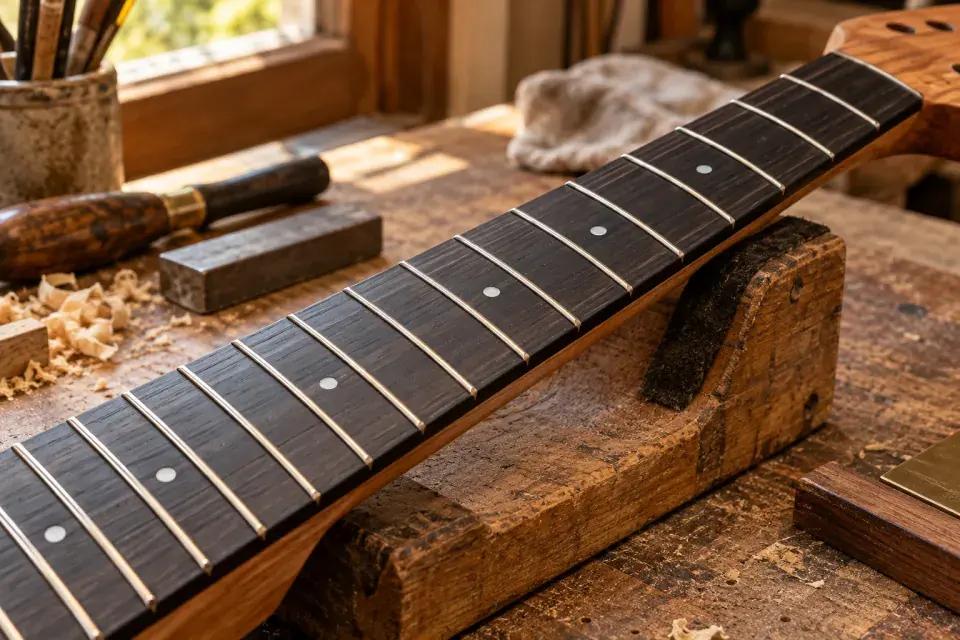
Which wood should you choose?
Ebony, Indian rosewood, and hard maple are established fretboard options. Ebony suits a fine, firm surface, rosewood offers a different texture and appearance, and maple works well when the finish and fretting method are planned together. Hardness is useful, but accurate preparation is what makes frets seat and play correctly.
Practical wood choices
These editorial choices account for the application as well as the numbers. They may differ from the automated property ranking below.
Ebony
Fine texture and high hardness support crisp machining, but some blanks are brittle or checked. Natural streaks are an appearance feature rather than proof of poor performance. Inspect the actual board before paying a premium for uniform black color.
Species profiles:African ebony
Indian rosewood
A familiar fingerboard wood with a more open texture than ebony. Confirm species and provenance, particularly when buying across borders. Adhesive choice and surface preparation need to suit the stock.
Species profiles:Indian rosewood
Hard maple
A pale alternative frequently used with a protective finish. Work out whether frets will be installed before or after finishing and how future refretting will be handled. Figure can make surface preparation more demanding.
Species profiles:Sugar mapleBlack maple
What matters for this project
The fretboard must hold slot walls, resist local wear, and remain compatible with the neck beneath it. Slot width depends on the fretwire tang and tools, not on a universal species rule. Density also adds neck weight. A uniformly dry, straight blank is more useful than an unusually hard board with hidden checks.
What to check before you buy
Specify scale length, radius allowance, final width, and thickness before ordering a pre-slotted or rough board. Check that a pre-slotted board matches the instrument design. Leave room for final leveling and inlays without making the board unnecessarily thick.
Building and looking after it
Prepare the neck joint surfaces accurately and use an appropriate adhesive. Verify slot position, depth, and width on scrap before fretting. Support the work while radiusing and avoid excessive chipout at the ends of slots. Use maintenance products appropriate to the actual finish rather than assuming every dark fretboard should be oiled.
Mistakes to avoid
Do not buy an unknown dark timber merely because it resembles ebony. Hardness does not establish fret retention, legality of sourcing, or dimensional stability. A loose slot cannot be corrected by the species name on the receipt.
Property comparison ranking
Janka at least 1,700 lbf. The score combines hardness divided by 4,000 with lower volumetric shrinkage.
This ranking compares selected properties. Use the practical choices above to check the other requirements of your project.
Species enter when the required fields are present and the rule gives a positive score. An absent wood may lack data or fall outside the scoring range; absence is not proof that it is unsuitable.
The order also uses an editorial availability multiplier, shown in the last column. It changes the order without removing a qualifying species. These scores compare selected properties; they do not evaluate every requirement of the finished project.
| # | Wood | Janka | Density | MOR | MOE | Shrinkage | T/R | Availability |
|---|---|---|---|---|---|---|---|---|
| 1 | Cocobolo | 3,860 lbf* | 69.0 lb/ft³ | — | — | 7.0% | 1.59 | |
| 2 | Indian rosewood | 3,170 lbf | 53.0 lb/ft³ | 16,900 lb/in² | 1.78 ×10⁶ lb/in² | 8.5% | 2.15 | |
| 3 | Ipe | 3,680 lbf | 70.0 lb/ft³ | 25,400 lb/in² | 3.14 ×10⁶ lb/in² | 13.2% | 1.21 | |
| 4 | Cumaru | 3,415 lbf | 66.8 lb/ft³ | 24,371 lb/in² | 2.43 ×10⁶ lb/in² | 13.5% | 1.56 | |
| 5 | Canalete | 2,200 lbf | 58.2 lb/ft³ | — | — | 11.6% | 1.85 | |
| 6 | Purpleheart | 1,860 lbf | 58.0 lb/ft³ | 19,200 lb/in² | 2.27 ×10⁶ lb/in² | 9.9% | 1.91 | |
| 7 | Bubinga | 2,690 lbf | 55.9 lb/ft³ | 22,600 lb/in² | 2.48 ×10⁶ lb/in² | 14.2% | 1.45 | |
| 8 | Brazilian rosewood | 2,720 lbf | 64.1 lb/ft³ | 19,000 lb/in² | 1.88 ×10⁶ lb/in² | 8.5% | 1.59 | |
| 9 | Pecan hickory | 1,820 lbf | 46.1 lb/ft³ | 13,700 lb/in² | 1.73 ×10⁶ lb/in² | 13.6% | 1.82 | |
| 10 | Goncalo alves | 2,160 lbf | 67.7 lb/ft³ | 16,600 lb/in² | 2.23 ×10⁶ lb/in² | 10.0% | 1.90 | |
| 11 | Marishballi | 3,570 lbf | 62.0 lb/ft³ | 27,700 lb/in² | 3.34 ×10⁶ lb/in² | 17.2% | 1.56 | |
| 12 | Wallaba | 2,040 lbf | 58.0 lb/ft³ | 19,100 lb/in² | 2.28 ×10⁶ lb/in² | 10.0% | 1.92 | |
| 13 | Azobe | 3,350 lbf | 70.0 lb/ft³ | 24,500 lb/in² | 2.47 ×10⁶ lb/in² | 17.0% | 1.31 | |
| 14 | Sucupira | 2,448 lbf* | 58.7 lb/ft³ | 19,400 lb/in² | — | 13.4% | 1.56 | |
| 15 | Black locust | 1,700 lbf | 48.3 lb/ft³ | 19,400 lb/in² | 2.05 ×10⁶ lb/in² | 10.2% | 1.57 | |
| 16 | Macawood | 3,150 lbf | 64.0 lb/ft³ | 27,600 lb/in² | 3.20 ×10⁶ lb/in² | 6.5% | 1.30 | |
| 17 | Shagbark hickory | 1,880 lbf | 50.3 lb/ft³ | 20,200 lb/in² | 2.16 ×10⁶ lb/in² | 16.7% | 1.50 | |
| 18 | Peroba rosa | 1,730 lbf | 51.5 lb/ft³ | 12,100 lb/in² | 1.53 ×10⁶ lb/in² | 11.6% | 1.68 | |
| 19 | Wamara | 3,692 lbf | 70.0 lb/ft³ | 26,370 lb/in² | 3.63 ×10⁶ lb/in² | 11.2% | 1.95 | |
| 20 | Curupay | 3,840 lbf | 66.0 lb/ft³ | 29,290 lb/in² | 2.60 ×10⁶ lb/in² | 12.0% | 1.65 | |
| 21 | Mockernut hickory | 1,970 lbf | 50.3 lb/ft³ | 19,200 lb/in² | 2.22 ×10⁶ lb/in² | 17.8% | 1.43 | |
| 22 | African ebony | 3,220 lbf | 63.0 lb/ft³ | 21,200 lb/in² | — | 20.0% | 1.17 | |
| 23 | Muirapixuna | 3,435 lbf | 84.1 lb/ft³ | 26,227 lb/in² | 2.38 ×10⁶ lb/in² | 11.5% | 2.28 | |
| 24 | Jatobá / jutaí-do-campo | 3,792 lbf | 73.4 lb/ft³ | 24,635 lb/in² | 2.46 ×10⁶ lb/in² | 13.4% | 2.62 | |
| 25 | Urucurana | 4,206 lbf | 59.9 lb/ft³ | 21,747 lb/in² | 2.32 ×10⁶ lb/in² | 15.5% | 1.55 |
Before you choose a board
Use this ranking to compare the properties listed above. Grain direction, defects, moisture content, board dimensions, and construction also affect performance. Check the species page for the original measurements and any estimate marks, then inspect the actual stock you can buy.
The score does not assess decay resistance, food-contact suitability, heat resistance, or structural load capacity. For outdoor work, check durability and treatment requirements separately. For food-contact items and toys, check the intended finish and published safety information.
Read wood allergy and toxicity sourcesHow to read the measurements
Janka compares resistance to indentation. Density is the mass of a given volume of wood. Modulus of rupture (MOR) describes bending strength in a test specimen. Shrinkage figures describe the change from green to oven-dry wood, and T/R compares tangential with radial shrinkage. They are useful for comparison, but do not directly predict seasonal movement in your finished piece.
These are species-level reference values, not a test of the board you are buying or allowable structural design values. Grain, defects, moisture, dimensions, joints, and treatment can change the result. An asterisk beside Janka marks an estimate; open the species page for its source and method. Use the header settings to switch units.
Frequently asked questions
Does ebony need to be completely black?
No. Color uniformity is a cosmetic preference. Soundness, grain, dryness, and machining quality are more relevant to a working fretboard.
Should every fretboard be oiled?
No. Finished maple and unfinished hardwood boards need different care. Follow the instrument or finish maker's advice and avoid saturating slots or joints.
Can I choose a fretboard only for its appearance?
Appearance can guide the final choice once the blank meets the construction requirements. First check dryness, straightness, dimensions, defects, and the machining needed for the fretwire and inlays. Highly uniform color is optional, while a check across a slot or insufficient thickness after radiusing can affect the finished board regardless of how attractive the surface looks.
Sources and further reading
The application advice is editorial guidance. The references below provide background; each wood's measured values have their own sources on its species page.
- USDA Forest Products Laboratory — Wood Handbook
Background on wood properties, moisture, construction, and finishing.