Best wood for instrument bodies
Plan body weight, balance, routing, and finish around the instrument design.
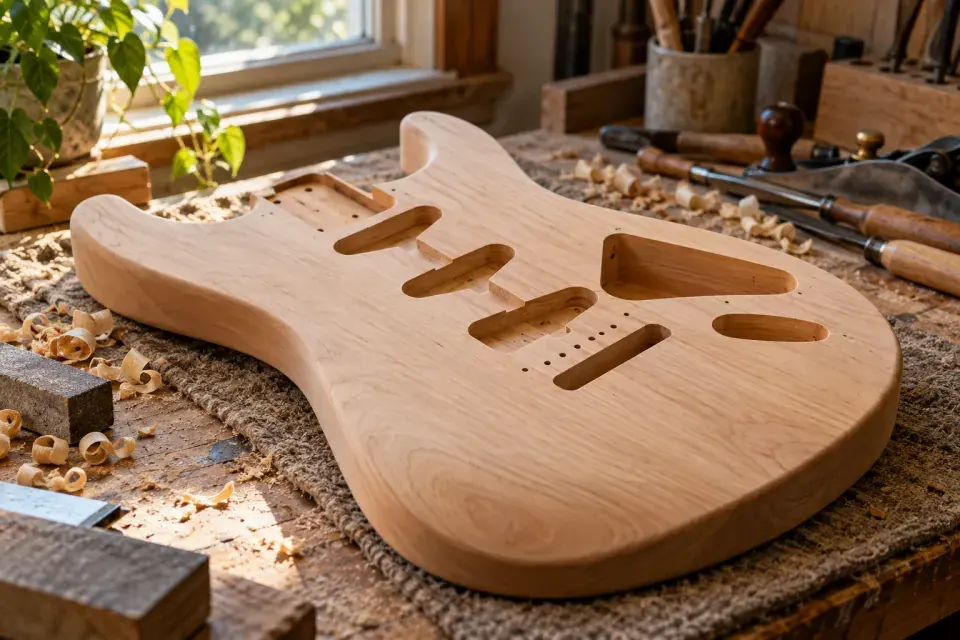
Which wood should you choose?
Alder, ash, and mahogany are established solid-body guitar materials, while basswood is useful for a lighter, easily machined body. Choose with the neck, hardware, and finished instrument weight in mind. A body is not acoustically irrelevant, but simple species numbers cannot predict an amplified instrument's final sound.
Practical wood choices
These editorial choices account for the application as well as the numbers. They may differ from the automated property ranking below.
Alder
A practical starting point for many painted or natural-finish solid bodies. It machines readily and often has a comparatively understated grain. Evaluate the actual blank's weight rather than relying entirely on a species average.
Species profiles:Red alder
Ash
Offers prominent grain for transparent finishes, with substantial weight variation between blanks and species. Terms such as swamp ash are trade descriptions rather than a guarantee of one density. Weigh the blank before committing.
Species profiles:White ash
Mahogany or basswood
Mahogany can suit designs seeking its working character and appearance; basswood suits easily shaped painted bodies. They differ considerably, so select for the actual design and required screw-holding locations.
Species profiles:True mahoganyAmerican basswood
What matters for this project
The body supports the neck connection, bridge, controls, and strap hardware. Routing can leave thin walls or weak short-grain areas. Density affects weight, but body thickness, cavities, hardware, and neck mass determine balance. Finish preparation also varies: open grain may require filling where a mirror-smooth surface is desired.
What to check before you buy
Check dimensions against a full-size template, including any offset outline. Ask for the blank's actual weight and moisture condition. Multi-piece blanks can work well when joints are sound and grain is planned. Reserve attractive faces for transparent finishes rather than paying for figure beneath opaque paint.
Building and looking after it
Establish accurate centerlines and neck geometry before routing. Leave adequate material around bridge and neck fasteners, and use the hardware maker's pilot-hole guidance. Test finish schedules on offcuts. Check the instrument's balance before finalizing strap locations or removing extra wood for weight relief.
Mistakes to avoid
The table cannot assign a reliable tone to a species or prove that a light body will balance well. A high rank does not assess local screw retention, neck-joint integrity, or the quality of a glue-up.
Property comparison ranking
Density 380–720 kg/m³. The score combines density near 550 kg/m³ with lower volumetric shrinkage.
This ranking compares selected properties. Use the practical choices above to check the other requirements of your project.
Species enter when the required fields are present and the rule gives a positive score. An absent wood may lack data or fall outside the scoring range; absence is not proof that it is unsuitable.
The order also uses an editorial availability multiplier, shown in the last column. It changes the order without removing a qualifying species. These scores compare selected properties; they do not evaluate every requirement of the finished project.
| # | Wood | Janka | Density | MOR | MOE | Shrinkage | T/R | Availability |
|---|---|---|---|---|---|---|---|---|
| 1 | Eastern redcedar | 615 lbf* | 32.8 lb/ft³ | 8,800 lb/in² | 0.88 ×10⁶ lb/in² | 7.8% | 1.52 | |
| 2 | Rubberwood | 915 lbf* | 38.0 lb/ft³ | — | — | 7.4% | 2.22 | |
| 3 | African mahogany | 830 lbf | 32.0 lb/ft³ | 10,700 lb/in² | 1.40 ×10⁶ lb/in² | 8.8% | 1.80 | |
| 4 | Spanish-cedar | 600 lbf | 35.0 lb/ft³ | 11,500 lb/in² | 1.44 ×10⁶ lb/in² | 10.3% | 1.50 | |
| 5 | Black cherry | 950 lbf | 35.0 lb/ft³ | 12,300 lb/in² | 1.49 ×10⁶ lb/in² | 11.5% | 1.92 | |
| 6 | Teak | 1,000 lbf | 40.0 lb/ft³ | 14,600 lb/in² | 1.55 ×10⁶ lb/in² | 7.0% | 2.32 | |
| 7 | Bigleaf maple | 850 lbf | 33.6 lb/ft³ | 10,700 lb/in² | 1.45 ×10⁶ lb/in² | 11.6% | 1.92 | |
| 8 | Old-growth redwood | 480 lbf | 28.0 lb/ft³ | 10,000 lb/in² | 1.34 ×10⁶ lb/in² | 6.8% | 1.69 | |
| 9 | Coast Douglas-fir | 710 lbf | 33.6 lb/ft³ | 12,400 lb/in² | 1.95 ×10⁶ lb/in² | 12.4% | 1.58 | |
| 10 | Red pine | 560 lbf | 32.2 lb/ft³ | 11,000 lb/in² | 1.63 ×10⁶ lb/in² | 11.3% | 1.89 | |
| 11 | Silver maple | 700 lbf | 32.8 lb/ft³ | 8,900 lb/in² | 1.14 ×10⁶ lb/in² | 12.0% | 2.40 | |
| 12 | Loblolly pine | 690 lbf | 35.6 lb/ft³ | 12,800 lb/in² | 1.79 ×10⁶ lb/in² | 12.3% | 1.54 | |
| 13 | Shortleaf pine | 690 lbf | 35.6 lb/ft³ | 13,100 lb/in² | 1.75 ×10⁶ lb/in² | 12.3% | 1.67 | |
| 14 | True mahogany | 800 lbf | 41.0 lb/ft³ | 11,500 lb/in² | 1.50 ×10⁶ lb/in² | 7.8% | 1.37 | |
| 15 | Port-Orford cedar | 630 lbf | 30.1 lb/ft³ | 12,700 lb/in² | 1.70 ×10⁶ lb/in² | 10.1% | 1.50 | |
| 16 | American sycamore | 770 lbf | 34.3 lb/ft³ | 10,000 lb/in² | 1.42 ×10⁶ lb/in² | 14.1% | 1.68 | |
| 17 | Jack pine | 570 lbf | 30.1 lb/ft³ | 9,900 lb/in² | 1.35 ×10⁶ lb/in² | 10.3% | 1.78 | |
| 18 | Black tupelo | 810 lbf | 35.0 lb/ft³ | 9,600 lb/in² | 1.20 ×10⁶ lb/in² | 14.4% | 1.71 | |
| 19 | Western hemlock | 540 lbf | 31.5 lb/ft³ | 11,300 lb/in² | 1.63 ×10⁶ lb/in² | 12.4% | 1.86 | |
| 20 | American elm | 830 lbf | 35.0 lb/ft³ | 11,800 lb/in² | 1.34 ×10⁶ lb/in² | 14.6% | 2.26 | |
| 21 | Black ash | 850 lbf | 34.3 lb/ft³ | 12,600 lb/in² | 1.60 ×10⁶ lb/in² | 15.2% | 1.56 | |
| 22 | Incense cedar | 470 lbf | 25.8 lb/ft³ | 8,000 lb/in² | 1.04 ×10⁶ lb/in² | 7.7% | 1.58 | |
| 23 | Eastern hemlock | 500 lbf | 28.0 lb/ft³ | 8,900 lb/in² | 1.20 ×10⁶ lb/in² | 9.7% | 2.27 | |
| 24 | Ponderosa pine | 460 lbf | 28.0 lb/ft³ | 9,400 lb/in² | 1.29 ×10⁶ lb/in² | 9.7% | 1.59 | |
| 25 | Red maple | 950 lbf | 37.8 lb/ft³ | 13,400 lb/in² | 1.64 ×10⁶ lb/in² | 12.6% | 2.05 |
Before you choose a board
Use this ranking to compare the properties listed above. Grain direction, defects, moisture content, board dimensions, and construction also affect performance. Check the species page for the original measurements and any estimate marks, then inspect the actual stock you can buy.
The score does not assess decay resistance, food-contact suitability, heat resistance, or structural load capacity. For outdoor work, check durability and treatment requirements separately. For food-contact items and toys, check the intended finish and published safety information.
Read wood allergy and toxicity sourcesHow to read the measurements
Janka compares resistance to indentation. Density is the mass of a given volume of wood. Modulus of rupture (MOR) describes bending strength in a test specimen. Shrinkage figures describe the change from green to oven-dry wood, and T/R compares tangential with radial shrinkage. They are useful for comparison, but do not directly predict seasonal movement in your finished piece.
These are species-level reference values, not a test of the board you are buying or allowable structural design values. Grain, defects, moisture, dimensions, joints, and treatment can change the result. An asterisk beside Janka marks an estimate; open the species page for its source and method. Use the header settings to switch units.
Frequently asked questions
Is a one-piece body better?
Not inherently. A well-made multi-piece blank can be stable and functional. Joint quality, grain, weight, and construction are more useful criteria than counting pieces.
Should I choose the lightest wood?
Only if it suits the full design. An extremely light body can change neck balance and may require more attention at hardware attachment points.
How can I estimate the final body weight?
Weigh the actual blank and account for the material removed by the outline and cavities, then include hardware, finish, and the neck when considering the complete instrument. Species density gives a rough comparison, but individual boards vary. A measured blank and a realistic parts list provide a more useful estimate than the trade name on the order.
Sources and further reading
The application advice is editorial guidance. The references below provide background; each wood's measured values have their own sources on its species page.
- USDA Forest Products Laboratory — Wood Handbook
Background on wood properties, moisture, construction, and finishing.