Best wood for carving and whittling
Start with clear, readable grain and match hardness to the tools and detail.
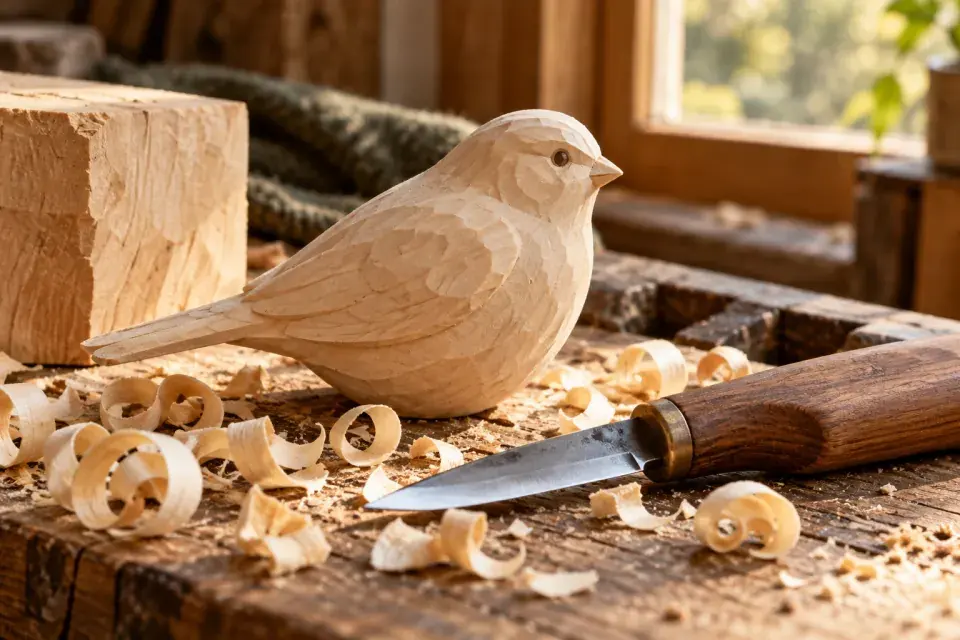
Which wood should you choose?
Basswood is an accessible first choice for whittling and small relief carvings. Butternut offers more visible grain with manageable cutting resistance, while cherry suits experienced carvers wanting a stronger, finer finished surface. The best blank is one you can cut cleanly while controlling the direction of the fibers.
Practical wood choices
These editorial choices account for the application as well as the numbers. They may differ from the automated property ranking below.
Basswood
Soft, relatively even-textured stock is forgiving when learning knife control. It accepts detail better than its low hardness might suggest, though thin projections still break and surfaces can bruise under blunt tools.
Species profiles:American basswood
Butternut
A useful step toward more pronounced grain and a natural finish. Its grain contributes character but can redirect a cut. Availability and blank quality vary, so buy clear carving stock where possible.
Species profiles:Butternut
Cherry
Good for durable objects and crisp surfaces when tools are sharp. It takes more force than basswood, so reduce cut size and work carefully around changing grain rather than forcing a knife through it.
Species profiles:Black cherry
What matters for this project
Hardness is a useful starting point, but grain uniformity, knots, and direction determine much of the carving experience. A low hardness number does not guarantee a clean surface: some woods crush or tear. Choose the wood for the narrowest feature in the design, not just for the largest part of the block.
What to check before you buy
Inspect the ends for checks and choose a blank with grain running along delicate features. A larger block may contain defects hidden inside, so allow room to adjust the design. Avoid pith in a piece intended to dry intact. Buy a small test blank before committing to an unfamiliar species.
Building and looking after it
Keep tools sharp, take controlled cuts, and change cutting direction when fibers lift. Leave thin ears, wings, or handles until the surrounding work is nearly finished. For green wood, expect drying movement and reserve material for final shaping. Test paint or finish on an offcut because end grain can absorb it differently.
Mistakes to avoid
Avoid knotty construction offcuts for a first detailed carving. Strong figure and interlocked grain may look appealing but complicate cutting. Dust exposure remains relevant during sanding even when the carving itself produces mostly chips.
Property comparison ranking
Janka 250–1,000 lbf. The score favors hardness closest to 500 lbf; values at 1,000 score zero and are excluded.
This ranking compares selected properties. Use the practical choices above to check the other requirements of your project.
Species enter when the required fields are present and the rule gives a positive score. An absent wood may lack data or fall outside the scoring range; absence is not proof that it is unsuitable.
The order also uses an editorial availability multiplier, shown in the last column. It changes the order without removing a qualifying species. These scores compare selected properties; they do not evaluate every requirement of the finished project.
| # | Wood | Janka | Density | MOR | MOE | Shrinkage | T/R | Availability |
|---|---|---|---|---|---|---|---|---|
| 1 | Eastern hemlock | 500 lbf | 28.0 lb/ft³ | 8,900 lb/in² | 1.20 ×10⁶ lb/in² | 9.7% | 2.27 | |
| 2 | Baldcypress | 510 lbf | 32.2 lb/ft³ | 10,600 lb/in² | 1.44 ×10⁶ lb/in² | — | — | |
| 3 | Butternut | 490 lbf | 26.6 lb/ft³ | 8,100 lb/in² | 1.18 ×10⁶ lb/in² | 10.6% | 1.88 | |
| 4 | Grand fir | 490 lbf | 25.8 lb/ft³ | 8,900 lb/in² | 1.57 ×10⁶ lb/in² | 11.0% | 2.21 | |
| 5 | Sitka spruce | 510 lbf | 28.0 lb/ft³ | 10,200 lb/in² | 1.57 ×10⁶ lb/in² | 11.5% | 1.74 | |
| 6 | Lodgepole pine | 480 lbf | 28.7 lb/ft³ | 9,400 lb/in² | 1.34 ×10⁶ lb/in² | 11.1% | 1.56 | |
| 7 | Old-growth redwood | 480 lbf | 28.0 lb/ft³ | 10,000 lb/in² | 1.34 ×10⁶ lb/in² | 6.8% | 1.69 | |
| 8 | Bigtooth aspen | 471 lbf* | 27.3 lb/ft³ | 9,100 lb/in² | 1.43 ×10⁶ lb/in² | 11.8% | 2.39 | |
| 9 | Black willow | 471 lbf* | 27.3 lb/ft³ | 7,800 lb/in² | 1.01 ×10⁶ lb/in² | 13.9% | 2.64 | |
| 10 | Black spruce | 530 lbf | 29.3 lb/ft³ | 10,800 lb/in² | 1.61 ×10⁶ lb/in² | 11.3% | 1.66 | |
| 11 | Incense cedar | 470 lbf | 25.8 lb/ft³ | 8,000 lb/in² | 1.04 ×10⁶ lb/in² | 7.7% | 1.58 | |
| 12 | Red spruce | 530 lbf | 28.0 lb/ft³ | 10,800 lb/in² | 1.66 ×10⁶ lb/in² | 11.8% | 2.05 | |
| 13 | Ponderosa pine | 460 lbf | 28.0 lb/ft³ | 9,400 lb/in² | 1.29 ×10⁶ lb/in² | 9.7% | 1.59 | |
| 14 | Western hemlock | 540 lbf | 31.5 lb/ft³ | 11,300 lb/in² | 1.63 ×10⁶ lb/in² | 12.4% | 1.86 | |
| 15 | Yellow-poplar | 540 lbf | 29.3 lb/ft³ | 10,100 lb/in² | 1.58 ×10⁶ lb/in² | 12.7% | 1.78 | |
| 16 | Norway spruce | 449 lbf* | 26.7 lb/ft³ | — | — | — | — | |
| 17 | Red pine | 560 lbf | 32.2 lb/ft³ | 11,000 lb/in² | 1.63 ×10⁶ lb/in² | 11.3% | 1.89 | |
| 18 | Eastern cottonwood | 430 lbf | 28.0 lb/ft³ | 8,500 lb/in² | 1.37 ×10⁶ lb/in² | 13.9% | 2.36 | |
| 19 | Jack pine | 570 lbf | 30.1 lb/ft³ | 9,900 lb/in² | 1.35 ×10⁶ lb/in² | 10.3% | 1.78 | |
| 20 | Obeche | 430 lbf | 24.0 lb/ft³ | 7,400 lb/in² | 0.86 ×10⁶ lb/in² | 9.2% | 1.80 | |
| 21 | Western white pine | 420 lbf | 26.6 lb/ft³ | 9,700 lb/in² | 1.46 ×10⁶ lb/in² | 11.8% | 1.80 | |
| 22 | Young-growth redwood | 420 lbf | 24.5 lb/ft³ | 7,900 lb/in² | 1.10 ×10⁶ lb/in² | 7.0% | 2.23 | |
| 23 | American basswood | 410 lbf | 25.8 lb/ft³ | 8,700 lb/in² | 1.46 ×10⁶ lb/in² | 15.8% | 1.41 | |
| 24 | Noble fir | 410 lbf | 27.3 lb/ft³ | 10,700 lb/in² | 1.72 ×10⁶ lb/in² | 12.4% | 1.93 | |
| 25 | Red alder | 590 lbf | 28.7 lb/ft³ | 9,800 lb/in² | 1.38 ×10⁶ lb/in² | 12.6% | 1.66 |
Before you choose a board
Use this ranking to compare the properties listed above. Grain direction, defects, moisture content, board dimensions, and construction also affect performance. Check the species page for the original measurements and any estimate marks, then inspect the actual stock you can buy.
The score does not assess decay resistance, food-contact suitability, heat resistance, or structural load capacity. For outdoor work, check durability and treatment requirements separately. For food-contact items and toys, check the intended finish and published safety information.
Read wood allergy and toxicity sourcesHow to read the measurements
Janka compares resistance to indentation. Density is the mass of a given volume of wood. Modulus of rupture (MOR) describes bending strength in a test specimen. Shrinkage figures describe the change from green to oven-dry wood, and T/R compares tangential with radial shrinkage. They are useful for comparison, but do not directly predict seasonal movement in your finished piece.
These are species-level reference values, not a test of the board you are buying or allowable structural design values. Grain, defects, moisture, dimensions, joints, and treatment can change the result. An asterisk beside Janka marks an estimate; open the species page for its source and method. Use the header settings to switch units.
Frequently asked questions
Is pine suitable for whittling?
Clear pine can be used, but alternating earlywood and latewood, resin, and knots can make cuts less predictable than basswood. A cheap block is useful only if it supports learning.
Does softer wood hold less detail?
Not always. Fine, even grain and clean tool work can support excellent detail. The durability of thin projections is a separate question from the sharpness of the carved surface.
Which grain direction should a delicate feature follow?
Arrange long thin features so the wood fibers continue through them rather than crossing a narrow neck. Rotate the design within the blank before cutting if that improves continuity. When a feature cannot follow the grain, consider changing its thickness or making it as a separate component instead of trusting a softer species to prevent breakage.
Sources and further reading
The application advice is editorial guidance. The references below provide background; each wood's measured values have their own sources on its species page.
- USDA Forest Products Laboratory — Wood Handbook
Background on wood properties, moisture, construction, and finishing.