Best wood for exterior trim and siding
Prioritize durable stock, paint compatibility, drainage, and protected end grain.
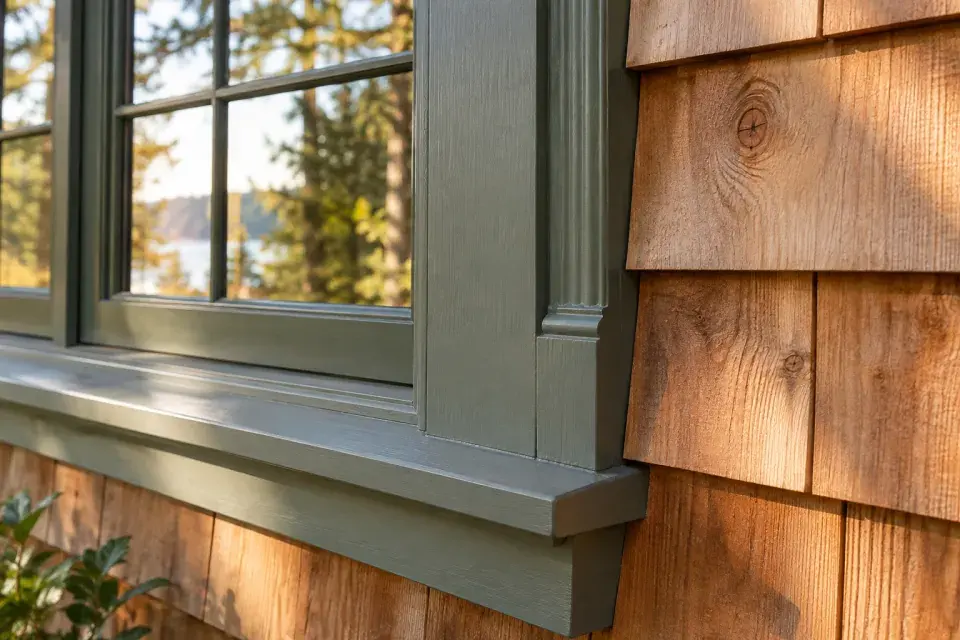
Which wood should you choose?
Western red cedar and redwood are useful natural-wood choices for exterior trim when the grade and heartwood content suit the exposure. Modified wood and correctly specified treated trim are alternatives. For painted work, dimensional behavior and coating preparation are central, but decay resistance cannot be inferred from low shrinkage alone.
Practical wood choices
These editorial choices account for the application as well as the numbers. They may differ from the automated property ranking below.
Western red cedar
Light, workable, and available in trim and siding products. Soft surfaces can crush under fasteners, and extractives may affect coatings. Use preparation and primers suitable for the actual stock.
Species profiles:Western redcedar
Redwood
An option where suitable grades are locally available. Check heartwood content and knots as well as species. Smooth paintwork and natural-finish siding may call for different product grades.
Species profiles:Young-growth redwood
Modified or treated trim
Products can offer performance beyond that of the underlying species. Evaluate the exact manufacturer's exposure rating, machining instructions, coating system, and fastener requirements rather than applying raw-wood averages.
What matters for this project
Trim fails where moisture is retained: end grain, horizontal ledges, joints, and unprotected backs. Choose the profile and flashing arrangement alongside the wood. A dimensionally quiet board can still decay, while a durable timber can still crack paint if installed wet or restrained poorly.
What to check before you buy
Check straightness, moisture condition, grade, and supplied primer or coating. Ask whether cut ends need special treatment and whether the product is suitable near grade or masonry. Plan long visible pieces around defects instead of expecting filler to solve unstable knots.
Building and looking after it
Detail joints to shed water and integrate flashing with the wall's drainage system. Follow the coating maker's instructions for backs and cut ends. Use compatible corrosion-resistant fasteners and avoid overdriving them into soft material. Maintain joints and coatings before persistent moisture causes hidden damage.
Mistakes to avoid
Density and shrinkage cannot certify exterior durability or a complete wall assembly. A paint film is not a substitute for flashing. Do not put stock intended for above-ground exposure into ground contact without an appropriate product specification.
Property comparison ranking
Density at most 750 kg/m³. The score favors lower volumetric shrinkage.
This ranking compares selected properties. Use the practical choices above to check the other requirements of your project.
Species enter when the required fields are present and the rule gives a positive score. An absent wood may lack data or fall outside the scoring range; absence is not proof that it is unsuitable.
The order also uses an editorial availability multiplier, shown in the last column. It changes the order without removing a qualifying species. These scores compare selected properties; they do not evaluate every requirement of the finished project.
| # | Wood | Janka | Density | MOR | MOE | Shrinkage | T/R | Availability |
|---|---|---|---|---|---|---|---|---|
| 1 | Old-growth redwood | 480 lbf | 28.0 lb/ft³ | 10,000 lb/in² | 1.34 ×10⁶ lb/in² | 6.8% | 1.69 | |
| 2 | Western redcedar | 350 lbf | 22.3 lb/ft³ | 7,500 lb/in² | 1.11 ×10⁶ lb/in² | 6.8% | 2.08 | |
| 3 | Teak | 1,000 lbf | 40.0 lb/ft³ | 14,600 lb/in² | 1.55 ×10⁶ lb/in² | 7.0% | 2.32 | |
| 4 | Young-growth redwood | 420 lbf | 24.5 lb/ft³ | 7,900 lb/in² | 1.10 ×10⁶ lb/in² | 7.0% | 2.23 | |
| 5 | Northern white cedar | 320 lbf | 21.7 lb/ft³ | 6,500 lb/in² | 0.80 ×10⁶ lb/in² | 7.2% | 2.23 | |
| 6 | Rubberwood | 915 lbf* | 38.0 lb/ft³ | — | — | 7.4% | 2.22 | |
| 7 | African Padauk | 1,538 lbf* | 46.0 lb/ft³ | 13,900 lb/in² | 1.56 ×10⁶ lb/in² | 7.6% | 1.58 | |
| 8 | Incense cedar | 470 lbf | 25.8 lb/ft³ | 8,000 lb/in² | 1.04 ×10⁶ lb/in² | 7.7% | 1.58 | |
| 9 | Eastern redcedar | 615 lbf* | 32.8 lb/ft³ | 8,800 lb/in² | 0.88 ×10⁶ lb/in² | 7.8% | 1.52 | |
| 10 | True mahogany | 800 lbf | 41.0 lb/ft³ | 11,500 lb/in² | 1.50 ×10⁶ lb/in² | 7.8% | 1.37 | |
| 11 | Sugar pine | 380 lbf | 25.2 lb/ft³ | 8,200 lb/in² | 1.19 ×10⁶ lb/in² | 7.9% | 1.93 | |
| 12 | Eastern white pine | 380 lbf | 24.5 lb/ft³ | 8,600 lb/in² | 1.24 ×10⁶ lb/in² | 8.2% | 2.90 | |
| 13 | African mahogany | 830 lbf | 32.0 lb/ft³ | 10,700 lb/in² | 1.40 ×10⁶ lb/in² | 8.8% | 1.80 | |
| 14 | Iroko | 1,260 lbf | 43.0 lb/ft³ | 12,400 lb/in² | 1.46 ×10⁶ lb/in² | 8.8% | 1.36 | |
| 15 | Obeche | 430 lbf | 24.0 lb/ft³ | 7,400 lb/in² | 0.86 ×10⁶ lb/in² | 9.2% | 1.80 | |
| 16 | Eastern hemlock | 500 lbf | 28.0 lb/ft³ | 8,900 lb/in² | 1.20 ×10⁶ lb/in² | 9.7% | 2.27 | |
| 17 | Ponderosa pine | 460 lbf | 28.0 lb/ft³ | 9,400 lb/in² | 1.29 ×10⁶ lb/in² | 9.7% | 1.59 | |
| 18 | Port-Orford cedar | 630 lbf | 30.1 lb/ft³ | 12,700 lb/in² | 1.70 ×10⁶ lb/in² | 10.1% | 1.50 | |
| 19 | Jack pine | 570 lbf | 30.1 lb/ft³ | 9,900 lb/in² | 1.35 ×10⁶ lb/in² | 10.3% | 1.78 | |
| 20 | Spanish-cedar | 600 lbf | 35.0 lb/ft³ | 11,500 lb/in² | 1.44 ×10⁶ lb/in² | 10.3% | 1.50 | |
| 21 | Butternut | 490 lbf | 26.6 lb/ft³ | 8,100 lb/in² | 1.18 ×10⁶ lb/in² | 10.6% | 1.88 | |
| 22 | Balsa | 88 lbf | 11.5 lb/ft³ | 3,140 lb/in² | 0.49 ×10⁶ lb/in² | 10.8% | 2.53 | |
| 23 | Engelmann spruce | 390 lbf | 24.5 lb/ft³ | 9,300 lb/in² | 1.30 ×10⁶ lb/in² | 11.0% | 1.87 | |
| 24 | Grand fir | 490 lbf | 25.8 lb/ft³ | 8,900 lb/in² | 1.57 ×10⁶ lb/in² | 11.0% | 2.21 | |
| 25 | Lodgepole pine | 480 lbf | 28.7 lb/ft³ | 9,400 lb/in² | 1.34 ×10⁶ lb/in² | 11.1% | 1.56 |
Before you choose a board
Use this ranking to compare the properties listed above. Grain direction, defects, moisture content, board dimensions, and construction also affect performance. Check the species page for the original measurements and any estimate marks, then inspect the actual stock you can buy.
The score does not assess decay resistance, food-contact suitability, heat resistance, or structural load capacity. For outdoor work, check durability and treatment requirements separately. For food-contact items and toys, check the intended finish and published safety information.
Read wood allergy and toxicity sourcesHow to read the measurements
Janka compares resistance to indentation. Density is the mass of a given volume of wood. Modulus of rupture (MOR) describes bending strength in a test specimen. Shrinkage figures describe the change from green to oven-dry wood, and T/R compares tangential with radial shrinkage. They are useful for comparison, but do not directly predict seasonal movement in your finished piece.
These are species-level reference values, not a test of the board you are buying or allowable structural design values. Grain, defects, moisture, dimensions, joints, and treatment can change the result. An asterisk beside Janka marks an estimate; open the species page for its source and method. Use the header settings to switch units.
Frequently asked questions
Should trim be primed on every side?
Follow the product and coating system's instructions. Back and end preparation can matter, but must be coordinated with drying, drainage, and the supplied factory treatment.
Can interior trim wood be used outside?
Only after assessing species, product treatment, exposure, coating, and detailing. An interior profile's appearance does not establish suitability for exterior service.
What should I check when repainting old trim?
Look for soft areas, open joints, damaged end grain, and water paths before preparing the new coating. Resolve drainage or flashing defects rather than covering them with paint. Identify existing coatings before sanding, and replace compromised wood with a product suited to the exposure. Fresh paint can improve appearance while leaving a concealed moisture problem unresolved.
Sources and further reading
The application advice is editorial guidance. The references below provide background; each wood's measured values have their own sources on its species page.
- USDA Forest Products Laboratory — Wood Handbook
Background on wood properties, moisture, construction, and finishing.