Best wood for guitar tops and soundboards
Compare spruce, cedar, and redwood, then judge the individual soundboard blank.
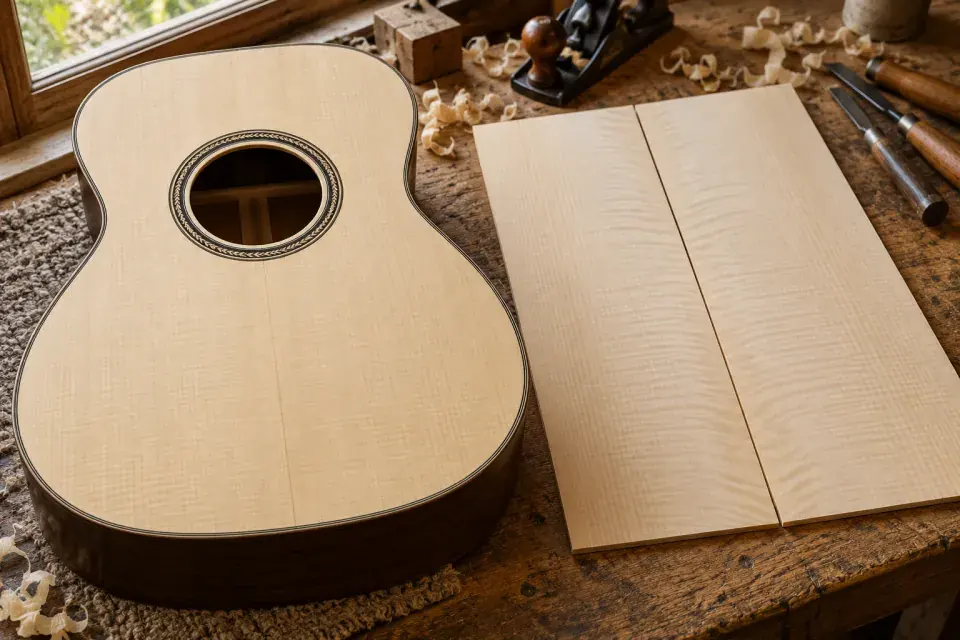
Which wood should you choose?
Sitka spruce is a versatile starting point for many steel-string soundboards. Western red cedar is another established choice, especially when a builder wants a responsive top for a lighter attack. Other spruces and redwood also work well. The species narrows the search; the individual blank, thickness, bracing, bridge, and body design determine how that choice performs.
Practical wood choices
These editorial choices account for the application as well as the numbers. They may differ from the automated property ranking below.
Sitka spruce
A widely available reference point with a useful balance of low weight and stiffness. It suits many steel-string designs and is a practical first-build choice because established plans and suitable stock are readily available. Grade and appearance do not replace testing the particular set.
Species profiles:Sitka spruce
Western red cedar
Often selected for light-touch instruments and a quick response. It is a softer material that needs careful handling during construction. A spruce top's thickness and bracing schedule should not be copied automatically onto a cedar blank.
Species profiles:Western redcedar
Engelmann, European, or red spruce
Alternative spruces let a builder choose among different blanks and working traditions. Broad tonal descriptions are starting points rather than promises. Measure weight and stiffness, inspect runout, and use a bracing approach appropriate to the actual set.
Species profiles:Engelmann spruceNorway spruceRed spruce
Redwood
An option for builders seeking a different visual and working character. Quality and stiffness can vary substantially between sets. Straight grain, soundness, and reliable drying are more useful purchase criteria than an exceptional color or a persuasive tonewood label.
Species profiles:Young-growth redwood
What matters for this project
A soundboard converts bridge motion into vibration across a light, braced plate. Longitudinal stiffness relative to density is useful, but cross-grain stiffness, damping, grain orientation, and the construction all contribute. The table below is therefore a screening tool, not a sound-quality ranking. Its bulk species averages do not measure acoustic-grade blanks. Low-density construction lumber can score well without being suitable soundboard stock. Cosmetic grain spacing and color also cannot predict the completed instrument's tone.
What to check before you buy
Buy a soundboard set from a supplier who identifies the species, describes drying, and understands instrument stock. Look for sufficient dimensions for your body outline, straight grain, a good quartered cut, and minimal runout. Inspect both halves for checks, compression features, defects near the bridge, and mismatched thickness. Bookmatching gives visual continuity but is not proof of acoustic quality. Ask whether grading is cosmetic, structural, or both. For a first build, a plain, sound set generally offers better value than premium visual figure.
Building and looking after it
Acclimate the set in the controlled environment where you will join and assemble it. Prepare an accurate center seam before bringing the top toward final thickness. Evaluate the plate and brace stock together: a flexible blank may need a different thickness or bracing treatment from a stiffer blank of the same species. Follow a proven instrument plan and avoid chasing a universal thickness number. Support the top during routing and sanding, especially with softer cedar. After assembly, stable storage humidity helps protect the top, bridge joint, and braces; no finish makes the instrument immune to moisture changes.
Mistakes to avoid
Do not describe stiffness-to-density ratio as the single factor that decides sound. Do not infer a specific tone, volume, or durability from the ranking position. Highly figured stock, visible runout, and an uncertain drying history require scrutiny even if the species is respected. A laminated commercial top is also a different construction system from the solid soundboards discussed here.
Property comparison ranking
Density at most 600 kg/m³. The score is proportional to modulus of elasticity divided by density.
This ranking compares selected properties. Use the practical choices above to check the other requirements of your project.
Species enter when the required fields are present and the rule gives a positive score. An absent wood may lack data or fall outside the scoring range; absence is not proof that it is unsuitable.
The order also uses an editorial availability multiplier, shown in the last column. It changes the order without removing a qualifying species. These scores compare selected properties; they do not evaluate every requirement of the finished project.
| # | Wood | Janka | Density | MOR | MOE | Shrinkage | T/R | Availability |
|---|---|---|---|---|---|---|---|---|
| 1 | Noble fir | 410 lbf | 27.3 lb/ft³ | 10,700 lb/in² | 1.72 ×10⁶ lb/in² | 12.4% | 1.93 | |
| 2 | Grand fir | 490 lbf | 25.8 lb/ft³ | 8,900 lb/in² | 1.57 ×10⁶ lb/in² | 11.0% | 2.21 | |
| 3 | Red spruce | 530 lbf | 28.0 lb/ft³ | 10,800 lb/in² | 1.66 ×10⁶ lb/in² | 11.8% | 2.05 | |
| 4 | Balsam fir | 380 lbf | 24.5 lb/ft³ | 9,200 lb/in² | 1.45 ×10⁶ lb/in² | 11.2% | 2.38 | |
| 5 | Douglas-fir | 645 lbf* | 33.9 lb/ft³ | 12,800 lb/in² | 1.97 ×10⁶ lb/in² | — | — | |
| 6 | Coast Douglas-fir | 710 lbf | 33.6 lb/ft³ | 12,400 lb/in² | 1.95 ×10⁶ lb/in² | 12.4% | 1.58 | |
| 7 | White spruce | 410 lbf | 25.2 lb/ft³ | 9,400 lb/in² | 1.43 ×10⁶ lb/in² | — | — | |
| 8 | Port-Orford cedar | 630 lbf | 30.1 lb/ft³ | 12,700 lb/in² | 1.70 ×10⁶ lb/in² | 10.1% | 1.50 | |
| 9 | American basswood | 410 lbf | 25.8 lb/ft³ | 8,700 lb/in² | 1.46 ×10⁶ lb/in² | 15.8% | 1.41 | |
| 10 | Sitka spruce | 510 lbf | 28.0 lb/ft³ | 10,200 lb/in² | 1.57 ×10⁶ lb/in² | 11.5% | 1.74 | |
| 11 | Western white pine | 420 lbf | 26.6 lb/ft³ | 9,700 lb/in² | 1.46 ×10⁶ lb/in² | 11.8% | 1.80 | |
| 12 | Black spruce | 530 lbf | 29.3 lb/ft³ | 10,800 lb/in² | 1.61 ×10⁶ lb/in² | 11.3% | 1.66 | |
| 13 | Yellow-poplar | 540 lbf | 29.3 lb/ft³ | 10,100 lb/in² | 1.58 ×10⁶ lb/in² | 12.7% | 1.78 | |
| 14 | Engelmann spruce | 390 lbf | 24.5 lb/ft³ | 9,300 lb/in² | 1.30 ×10⁶ lb/in² | 11.0% | 1.87 | |
| 15 | Bigtooth aspen | 471 lbf* | 27.3 lb/ft³ | 9,100 lb/in² | 1.43 ×10⁶ lb/in² | 11.8% | 2.39 | |
| 16 | Western hemlock | 540 lbf | 31.5 lb/ft³ | 11,300 lb/in² | 1.63 ×10⁶ lb/in² | 12.4% | 1.86 | |
| 17 | Western larch | 830 lbf | 36.3 lb/ft³ | 13,000 lb/in² | 1.87 ×10⁶ lb/in² | 14.0% | 2.02 | |
| 18 | Red pine | 560 lbf | 32.2 lb/ft³ | 11,000 lb/in² | 1.63 ×10⁶ lb/in² | 11.3% | 1.89 | |
| 19 | Eastern white pine | 380 lbf | 24.5 lb/ft³ | 8,600 lb/in² | 1.24 ×10⁶ lb/in² | 8.2% | 2.90 | |
| 20 | Loblolly pine | 690 lbf | 35.6 lb/ft³ | 12,800 lb/in² | 1.79 ×10⁶ lb/in² | 12.3% | 1.54 | |
| 21 | Western redcedar | 350 lbf | 22.3 lb/ft³ | 7,500 lb/in² | 1.11 ×10⁶ lb/in² | 6.8% | 2.08 | |
| 22 | Shortleaf pine | 690 lbf | 35.6 lb/ft³ | 13,100 lb/in² | 1.75 ×10⁶ lb/in² | 12.3% | 1.67 | |
| 23 | Eastern cottonwood | 430 lbf | 28.0 lb/ft³ | 8,500 lb/in² | 1.37 ×10⁶ lb/in² | 13.9% | 2.36 | |
| 24 | Red alder | 590 lbf | 28.7 lb/ft³ | 9,800 lb/in² | 1.38 ×10⁶ lb/in² | 12.6% | 1.66 | |
| 25 | Old-growth redwood | 480 lbf | 28.0 lb/ft³ | 10,000 lb/in² | 1.34 ×10⁶ lb/in² | 6.8% | 1.69 |
Before you choose a board
Use this ranking to compare the properties listed above. Grain direction, defects, moisture content, board dimensions, and construction also affect performance. Check the species page for the original measurements and any estimate marks, then inspect the actual stock you can buy.
The score does not assess decay resistance, food-contact suitability, heat resistance, or structural load capacity. For outdoor work, check durability and treatment requirements separately. For food-contact items and toys, check the intended finish and published safety information.
Read wood allergy and toxicity sourcesHow to read the measurements
Janka compares resistance to indentation. Density is the mass of a given volume of wood. Modulus of rupture (MOR) describes bending strength in a test specimen. Shrinkage figures describe the change from green to oven-dry wood, and T/R compares tangential with radial shrinkage. They are useful for comparison, but do not directly predict seasonal movement in your finished piece.
These are species-level reference values, not a test of the board you are buying or allowable structural design values. Grain, defects, moisture, dimensions, joints, and treatment can change the result. An asterisk beside Janka marks an estimate; open the species page for its source and method. Use the header settings to switch units.
Frequently asked questions
Is spruce better than cedar?
Neither is universally better. They offer different working properties and are used in different designs. Choose with the builder's intended string load, playing style, bracing, and the individual set in mind, then evaluate finished instruments where possible.
Does a higher visual grade sound better?
Not necessarily. A supplier may grade for color and grain uniformity as well as structural features. Ask what the grade means, and do not pay for cosmetic perfection expecting it to guarantee superior sound.
Can I use ordinary lumber for a top?
An experienced builder may find suitable stock, but species identification alone is insufficient. Drying, runout, cut, dimensions, and stiffness need assessment. Purpose-selected soundboard sets reduce uncertainty for a first instrument.
What does bookmatched mean?
Two adjacent slices are opened like a book to produce approximately mirrored grain. It is a way to prepare a two-piece top, not an acoustic measurement or a guarantee that both halves have identical stiffness.
Sources and further reading
The application advice is editorial guidance. The references below provide background; each wood's measured values have their own sources on its species page.
- StewMac — Acoustic guitar tops and soundboards
Luthier stock selection and soundboard grading.
- Pacific Rim Tonewoods — Softwoods for acoustic guitar soundboards
A specialist supplier's discussion of spruce, cedar, and redwood.
- USDA Forest Products Laboratory — Wood Handbook
Background on wood properties, moisture, construction, and finishing.