Best wood for outdoor signs
Select a stable carving surface and plan how rain leaves the finished sign.
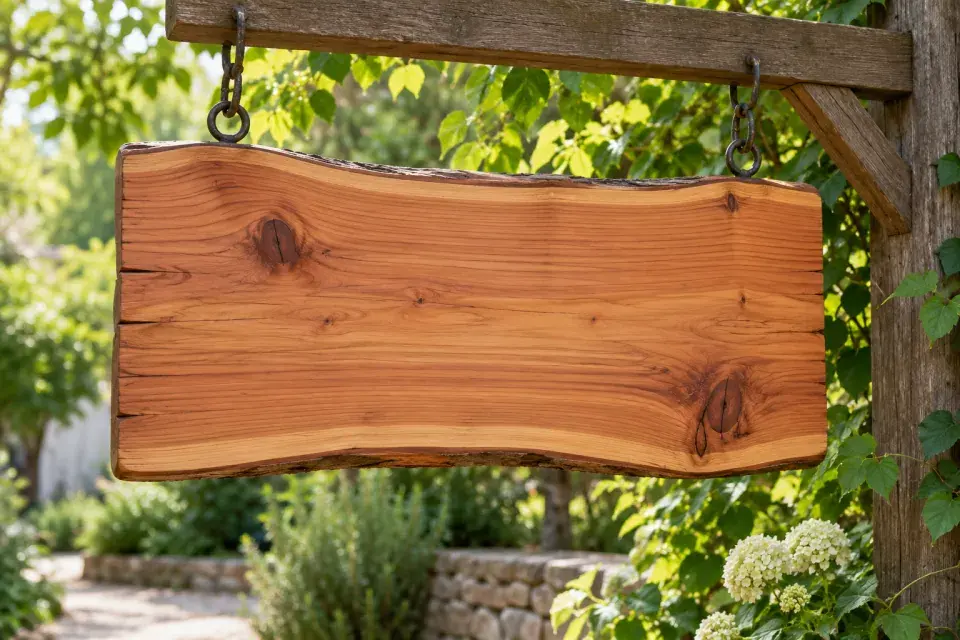
Which wood should you choose?
Western red cedar and redwood are useful solid-wood sign materials. For painted routed signs, purpose-made sign panels can be more predictable than a wide solid board. Choose for the lettering method, finish, mounting, and exposure rather than selecting the softest wood that a router can cut.
Practical wood choices
These editorial choices account for the application as well as the numbers. They may differ from the automated property ranking below.
Western red cedar
Easy to shape for carved and routed signs, with a naturally textured appearance. Its soft fibers need sharp tools for crisp edges. Check knots, heartwood content, and the coating system before buying.
Species profiles:Western redcedar
Redwood
Suitable for many carved sign designs when clear stock is available. Grade and local supply influence cost. Fine lettering needs sound grain around the narrow details, not just a clear-looking face.
Species profiles:Young-growth redwood
Exterior sign panel
An engineered option for broad, flat painted work. Verify the panel's intended exposure, edge sealing, mounting, and finish requirements. It is a different product category from the species ranked below.
What matters for this project
Narrow routed strokes, deep relief, and large flat faces call for different material behavior. Wide solid wood moves across the grain and may split if fixed rigidly. End grain and routed recesses can collect moisture. Consider panel construction and drainage while drawing the sign, not after carving it.
What to check before you buy
Look for clear stock around the entire lettering field. Allow thickness for carving and enough margin for the chosen fasteners. Ask whether the material is dry, primed, or treated. Make a small carving and finish sample before committing to a large, expensive blank.
Building and looking after it
Use sharp cutters, support delicate edges, and follow the finish manufacturer's preparation instructions. Seal vulnerable cut surfaces as specified. Mount to allow wood movement and keep water from sitting behind the sign. Check hardware and coatings periodically, particularly on heavy hanging signs.
Mistakes to avoid
The ranking cannot predict decay resistance, paint adhesion, or letter-edge quality. A low shrinkage number does not make an unsupported wide plank immune to cupping. Avoid unknown reclaimed material when machining through old coatings.
Property comparison ranking
Janka 350–1,300 lbf. The score favors lower volumetric shrinkage.
This ranking compares selected properties. Use the practical choices above to check the other requirements of your project.
Species enter when the required fields are present and the rule gives a positive score. An absent wood may lack data or fall outside the scoring range; absence is not proof that it is unsuitable.
The order also uses an editorial availability multiplier, shown in the last column. It changes the order without removing a qualifying species. These scores compare selected properties; they do not evaluate every requirement of the finished project.
| # | Wood | Janka | Density | MOR | MOE | Shrinkage | T/R | Availability |
|---|---|---|---|---|---|---|---|---|
| 1 | Old-growth redwood | 480 lbf | 28.0 lb/ft³ | 10,000 lb/in² | 1.34 ×10⁶ lb/in² | 6.8% | 1.69 | |
| 2 | Western redcedar | 350 lbf | 22.3 lb/ft³ | 7,500 lb/in² | 1.11 ×10⁶ lb/in² | 6.8% | 2.08 | |
| 3 | Teak | 1,000 lbf | 40.0 lb/ft³ | 14,600 lb/in² | 1.55 ×10⁶ lb/in² | 7.0% | 2.32 | |
| 4 | Young-growth redwood | 420 lbf | 24.5 lb/ft³ | 7,900 lb/in² | 1.10 ×10⁶ lb/in² | 7.0% | 2.23 | |
| 5 | Rubberwood | 915 lbf* | 38.0 lb/ft³ | — | — | 7.4% | 2.22 | |
| 6 | Incense cedar | 470 lbf | 25.8 lb/ft³ | 8,000 lb/in² | 1.04 ×10⁶ lb/in² | 7.7% | 1.58 | |
| 7 | Eastern redcedar | 615 lbf* | 32.8 lb/ft³ | 8,800 lb/in² | 0.88 ×10⁶ lb/in² | 7.8% | 1.52 | |
| 8 | True mahogany | 800 lbf | 41.0 lb/ft³ | 11,500 lb/in² | 1.50 ×10⁶ lb/in² | 7.8% | 1.37 | |
| 9 | Sugar pine | 380 lbf | 25.2 lb/ft³ | 8,200 lb/in² | 1.19 ×10⁶ lb/in² | 7.9% | 1.93 | |
| 10 | Eastern white pine | 380 lbf | 24.5 lb/ft³ | 8,600 lb/in² | 1.24 ×10⁶ lb/in² | 8.2% | 2.90 | |
| 11 | African mahogany | 830 lbf | 32.0 lb/ft³ | 10,700 lb/in² | 1.40 ×10⁶ lb/in² | 8.8% | 1.80 | |
| 12 | Iroko | 1,260 lbf | 43.0 lb/ft³ | 12,400 lb/in² | 1.46 ×10⁶ lb/in² | 8.8% | 1.36 | |
| 13 | Obeche | 430 lbf | 24.0 lb/ft³ | 7,400 lb/in² | 0.86 ×10⁶ lb/in² | 9.2% | 1.80 | |
| 14 | Eastern hemlock | 500 lbf | 28.0 lb/ft³ | 8,900 lb/in² | 1.20 ×10⁶ lb/in² | 9.7% | 2.27 | |
| 15 | Ponderosa pine | 460 lbf | 28.0 lb/ft³ | 9,400 lb/in² | 1.29 ×10⁶ lb/in² | 9.7% | 1.59 | |
| 16 | Port-Orford cedar | 630 lbf | 30.1 lb/ft³ | 12,700 lb/in² | 1.70 ×10⁶ lb/in² | 10.1% | 1.50 | |
| 17 | Jack pine | 570 lbf | 30.1 lb/ft³ | 9,900 lb/in² | 1.35 ×10⁶ lb/in² | 10.3% | 1.78 | |
| 18 | Spanish-cedar | 600 lbf | 35.0 lb/ft³ | 11,500 lb/in² | 1.44 ×10⁶ lb/in² | 10.3% | 1.50 | |
| 19 | Butternut | 490 lbf | 26.6 lb/ft³ | 8,100 lb/in² | 1.18 ×10⁶ lb/in² | 10.6% | 1.88 | |
| 20 | Engelmann spruce | 390 lbf | 24.5 lb/ft³ | 9,300 lb/in² | 1.30 ×10⁶ lb/in² | 11.0% | 1.87 | |
| 21 | Grand fir | 490 lbf | 25.8 lb/ft³ | 8,900 lb/in² | 1.57 ×10⁶ lb/in² | 11.0% | 2.21 | |
| 22 | Lodgepole pine | 480 lbf | 28.7 lb/ft³ | 9,400 lb/in² | 1.34 ×10⁶ lb/in² | 11.1% | 1.56 | |
| 23 | Balsam fir | 380 lbf | 24.5 lb/ft³ | 9,200 lb/in² | 1.45 ×10⁶ lb/in² | 11.2% | 2.38 | |
| 24 | Black spruce | 530 lbf | 29.3 lb/ft³ | 10,800 lb/in² | 1.61 ×10⁶ lb/in² | 11.3% | 1.66 | |
| 25 | Okoume | 380 lbf | 28.0 lb/ft³ | 7,400 lb/in² | 1.14 ×10⁶ lb/in² | 11.3% | 1.49 |
Before you choose a board
Use this ranking to compare the properties listed above. Grain direction, defects, moisture content, board dimensions, and construction also affect performance. Check the species page for the original measurements and any estimate marks, then inspect the actual stock you can buy.
The score does not assess decay resistance, food-contact suitability, heat resistance, or structural load capacity. For outdoor work, check durability and treatment requirements separately. For food-contact items and toys, check the intended finish and published safety information.
Read wood allergy and toxicity sourcesHow to read the measurements
Janka compares resistance to indentation. Density is the mass of a given volume of wood. Modulus of rupture (MOR) describes bending strength in a test specimen. Shrinkage figures describe the change from green to oven-dry wood, and T/R compares tangential with radial shrinkage. They are useful for comparison, but do not directly predict seasonal movement in your finished piece.
These are species-level reference values, not a test of the board you are buying or allowable structural design values. Grain, defects, moisture, dimensions, joints, and treatment can change the result. An asterisk beside Janka marks an estimate; open the species page for its source and method. Use the header settings to switch units.
Frequently asked questions
Should I laminate a wide sign?
Lamination can provide usable width, but a solid-wood assembly still moves. A suitable exterior panel may be preferable when long-term flatness is central to the design.
Can I leave cedar unfinished?
It will weather and change color. Consider whether the lettering remains legible and whether the mounting and drainage suit that approach; unfinished does not mean maintenance-free.
How can lettering stay readable as the sign weathers?
Plan contrast, stroke width, and the finish together. Fine shallow details may disappear visually as surfaces gray or coatings wear. Test a full-size section under the expected viewing distance and lighting, then choose a maintenance approach that preserves that contrast. Readability depends on the design and ongoing condition, not simply on how sharply the wood carves initially.
Sources and further reading
The application advice is editorial guidance. The references below provide background; each wood's measured values have their own sources on its species page.
- USDA Forest Products Laboratory — Wood Handbook
Background on wood properties, moisture, construction, and finishing.